
The Complete History of the Microwave Oven: The Accidental Invention That Changed How the World Eats
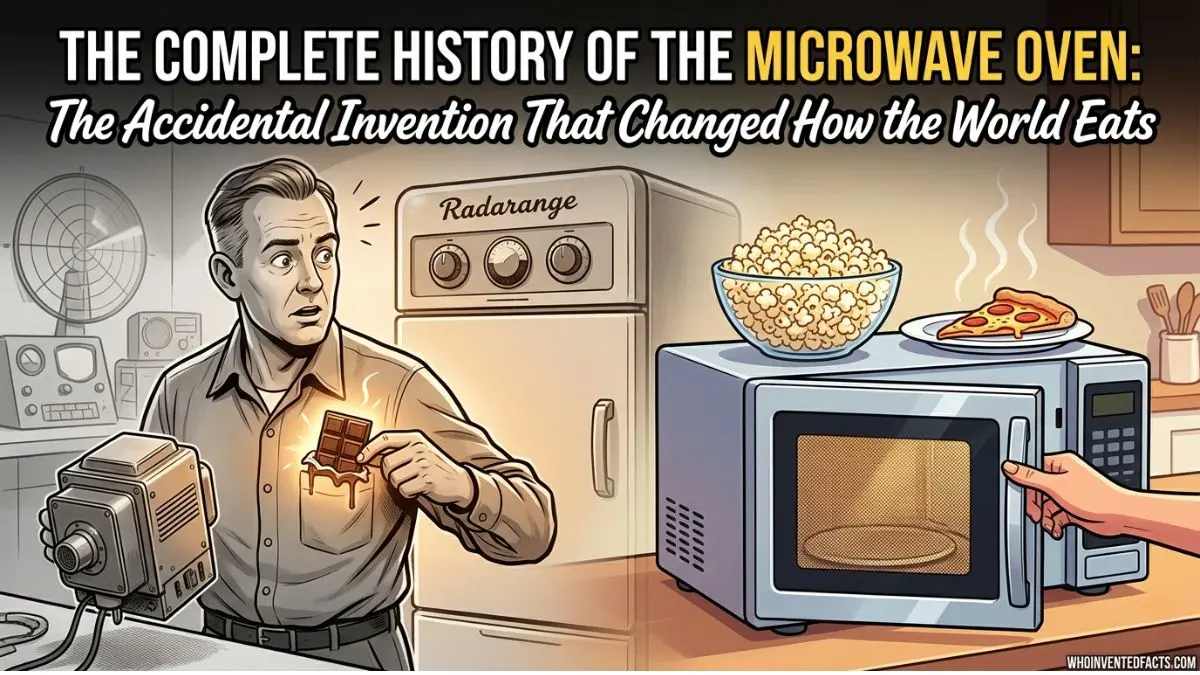
Who Invented the Microwave Oven? The credit for invention goes to Percy Spencer.
Imagine you’re working in a lab, working on a top-secret military project. Suddenly, you feel something sticky in your pocket. You put your hand in and see your favorite chocolate bar has turned into a soft mess, although it wasn’t near heat.
In this blog post, we’ll explore history of the microwave. We’ll tell about its inventor, the melted chocolate story, and how the refrigerator size machine changed into small appliance we use in kitchens today.
Who Invented the Microwave Oven? Full History
But the story most people know is not complete. Yes, there was a melted candy bar, and Percy Spencer. But many important parts are often left out. Few people talk about the inventors who came before Percy Spencer and the claims made by Soviet researchers. They also ignore the unfair reward Spencer received and the global competition that made microwaves affordable for everyday homes.
Part 1: Before Percy Spencer — The Technology That Made It All Possible
To understand the microwave oven, you first need to understand the magnetron—because Percy Spencer did not invent it. That credit belongs to two British physicists at the University of Birmingham, John Turton Randall and Harry Albert Boot.
In February 1940, working in a small university lab, they created the cavity magnetron. It was a compact vacuum tube that could produce strong microwave radiation at very short wavelengths. Even though it was about the size of a dinner plate, it generated signals far more powerful than anything made before.
The British military quickly realized how important it was. The cavity magnetron became the core of Allied radar during World War II, helping planes and ships detect enemies in fog, clouds, and darkness over long distances. Winston Churchill even called it “the most valuable cargo ever brought to our shores” when it was secretly sent to the United States to share with allies.
Despite their major breakthrough, Randall and Boot never received much recognition. Their names are often missing from microwave histories, even though without their invention, Percy Spencer’s famous discovery would not have been possible.
Radar and the War Effort
By the early 1940s, radar had become most important military tools for the Allied forces. It detected enemy aircraft and submarines from long distances, even before they could be seen. This gave the Allies a major advantage in the war. But, magnetrons were very hard to produce in large numbers.
In Britain, factories could only make about 17 magnetrons per week, which was far too few for military needs. Because of this shortage, the work was moved to the United States to speed up production. This is where Percy Spencer entered the story, although at this stage he was not yet known for inventing the microwave oven.
Part 2: Percy Spencer — The Man Behind the Accident
A Childhood That Defied Every Obstacle
Percy LeBaron Spencer was born on July 9, 1894, in Howland, Maine, a small rural town about 25 miles north of Orono. His early life was filled with hardship.
His father died when Percy was only 18 months old. Since his mother could not care for him, she sent him to live with his aunt and uncle in the nearby town of South Lincoln. Soon after, his uncle also passed away. Percy was still a young boy when he had to leave school at age 12 and work in a spool mill to help support the family. He never returned to formal education and had no high school diploma, college degree, or engineering training.
Percy had a strong curiosity and an amazing ability to teach himself. At age 14, while working in a paper mill, he got a job helping install one of Maine’s first electrical systems. He learned electrical skills by doing the work himself.
Then an even changed his life forever. In 1912, the Titanic sank, and the world heard how radio operators helped save lives during the rescue. Spencer became deeply inspired by the power of wireless communication. He joined the U.S. Navy to learn radio technology. During long night shifts at sea, he studied calculus, physics, and trigonometry from books on his own, with no teacher or classroom.
Rising at Raytheon
After leaving the Navy with honor following World War I, Percy Spencer joined the Wireless Specialty Apparatus Company in Boston. Later, he moved to Raytheon Manufacturing Company, which was then a small but growing electronics business co-founded by engineer Vannevar Bush. Bush later became famous for helping organize the Manhattan Project and for predicting future technologies like personal computers and the internet. By joining Raytheon, Spencer was working at the center of America’s technological progress during one of the most important times in history.
At Raytheon, Spencer’s talent quickly became clear. During the 1920s and 1930s, he became one of the company’s most respected engineers and gained importance in the radio and vacuum tube division. He was known less for theory and more for practical skill. He had a special talent for finding simple and smart solutions to manufacturing problems that even trained engineers struggled to solve.
When World War II began and Raytheon became a major defense contractor, Spencer became the company’s main problem solver. One of his important wartime contributions was helping develop proximity fuses, which show the kind of engineer he was.
A proximity fuse was a device that made a shell or bomb explode near a target instead of only on direct impact. This made anti-aircraft weapons much more effective because they no longer needed a perfect hit to destroy enemy planes. Even a close miss could bring an aircraft down. It became one of the most valuable military technologies of World War II, and Spencer’s role in its development earned high recognition from the U.S. military.
The Magnetron Manufacturing Miracle
When Raytheon received the cavity magnetron design from Britain, the company faced a huge challenge. They needed to produce a highly complex device quickly enough to support the war effort.
At that time, only about 17 magnetrons were being made each week. Percy Spencer completely improved the production system. He simplified the steps, redesigned tools, and made the factory lines faster and more efficient. In a short time, production increased to 2,600 magnetrons per day.
This was not a small improvement. It was a major breakthrough that helped strengthen Allied radar systems during World War II. Because of this achievement, the U.S. Navy gave Spencer its Distinguished Public Service Medal, the highest award given to a civilian. The man who never finished fifth grade had made one of the most important engineering contributions of the war.
The magnetrons Spencer helped produce created so much heat that they needed water cooling. Air cooling was not enough. Each unit had to be connected to a water line to keep it cool. The first commercial microwave ovens had the same problem. They needed their own water connection, so they were only practical for large businesses and commercial kitchens. This is one reason why it took about 20 years before microwaves became suitable for homes.
Part 3: The Accident — What Really Happened
The Candy Bar Debate
This is where the story becomes interesting. Most accounts say Percy Spencer noticed a chocolate bar melting in his pocket while standing near an active magnetron in 1945. It became one of the most famous accidental discoveries in technology history.
But, Spencer’s grandson Rod shared a different version of the story. He said his grandfather did not carry a plain chocolate bar. Percy loved nature and small animals, influenced by his childhood in rural Maine. Rod said Percy often carried a peanut cluster bar to work so he could share it with squirrels and chipmunks during lunch breaks.
Rod believed this detail is important. Chocolate melts easily at a low temperature, so it could melt from normal body heat. A peanut cluster bar needs more heat to melt, making the microwave effect much clearer and more surprising.
Whatever the snack was, one fact is clear. Spencer was standing near an active magnetron when he noticed the candy in his pocket had turned warm and soft. While many people might have ignored it, Spencer wanted to know why it happened.
The Experiments That Followed
Spencer quickly began testing his idea with different foods.
Test 1 — Popcorn
He placed corn kernels near the magnetron. Soon, they started popping and flying around the lab. His coworkers were shocked, but Spencer was excited. These were the first microwaved popcorn kernels in history.
Test 2 — The Exploding Egg
Next, Spencer placed an egg near the magnetron. The microwaves heated the moisture inside the egg very quickly. Pressure built up inside the shell until the egg suddenly exploded, making a big mess.
Test 3 — More Food Testing
Spencer then tested fish, vegetables, and meat. He found that microwaves could cook food much faster than normal ovens.
The reason was simple but important. Traditional ovens heat food from the outside first. Microwaves send energy into the food and heat water molecules inside it, so the food cooks faster from within.
Some historical researchers say that Soviet-era reports suggest engineers in the USSR may have also noticed microwave heating effects during or soon after World War II. This happened while Soviet scientists were doing their own research on radar and magnetron technology.
Dr. Joseph Schwarcz, director of McGill University’s Office for Science and Society, said that others may have noticed similar effects earlier but did not make use of them, while Percy Spencer did. As Louis Pasteur famously said, “Chance favors the prepared mind,” and Percy’s mind was ready to understand the discovery.
Part 4: From Discovery to Patent
Building the First Microwave
After his experiments, Percy Spencer designed a simple cooking chamber. It was a metal box with an opening where the magnetron could direct microwave energy inside. His key discovery was that metal walls could keep the microwaves trapped inside while focusing the energy on the food.
Microwaves can pass through glass, plastic, paper, and fabric, but they cannot pass through metal. Instead, they bounce off metal surfaces. That is why microwave ovens have metal interiors, and why metal containers can create dangerous sparks inside them.
On October 8, 1945, Raytheon filed a patent for a microwave cooking process. Percy Spencer was named as the inventor. The patent was officially titled Method of Treating Foodstuffs and was given the number US Patent 2,495,429. It was awarded on January 24, 1950. In the patent, Spencer wrote that one goal of his invention was to create an efficient way to use electromagnetic energy for cooking food.
During his life, Spencer received more than 100 patents, mostly related to microwave technology.
Part 5: The First Microwave Ovens
The Radarange (1947)
In 1947, Raytheon introduced the world’s first commercial microwave oven. It was called the Radarange, a name that combined the words radar and range, which was an American term for a cooking stove. The name suited the machine because it was basically radar technology adapted for cooking.
The Radarange was nothing like today’s kitchen microwaves. It was about 5.5 to 6 feet tall, weighed around 750 pounds (340 kilograms), and cost between $3,000 and $5,000 at that time. In today’s money, that would be tens of thousands of dollars. It also needed a water line for cooling because the magnetron became very hot. This made it impossible for normal home kitchens.
The first Radarange was tested in a Boston restaurant in 1947. Later, it was sold to military bases, hospitals, restaurants, ships, and airline kitchens. In these places, its speed made the high price worthwhile.
Microwave technology was also used in factories. It helped roast coffee beans and peanuts, defrost meat, dry pasta, sterilize packaged food, and dry materials like paper, leather, and textiles. For the average family, the Radarange was far too large and expensive.
The Tappan Model RL-1 (1955) — The First Home Microwave
In 1955, appliance company Tappan, working with Raytheon, introduced the first microwave made for home use. It cost $1,295 at the time, which would equal around $14,000 today. It was also very large, almost the size of a regular stove. Because of this, very few units were sold.
There were three main problems: high cost, large size, and fear. Many Americans in the 1950s were worried about radiation because the atomic bomb had been used only a decade earlier and nuclear testing was still happening. Since microwave ovens used radiation to cook food, many people felt uncomfortable with them, even though microwave radiation was different from nuclear radiation. This fear slowed the popularity of microwave ovens.
Part 6: The Breakthrough — How Microwaves Entered Homes
Raytheon Buys Amana — A Smart Move
In 1965, Raytheon made an important decision. It bought Amana Refrigeration, a company in Iowa that made home appliances. Raytheon was strong in engineering and defense, but it had no experience selling products to regular families. Amana did. It already had strong connections with appliance stores and customers across the United States.
This deal helped Raytheon bring microwave ovens closer to everyday homes.
The Amana Radarange (1967) — A Big Step Forward
In 1967, Amana launched the Radarange RR-4, the first microwave oven small enough and affordable enough for home use. It cost about $495 at the time (around $4,500 today).
For the first time, a microwave could sit on a kitchen counter and run on normal home electricity. It no longer needed special installation or water cooling.
This was possible because magnetron technology improved, making air cooling enough. This solved one of the biggest problems that had kept microwaves out of homes.
The Amana Radarange became the first real microwave oven for ordinary families.
The Japanese Manufacturing Revolution
To make microwaves cheap enough for everyone, magnetrons had to become much less expensive. This change came mainly from Japan, not the United States.
By the early 1970s, companies like Panasonic, Sharp, Sanyo, and Toshiba found better ways to mass-produce magnetrons at low cost. They improved factory methods and reduced production complexity.
As a result, microwave prices dropped quickly around the world. Even American companies began buying Japanese parts because they were cheaper. This global competition helped make microwaves affordable for regular households.
Social Changes That Increased Demand
Microwaves became popular not only because of technology, but also because society was changing.
1. More Working Families
As more women joined the workforce, families had less time to cook. Microwaves offered quick meals in minutes.
2. Rise of Frozen Foods
Companies started making microwave-friendly meals like frozen dinners and popcorn. These products helped increase microwave use.
3. Falling Prices
By the late 1970s, microwave prices dropped below $200, making them more affordable for middle-class families.
4. Safety Improvements
Government safety rules improved, and people slowly became less afraid of microwave radiation.
Rapid Growth in Homes
The numbers show how fast microwaves spread:
- 1975: about 4% of U.S. homes had a microwave
- 1976: around 14%
- 1986: about 25%
- 1997: nearly 90% of homes
Within a few decades, the microwave went from a rare industrial machine to a common kitchen appliance found almost everywhere.
Part 7: How a Microwave Actually Works — The Science
Electromagnetic Radiation and Water Molecules
A microwave oven works using electromagnetic waves at a frequency of 2,450 MHz (2.45 GHz), usually with a power of 500 to 1,100 watts. At this frequency, microwaves interact strongly with water molecules.
When these waves enter food, they make water molecules move and vibrate extremely fast—billions of times every second. This rapid movement creates friction between molecules, and friction produces heat.
Unlike a normal oven, which heats food from the outside, a microwave creates heat inside the food itself. This is why food cooks so quickly and evenly in some cases.
Why Some Foods Heat Faster Than Others
Foods with more water heat quickly in a microwave. That’s why soup, vegetables, and leftovers warm up fast.
Foods with less water, like bread or dry snacks, heat more slowly or unevenly. Sometimes the outside feels cool while the inside is already hot.
What Materials Are Safe or Unsafe
Microwaves pass easily through glass, ceramic, paper, and most plastics, which is why these materials are safe to use in microwave ovens.
However, microwaves cannot pass through metal. Instead, metal reflects them. This is why putting metal containers or foil inside a microwave can cause sparks.
Why Microwaves Have Metal Walls
The inside of a microwave is made of metal for safety. The metal walls reflect microwaves back into the food so they don’t escape.
The door also has a special metal mesh. The holes are very small—smaller than the microwave waves—so the waves stay inside. But the holes are large enough for light to pass through, so you can still see your food while it cooks.
Part 8: The Financial Injustice — Percy Spencer’s Untold Story
$2 and a Patent
Raytheon earned huge profits from it through sales and licensing. But Spencer himself received only a $2 bonus for his invention. This was the standard payment at Raytheon for any employee invention at the time.
In those days, companies owned all employee inventions. Engineers had to give up their rights as part of their job. The $2 was just a formal reward, not a share of the profit.
Spencer never sued the company and never publicly complained. He kept working at Raytheon and later became a Senior Vice President, but his salary was not linked to the value of his invention.
His Final Years
Spencer died on September 7, 1970, just as microwave ovens were becoming common in homes. He never saw how widely his invention would spread, and he never earned royalties from it.
In 1999, nearly 30 years after his death, he was inducted into the National Inventors Hall of Fame. This recognition came too late for him, but it secured his place in history.
Spencer’s Personal Life
Percy Spencer was known as a friendly and lively person. His grandson described him as energetic, talkative, and generous. He loved nature and often fed small animals like squirrels and chipmunks during lunch breaks.
He was also known for explaining complex engineering ideas in simple ways, which made him a great mentor and problem solver.
Spencer spent his entire career at Raytheon and retired after decades of service. He died at the age of 76, leaving behind a legacy that changed everyday life around the world.
Part 9: Global Adoption — The Story Beyond America
Japan: Early User and Manufacturing Leader
Even though the microwave oven was invented in the United States, Japan played a very important role in its global success. Japanese companies were early users and later became the main manufacturers that made microwaves affordable worldwide.
Europe: Slower Acceptance
Microwaves became popular in Europe later than in the United States, by about ten years. In France, Italy, and Germany, traditional cooking is an important part of culture, so many people were slow to accept microwave cooking.
However, by the 1990s, microwaves became common in most European homes due to busy lifestyles, working families, and lower price
Part 10: Industries Beyond the Kitchen
Industrial and Scientific Uses
The microwave oven is best known as a kitchen appliance, but microwave technology is used in many other industries as well. Its applications go far beyond cooking food.
Food Industry at Large Scale
Factories use industrial microwave systems to process food quickly and efficiently. They are used for:
- Pasteurizing packaged foods
- Roasting coffee beans and nuts
- Drying pasta and snacks
- Defrosting frozen meat
- Sterilizing food packaging
- These methods are faster and more energy-efficient than traditional heating.
Materials Processing
Microwave heating is also used to dry and process materials such as:
- Ceramics
- Paper
- Leather
- Tobacco
- Wood
- Textiles
- Cork
It works better than normal heat in many cases because it dries materials evenly from the inside, not just the surface.
Medical Uses — Cancer Treatment
One of the most important modern uses of microwaves is in medicine.
Microwave ablation is a treatment that uses focused microwave energy to destroy cancer tumors. A thin needle delivers the energy directly into the tumor, heating and destroying it.
It is often used for tumors in the liver, lungs, kidneys, and bones. The procedure is less invasive than surgery and can sometimes be done with local anesthesia. It is now widely used in hospitals around the world.
Chemistry and Drug Production
In laboratories, microwaves help speed up chemical reactions. Reactions that normally take hours can be completed in minutes.
This helps scientists develop new medicines faster and reduce production costs.
Telecommunications and Modern Life
Microwave frequencies are also a key part of modern communication systems. They are used in:
- Mobile phone networks
- Wi-Fi connections
- Satellite communication
- Radar systems
Every phone call, message, or internet connection depends on microwave technology in some way.
Part 11: The Competition That Drove Progress
In the 1970s and 1980s, many companies started making microwave ovens. American brands like GE, Amana, Whirlpool, and Tappan competed with Japanese companies such as Panasonic, Sharp, Toshiba, and Sanyo. This strong competition helped improve the technology quickly and made prices lower.
By 1975, microwave ovens were even selling more than traditional gas stoves in the United States. Around one million units were sold that year, and sales doubled by 1977.
American companies were strong in branding and sales, while Japanese companies produced cheaper parts like magnetrons. This led many American brands to use Japanese components while still selling ovens under their own names.
Safety rules also helped improve microwaves. In 1971, the FDA set standards to limit microwave radiation leakage. This forced companies to improve door seals and overall safety, making microwaves safer and better for consumers.
Part 12: Modern Microwave Technology
Today’s microwaves are much more advanced than the basic models from the past. They can do far more than just reheat food.
Inverter Technology
Old microwaves switch power on and off, which can heat food unevenly. Inverter technology gives a steady, controlled level of power. This makes cooking smoother and more accurate, especially for delicate foods.
Convection Microwaves
These microwaves combine two systems, microwave heating and a fan oven. This means you can cook, bake, and brown food in the same appliance. Food cooks fast and also gets a crispy finish.
Air Fry Mode
Some modern microwaves can act like air fryers. They use fast hot air circulation to make food crispy without deep frying in oil.
Sensor Cooking
Built-in sensors can detect steam from food while it cooks. The microwave then automatically adjusts time and power. This helps prevent overcooking and makes cooking easier.
Smart Microwaves
New smart microwaves can connect to the internet. They can read cooking instructions from barcodes, be controlled through a phone, and even connect with smart home devices.
Modern microwaves are not just simple heating boxes. They are now smart, multi-function kitchen machines designed to cook food faster, better, and more precisely.
Part 13: The Environmental Dimension
Energy Efficiency
Microwave ovens are actually quite energy efficient. They usually use between 600 to 1,200 watts of power, but they cook food very quickly.
Traditional ovens use 2,000 to 5,000 watts and take much longer. According to the U.S. Department of Energy, microwaves can use about 50% less energy than normal ovens for similar cooking tasks. This makes them cheaper to run and better for saving energy.
The E-Waste Problem
The downside comes when microwaves are thrown away. They contain parts like magnetrons, capacitors, circuit boards, plastic, and metals. If not recycled properly, these materials can harm soil and water.
Many modern microwaves are hard to repair, even for small problems, which leads people to replace them instead of fixing them. This increases electronic waste.
Manufacturing Impact
Making microwaves also affects the environment. Producing magnetrons can involve toxic materials, and electronic parts often require rare metals and chemicals.
Part 14: The Future of Microwave Technology
Beyond the Kitchen
The future of microwave technology goes far beyond the kitchen and into areas Percy Spencer could never have imagined.
Advanced Cancer Treatment
Today, researchers are using microwaves for more precise cancer treatments. They can target tumors more accurately, and treat difficult locations
Space-Based Solar Power
Space agencies like the European Space Agency and JAXA are exploring systems that collect solar energy in space, where sunlight is constant. This energy could be sent to Earth using microwave beams and then converted into electricity.
Wireless Power Transmission
Scientists are also developing microwave-based wireless energy systems. These could charge electric vehicles without cables and supply power to remote or disaster-hit areas where normal electricity systems are not available.
Agricultural Applications
Microwaves are being tested in farming to control weeds without chemicals. This could offer a more sustainable method for agriculture, especially in organic farming and urban green spaces.
Advanced Materials Manufacturing
In manufacturing, microwaves are used in a process called microwave sintering. It helps create strong ceramic and metal materials used in aerospace parts, medical implants, and advanced electronics.
Microwave Oven Timeline
| Year | Event |
|---|---|
| 1940 | Randall and Boot invent the cavity magnetron at Birmingham University, England |
| 1945 | Percy Spencer notices melted candy bar near active magnetron; Raytheon files patent (October 8) |
| 1947 | First commercial Radarange introduced — 750 lbs, water-cooled, $3,000–$5,000 |
| 1950 | Spencer’s patent officially awarded (January 24) |
| 1955 | Tappan introduces first home microwave — $1,295, too large and expensive to sell |
| 1965 | Raytheon acquires Amana Refrigeration to access consumer market |
| 1967 | Amana countertop Radarange RR-4 introduced — $495, air-cooled, true home appliance |
| 1970 | Percy Spencer dies, September 7, age 76 |
| 1971 | FDA establishes first federal safety standards for microwave emissions |
| Early 1970s | Japanese manufacturers dramatically reduce magnetron production costs |
| 1975 | Microwaves outsell gas ranges in US; 4% of US homes have one; 1 million sold annually |
| 1976 | US home ownership jumps to 14% |
| 1986 | 25% of US homes have a microwave |
| 1990s | Inverter technology introduced for precise power control |
| 1997 | 90% of US homes have a microwave |
| 1999 | Spencer inducted into National Inventors Hall of Fame (posthumously) |
| 2000s | Sensor cooking, convection and air fry microwaves become mainstream |
| 2010s | Microwave tumor ablation enters mainstream clinical cancer treatment |
| Today | Smart microwaves, space-based solar power research, agricultural weed control applications |
Conclusion: The Candy Bar That Changed the World
Percy Spencer never finished school, but he became a great engineer through curiosity and self-learning. One day, he noticed a candy bar melting in his pocket and instead of ignoring it, he asked why it happened. That simple question led to the invention of the microwave oven.
Even though his invention became worth billions and is used in most homes today, Spencer was only paid $2 for it. His story is about curiosity, discovery, and unfair reward.
Today, microwaves are used everywhere—from kitchens to hospitals and even space research. Every time a microwave beeps, it reminds us how a small observation changed the world.
FAQs
Who really invented the microwave oven?
Percy Spencer is credited with inventing the microwave oven in 1945, but the key technology (the magnetron) was created by John Randall and Harry Boot in 1940. Spencer turned the idea into a practical cooking device.
Were there other claimants to the invention?
Yes, some engineers and Soviet-era reports suggest similar microwave heating observations, but Spencer was the first to develop it into a working invention.
Is it safe to use a microwave every day?
Yes. When used properly, microwaves are safe and do not cause cancer or DNA damage. Safety depends on using microwave-safe containers and proper maintenance.
How much did Percy Spencer earn from his invention?
He received only a $2 bonus from Raytheon, even though the microwave became a billion-dollar global industry.
What is the most surprising modern use of microwaves?
Microwaves are now used in cancer treatment (tumor ablation), where targeted energy destroys tumors with minimal surgery.
Are microwaves environmentally friendly?
Yes, they use about 50% less energy than ovens, but concerns remain about e-waste, manufacturing impacts, and poor repairability.