
The Accident That Changed The World: Origins and Development History of Tea
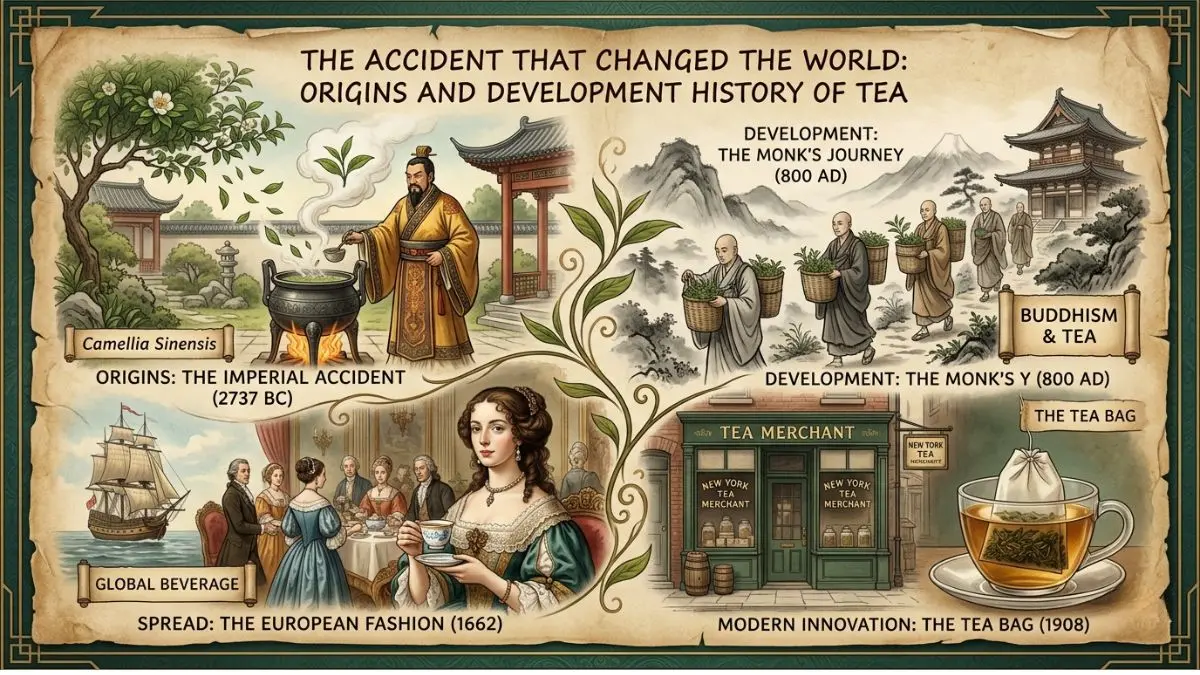
Who Invented Tea? The credit for the invention of tea goes to the Chinese emperor Shen Nong.
Tea is the world’s most popular drink after water, with thousands of cups enjoyed every second. People drink it in many ways, from hot milk tea in Britain to iced tea in America and traditional tea ceremonies in Japan. But did you know that the invention of tea wasn’t a planned endeavor, but an accident? This 5,000-year-old story involves kings, bandits, and royalty.
As British Prime Minister William Ewart Gladstone once said, tea can warm you when you are cold, cool you when you are hot, cheer you when you feel low, and calm you when you feel restless.
Who Invented Tea?
Legendary Beginnings: Tea in Ancient China
The story of tea began long ago and is full of old legends. One famous Chinese story says tea was discovered in 2737 BC by Shen Nong, who was known as a wise ruler and expert in herbs.
How Tea Was Found
One day, Shen Nong was sitting in his garden while water was boiling nearby. A soft wind blew some leaves from a wild tea tree, called Camellia sinensis, into the hot water.
What Happened Next
The water changed color and gave off a nice smell. Shen Nong tasted it and felt fresh and active. According to the legend, this became the first cup of tea in history.
He liked the drink and believed it could also help health problems. Because of this story, Shen Nong is still respected in China and Vietnam today.
Another Tea Story
There is another old story about Bodhidharma, an Indian monk connected with Zen Buddhism. It says he was trying to stay awake during long meditation. He chewed leaves from a wild tea plant, and they helped him feel awake and focused.
In one Japanese version, tea plants grew where his eyelids fell after he cut them off in frustration while trying not to sleep.
Real History of Tea
These stories are interesting, but history also gives real proof that tea is very old. In 1980, scientists found a tea fossil in Guizhou Province, China, believed to be around one million years old.
Experts also found tea remains in the tomb of Emperor Jing of Han from around 141 BC. This is the oldest clear proof of people drinking tea.
Where Tea Came From
The tea plant, Camellia sinensis, naturally grows in parts of southwest China, northern Myanmar, and northeastern India. But China was the first place where people grew tea on a large scale and made it an important part of daily life, culture, and trade.
Birthplace of Tea Culture
Yunnan Province is often called the home of tea culture. It has many ancient tea trees, some more than one thousand years old. Some wild trees in the mountains may be over 2,700 years old, showing how ancient tea really is.
Must Read: Who Invented the Tea Bag? One Small Mistake that Revolutionized the World of Tea!
From Medicine to Beverage: The Evolution of Tea in China
Tea did not become a daily drink overnight. It changed slowly over thousands of years in China. In the beginning, people used tea as medicine. During the time of Shen Nong, tea was valued for healing and detoxifying the body. People chewed fresh tea leaves or used their juice as medicine. It is believed Shen Nong himself used tea after testing wild plants for medicinal purposes.
Later, during the Spring and Autumn Period, tea became part of food. People added tea leaves to porridge and dishes with rice and seasonings. In some parts of southwest China, people still use tea leaves in cooking today.
A major change came during the Qin and Han dynasties, when tea started becoming an everyday drink instead of only medicine. Farmers began cultivating tea plants in places like Sichuan Province and Yunnan Province. Tea containers found in Han tombs show how important tea was becoming.
Tea culture truly flourished during the Tang Dynasty. This period is often called the golden age of tea. Tea drinking spread through all levels of society. Teahouses became social spaces where people gathered to talk, share ideas, and relax. Tea was no longer just a drink — it became part of culture.
One of the most important figures in tea history was Lu Yu. In the eighth century, he wrote The Classic of Tea, the first major book about tea. He explained tea types, preparation, and tea philosophy. His work turned tea into an art and gave it spiritual meaning.
During the Song Dynasty, tea culture became even more refined. People ground tea into powder, mixed it with hot water, and whisked it until frothy. This method later influenced Japanese tea traditions. Fine porcelain cups and artistic tea rituals also became popular.
Another major shift happened during the Ming Dynasty. In 1391, Emperor Hongwu Emperor ordered the end of compressed tea cakes. This changed tea forever.
The Big Change: Instead of pressing tea into bricks or cakes, people started using loose tea leaves.
The Result: Tea began to be steeped in hot water, much like we prepare it today. This simple method made tea easier to prepare and helped spread tea drinking to all social classes.
Before this change, tea bricks were even used as money in places like Tibet and Mongolia because tea was so valuable.
During and after the Ming period, different tea-making methods created the teas we know today—green, black, white, oolong, and Pu-erh tea. In the Wuyi Mountains, black tea processing developed, while white tea techniques grew in Fujian Province.
From medicine to food, from royal drink to daily habit, tea slowly became one of the world’s most loved beverages. Its journey shaped culture, trade, and everyday life for centuries.
Tea Spreads Across the Silk Roads
Long before tea became popular in Europe, it was already traveling across ancient trade routes like the Silk Road. Through caravans and camel trains, tea reached many regions before it entered Western markets.
Tea arrived in Russia in 1618 as a gift to Tsar Alexis from China. Traders carried it along Silk Road routes using camel caravans. Over time, tea became a big part of Russian life. The famous Samovar became a symbol of hospitality, used to heat water and serve tea in homes.
In Mongolia, people developed suutei tsai, a milk tea that became part of daily life. Because Mongols valued dairy-based drinks, tea mixed with milk fit naturally into their culture.
Tea also spread into Arab and Muslim lands through overland trade. Records show Arab traders knew about tea as early as the ninth century. In countries like Iran, teahouses became much more than places to drink tea. They were social centers where people discussed politics, business, and ideas. Many merchants even made deals there.
In Morocco, tea developed into a beautiful tradition. Guests are often welcomed with mint tea, served in colorful glasses with great ceremony.
The Tradition: Green tea, mint leaves, and sugar are brewed together to make Moroccan mint tea.
The Result: Tea became more than a drink. It became a symbol of welcome, friendship, and hospitality.
Across Muslim cultures, tea drinking became an all-day tradition, and many of these customs continue today.
Even centuries before European merchants traded tea, travelers like Marco Polo wrote about tea in accounts of the East. This shows tea had already become an important part of life across Asia and the Middle East long before Europe embraced it.
From the Silk Roads to Russian samovars and Moroccan tea rituals, tea spread across continents and created rich traditions wherever it went.
The Arrival of Tea in Japan: Spirituality and Ritual
Tea came to Japan in the early ninth century through a Buddhist monk named Saichō. After traveling to China to study Buddhism, he returned around 806 CE with tea seeds and planted them at his monastery.
The Beginning: Buddhist monks first drank tea in temples to stay alert during meditation and religious study.
The Result: Small tea plantations began growing at monasteries, and over time tea spread across Japan.
Tea was first enjoyed mostly by monks, priests, and the ruling class. But by the thirteenth century, tea became more widely available and popular.
Japanese tea culture grew stronger over time and developed its own unique style. One major figure in this history was Sen no Rikyu, who shaped the famous Japanese Tea Ceremony in the 1500s. He turned tea drinking into a spiritual and artistic practice built around harmony, simplicity, and respect.
Another important figure was Eisai, who helped popularize powdered green tea called Matcha.
The Method: Delicate green tea leaves were ground into powder, whisked with hot water using a bamboo whisk, and served in handcrafted bowls.
The Result: Tea became more than a drink. It became meditation, art, and ceremony.
This ritual became known as Chanoyu, the Japanese Tea Ceremony, and it remains famous around the world today.
Later, during the eighteenth century, a Kyoto tea merchant named Soen Nagatani created a new steaming and rolling process for green tea.
The Innovation: In 1738, he developed the method for making Sencha.
The Result: Sencha became the most popular tea in Japan and is still widely enjoyed today.
The Japanese made tea deeply connected to daily life. It became a drink for guests, social gatherings, and quiet reflection. Even today, green tea is part of everyday culture in Japan, served in homes, companies, and special occasions.
As Sen no Rikyu said, tea is simply boiling water, preparing tea, and drinking it properly. Yet through this simple act, Japan turned tea into a philosophy, an art, and a way of life.
Europe Discovers Tea: The Dutch and Portuguese
For centuries, China and Japan had rich tea traditions, but Europe knew almost nothing about tea. The first Europeans to encounter tea were Portuguese traders and missionaries in the 1500s. They discovered tea in Asia and likely brought small samples home.
But the Dutch were the first to turn tea into a commercial trade.
The Breakthrough: In 1606, the Dutch East India Company shipped the first known cargo of tea from China to Netherlands.
The Result: Tea reached a Western port for the first time and began its journey into Europe.
The Dutch made tea fashionable among wealthy people, and from there it spread to other European countries. But tea was very expensive, so only the rich could afford it.
Tea also caused debate in France. Some doctors praised it, while others questioned whether it was healthy. Ironically, this controversy made tea even more popular among the aristocracy.
One early tea lover was Louis XIV, who drank tea for health reasons. It was believed to help digestion and protect against illness.
Another interesting story comes from Madame de Sévigné, who wrote that Madame de la Sablière may have been one of the first people to add milk to tea.
The Experiment: Tea was mixed with milk.
The Result: A new tea tradition was born, one that would later become famous in Europe.
Even famous figures like Jean Racine and Cardinal Mazarin supported tea and drank it regularly.
After the French Revolution, tea became less popular in France for a time, but later returned in a big way. Today, French tea culture is known for elegance, pastries, and refined tea traditions.
What began as an exotic import soon became a fashionable drink in Europe. Thanks to Dutch trade and Portuguese discovery, tea started its transformation from an Eastern tradition into a global obsession.
The Turning Point: Tea in Britain and Catherine of Braganza
United Kingdom was initially slow to accept tea. The British often avoided foreign trends, and tea was not popular in the early years. But everything changed in 1662 with one important event.
The turning point came when King Charles II married Catherine of Braganza, a Portuguese princess who deeply loved tea.
The Influence: Catherine brought tea drinking traditions from Portugal to the royal court.
The Result: Tea quickly became fashionable among nobles and the upper class.
Before this, tea was only a curiosity in England. The first mention appeared in a 1658 advertisement in London describing a “China drink” called tea. At that time, most people in London did not even know what tea was.
Early tea was mainly sold in coffee houses, which were popular meeting places in the 1600s. One of the first tea sellers was Thomas Garraway, who opened a shop in 1657 and advertised tea as a healthy and exotic drink from China.
The Shift: Coffee houses introduced tea to the public, and wealthy people slowly started adopting it.
Later, tea became even more popular in royal life. Queen Catherine’s strong love for tea made it a symbol of elegance and luxury. Even Queen Anne of Great Britain later drank tea regularly and helped increase its popularity further.
At first, men preferred coffee houses, while women started drinking tea at home. Over time, tea became a social tradition and a sign of refinement.
In 1664, the British East India Company made its first official tea order, importing 100 pounds of tea from Asia. This marked the beginning of large-scale tea trade in Britain.
From a foreign curiosity, tea quickly turned into a national habit. Thanks to royal influence and global trade, tea became a permanent part of British life and culture.
The Dark Side: Tea Smuggling, Taxation, and Adulteration
As tea became popular in United Kingdom, demand grew rapidly across all social classes. Coffee houses in London served tea as a social and business drink, but it was still too expensive for many working-class people.
Everything changed when the government started heavy taxation on tea.
The Problem: In 1689, a very high tax of 25 pence per pound was placed on tea. Later it was reduced, but taxes stayed high for decades.
The Result: Tea became expensive, and many ordinary people could not afford it.
By the 18th century, tea had become so important that people were willing to break the law to get it. Smuggling networks grew quickly across Britain.
The Situation: Illegal traders began bringing tea into the country without paying taxes.
The Result: Smuggled tea became cheaper than legal tea, and a huge underground market developed. At one point, almost half of the tea in Britain was smuggled.
Some smugglers even used violent methods to protect their illegal trade, turning tea into a major part of organized crime.
Another serious issue was tea adulteration. Since smuggled tea had no official inspection, traders often mixed it with harmful substances.
The Practice: Merchants added fake ingredients like used tea leaves, plant waste, and even toxic materials.
The Result: Some tea became dangerous to drink and posed health risks to millions of people.
By 1784, the situation had become out of control. The government finally acted, and William Pitt the Younger reduced the tea tax from 119% to 12.5%.
The Change: Legal tea suddenly became affordable.
The Result: Smuggling collapsed almost overnight, and tea became available to all social classes.
This decision reshaped the tea trade forever and made tea a truly national drink in United Kingdom.
Revolution and Tea: The Boston Tea Party
Tea had become an important drink in the United States colonies by the 1600s. It first arrived through Dutch trade in New Amsterdam, which later became New York after the British took control in 1664. From there, tea became popular among wealthy colonists and households.
But problems began when the British East India Company faced financial trouble. The British government passed the Tea Act to help the company by giving it control over tea sales and reducing competition in the colonies. This allowed the company to sell tea more cheaply while bypassing colonial merchants.
The Issue: Colonists still had to pay taxes on tea without having any political representation in Britain.
The Result: Anger spread quickly across the colonies.
People strongly believed in “no taxation without representation,” and protests grew louder. Tension finally exploded on December 16, 1773.
A group known as the Sons of Liberty took action. They boarded British ships in Boston Harbor and threw 342 chests of tea into the water.
The Action: Colonists destroyed the tea shipment.
The Result: This protest became famous as the “Boston Tea Party.”
Britain responded with strict punishment laws called the Intolerable Acts, which further restricted colonial freedom. These actions increased anger and pushed the colonies closer to war.
Soon after, these tensions helped ignite the American Revolution, leading to the independence of the United States.
After these events, the British East India Company continued for a time, but its power slowly declined. Reformers like Richard Twining and other merchants exposed corruption and pushed for change. Eventually, the company was dissolved in 1874, ending its long control over the tea trade.
What began as a simple drink had now influenced a major revolution and changed world history forever.
The Clipper Ship Era: Speed, Competition, and Commerce
After the British East India Company lost its monopoly in 1833, the tea trade changed completely. Now, many private merchants joined the business, and competition increased sharply.
The Situation: Tea traders needed to bring tea from China to United Kingdom as fast as possible.
The Result: Speed became everything, and new fast ships were built.
These new vessels were called clipper ships. They had tall sails, sharp designs, and were made only for speed. British and American traders competed fiercely, especially during the famous races of the 1860s.
The Race: Ships left from Chinese ports and raced across oceans through long and dangerous routes.
The Result: The fastest ship won fame, money, and valuable tea markets in London.
One of the most famous ships was the Cutty Sark. It could carry thousands of tea chests in a single trip and deliver millions of cups worth of tea.
But this exciting era did not last long. In 1869, the opening of the Suez Canal changed global trade routes. Steamships replaced clippers because they were more reliable and could carry larger loads.
The Change: Steam power replaced sail power.
The Result: Clipper ships slowly disappeared from the tea trade.
Although the clipper era ended, ships like the Cutty Sark remained as symbols of a dramatic and adventurous time in maritime history.
The Opium Wars: Empire, Addiction, and Tea
By the 19th century, the United Kingdom had become deeply dependent on tea. Demand for Chinese tea grew rapidly, but trade with China created a serious economic problem.
The Problem: Britain imported huge amounts of tea, silk, and porcelain from China, but China did not buy British goods in return.
The Result: Britain lost large amounts of silver and faced a major trade imbalance.
To fix this, the British East India Company created a dangerous solution: they sold opium grown in India to China illegally.
The Strategy: Britain exported opium to China and used the silver earned to buy tea.
The Result: The trade became highly profitable, but it created widespread addiction in China.
By 1839, the situation had become severe. Millions of people in China were addicted to opium, and society was suffering badly. Chinese official Lin Zexu tried to stop the trade by banning opium and destroying supplies.
This action led to conflict.
Britain responded with military force in the First Opium War and later the Second Opium War.
The Action: Britain went to war to protect the opium trade.
The Result: China lost both wars due to weaker military technology.
During debates in Britain, William Gladstone strongly criticized the war and called it morally wrong.
After defeat, China was forced to accept harsh conditions. It lost control of Hong Kong, opened its ports to foreign trade, and allowed continued opium imports.
The Impact: China suffered social and economic damage, while Britain secured its trade interests.
The Opium Wars left a dark legacy in history. They show how the global tea trade was deeply connected to empire, power, and exploitation. Tea, a symbol of comfort and culture, was financed through one of the most controversial drug trades in history.
Expansion to India and Ceylon: Breaking China’s Monopoly
During the early 1800s, China was the main source of tea for Western countries, but the British wanted another supply because they depended too much on China. They started growing tea in India and later in Sri Lanka to break China’s control of the tea trade.
In 1788, Joseph Banks suggested that northeast India had a good climate for tea farming. Later, in 1848, Robert Fortune secretly traveled to China, learned tea-making methods, and sent thousands of tea plants back for British use. A more important discovery happened in Assam, India, where Robert Bruce found wild tea plants in 1824 and learned that local tribes were already using them. His brother Charles Bruce helped grow these plants, and experts confirmed they were real tea plants. This led to the fast growth of tea farming in Assam and Darjeeling.
By 1888, Britain imported more tea from India than from China, and by 1890 India supplied most of Britain’s tea. Tea farming later spread to Sri Lanka, where James Taylor started the first large tea plantation in 1867. After coffee crops were destroyed, tea became Sri Lanka’s main industry.
Tea also spread to parts of Africa like Kenya, Malawi, and Tanzania. Although tea farming became highly profitable, many laborers worked in very hard conditions, and most profits went to British rulers instead of local people.
Tea’s Role in British Social Life and Culture
By the 19th century, tea had become a central part of life in United Kingdom. At first, people drank it in small amounts, but its popularity grew rapidly when cheaper tea arrived from India and Sri Lanka.
The Change: Tea became more affordable and widely available.
The Result: By 1901, people in Britain were drinking large amounts of tea every year, and it became part of daily life.
During the world wars, tea became even more important. The British government controlled tea imports to keep it available for everyone.
The Situation: War created stress and hardship for the public.
The Result: Tea helped boost morale and comfort people during difficult times.
In everyday life, tea became a major social tradition. People organized tea parties, afternoon teas, and family gatherings around it.
The Practice: Tea became a part of social events and daily routines.
The Result: It turned into a symbol of British culture and hospitality.
Famous traditions like “afternoon tea” developed, usually served with sandwiches, cakes, and scones. Popular teas like Earl Grey tea and English Breakfast tea became household favorites.
Tea also shaped social interaction. In places like tea gardens and coffee houses in London, people from different social classes gathered and shared the same drink.
Over time, tea even influenced design and habits. Early cups had no handles, and teapots changed shape as tea drinking increased. Royal figures like Queen Anne helped popularize stronger tea habits in society.
The tea trade also became highly organized through events like the London Tea Auction, which operated for centuries before ending in 1998.
Even today, tea remains deeply rooted in British identity. It is more than just a drink—it represents comfort, tradition, and daily life across the country.
Modern Tea Innovations: Iced Tea and Tea Bags
As traditional tea auctions declined in importance, new ways of preparing and drinking tea changed how people around the world enjoyed it.
One of the biggest changes was the invention of the tea bag.
The Idea: Tea bags first appeared in the early 20th century in the United States.
The Result: Tea became faster and easier to prepare for everyday people.
A tea merchant named Thomas Sullivan is often linked with the first commercial tea bag. Early versions were handmade using silk or muslin.
The Change: Loose tea was packed into small bags.
The Result: People could brew tea quickly without needing strainers or extra tools.
At first, tea bags were not very popular, but by the 1970s they became widely used in United Kingdom and other countries.
Another major innovation was iced tea.
The Beginning: Iced tea started at the 1904 World’s Fair in St. Louis, United States.
The Situation: A tea vendor wanted to promote hot tea, but the summer heat was too strong.
The Experiment: Ice was added to hot brewed tea.
The Result: Visitors loved the cold drink, and iced tea became an instant success.
Today, iced tea makes up a large part of tea consumption in the U.S. and is enjoyed in many flavors worldwide.
In recent years, tea culture has continued to grow. Specialty tea shops and premium tea markets have expanded, especially in North America. People now focus more on high-quality teas, unique flavors, and healthier choices.
From simple tea bags to refreshing iced tea, modern innovations have made tea more flexible, global, and accessible than ever before.
Global Expansion and Modern Tea Traditions
The journey of tea did not stop in Europe or America. Over time, it spread across the entire world and became part of many different cultures.
From early centuries, China exported tea to Asia and later to Europe and other regions. As Western nations started growing tea in their own colonies, tea became a truly global drink.
In the late 1800s, countries like India and Sri Lanka developed strong tea industries. They learned cultivation and processing methods that originally came from China.
The Change: Tea farming spread beyond China.
The Result: Many countries became major tea producers.
Tea also reached other parts of the world in unique ways. In Japan, tea cultivation began when monks brought seeds from China centuries ago, shaping a strong tea tradition.
In Australia, tea arrived with British settlers. Later, commercial tea plantations were established in the 1800s, helping local production grow.
Different countries developed their own tea cultures and styles:
- In Morocco, tea is served with mint, sugar, and elaborate hospitality rituals.
- In Thailand, sweet iced tea called “cha yen” is popular and widely enjoyed.
- In Turkey, tea is brewed strong and shared in small glasses during social gatherings.
- In India, spiced chai is a daily essential made with milk and aromatic spices.
- In South Korea, tea ceremonies focus on calmness, tradition, and mindfulness.
- In Taiwan, bubble tea became a modern global trend loved by young people.
Even in South America, drinks like mate in Argentina show how deeply tea-like beverages became part of daily life.
The Result: Every region created its own tea identity, but all share a common origin.
Today, tea grows on millions of acres around the world and comes from the same plant, Camellia sinensis. The differences between green, black, white, and oolong tea come only from how the leaves are processed.
From an accidental discovery in ancient China to a global cultural symbol, tea has become one of the most loved and universal drinks in human history.
Fascinating Tea Facts Throughout History
Tea has a rich global history filled with surprising facts, cultural traditions, and scientific details.
One interesting fact is that many languages around the world name tea in two main ways. In some languages, like English, the word “tea” comes from the Chinese dialect Min Nan (“té”), which influenced words like “tea,” “tee,” and “thee” in many countries. In other languages, the word comes from Mandarin “cha,” which gave us “chai” in languages like Russian and others.
The Result: Tea carries two global linguistic roots that spread across the world through trade and culture.
Tea also has very ancient connections. Early ceramic teapots appeared in Asia thousands of years before tea even reached Europe. Tea culture also includes practices like reading tea leaves, known as tasseography.
In early United Kingdom history, tea was so expensive that only wealthy people could afford it. Small teapots were even used so buyers could test tea before purchasing it.
The Situation: Tea was a luxury item in early European society.
The Result: Tea became a symbol of wealth and status.
When tea first arrived in Britain, some people feared it. They believed tea houses encouraged strange behavior and social mixing. But despite this, tea houses continued to grow in popularity.
Tea houses also played an important role in politics and society. In China, they became places where intellectuals and revolutionaries discussed ideas. In some cases, they even influenced major political events.
In modern times, tea culture has continued to evolve in surprising ways. For example, luxury brands have even created diamond-studded tea bags for charity events, showing how tea still holds symbolic value.
Scientifically, tea is also unique. It contains caffeine, but also an amino acid called L-theanine.
The Effect: Tea gives a calm and steady energy boost.
The Result: Unlike coffee, tea usually does not cause a sudden “crash” afterward.
From ancient traditions to modern science, tea continues to influence language, culture, history, and daily life across the world.
Conclusion
Tea is not just a drink, it is a global story of discovery, culture, and change that began with an ancient Chinese legend and became a worldwide tradition. From Royal courts to trade empires, revolutions, teahouses, and daily household routines, tea has shaped economies, strengthened societies, and transformed lifestyles.
Whether it’s British milk tea, Japanese matcha, Indian chai, or Moroccan mint tea, each style reflects its own cultural identity. Today, tea still brings people together around the world, proving that even a simple leaf can leave a strong legacy in every cup.