
The Complete History of the Stapler from Luxury to Office Essential
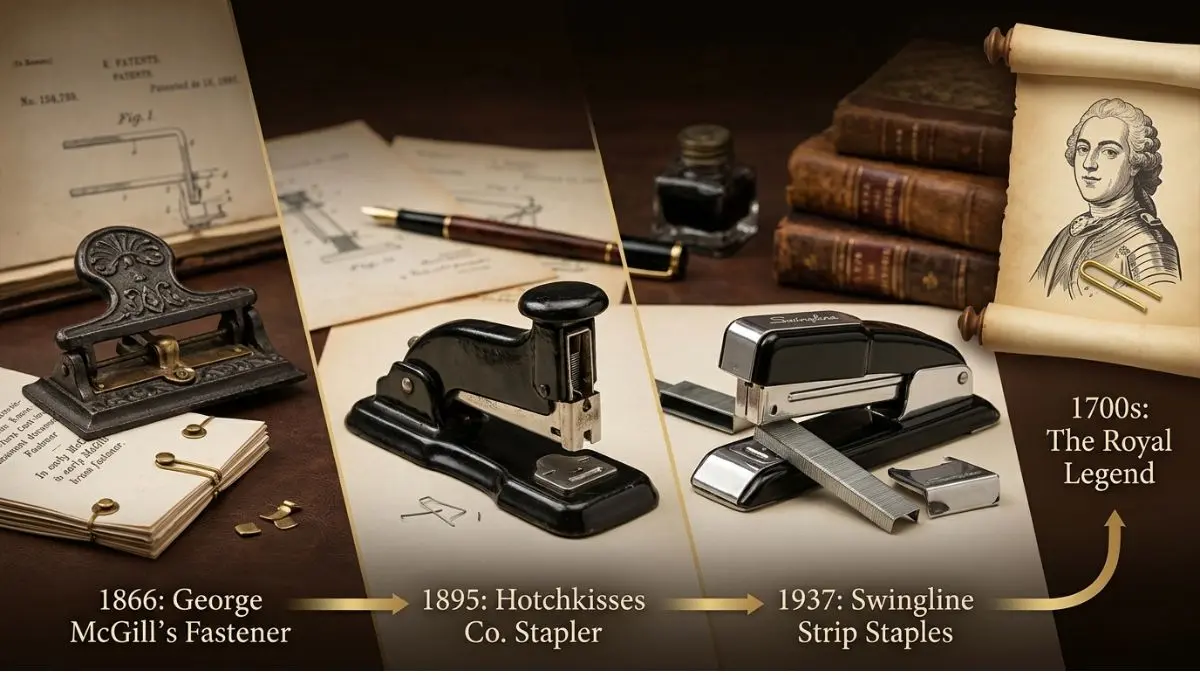
Who Invented the Stapler? The stapler wasn’t the invention of a single individual. It evolved through various inventions and improvements over time. But the first known stapler was custom-made for Louis XV of France in the 18th century.
Although many inventors contributed to the stapler’s evolution, McGill is widely credited as the inventor of the modern stapler.
Did you know that the small stapler on your office desk was once made of gold? Yes! The stapler’s story is no less than a movie script.
Who Invented the Stapler? Complete History
Part One: The Legend of King Louis XV and the Mystery of the Royal Stapler
Every great invention has an origin story, and the stapler has one of the most fascinating. Many people say the first stapler was made in the 18th century for Louis XV. According to the legend, craftsmen created a special device for the king that used handmade staples marked with the royal seal. Some later stories even claimed the staples were made of gold and decorated with precious stones.
It sounds like a fairy tale, but historians found the story may be far more legend than fact.
Fact or Fiction?
The idea that King Louis XV may have used some kind of paper-fastening device seems to have historical roots. But many of the famous details appear to have been added much later.
Historian Mike Dash looked into this story and traced much of it to Jack Linsky, founder of Swingline. In a 1962 article, Linsky claimed he owned a stapler from the time of Louis XV. But the dramatic details about gold staples, jewels, and luxury designs seem to have grown over time, especially in modern retellings.
Many historians doubt these details. Staples are tiny metal fasteners, so there would be little space for gemstones or detailed decorations. Also, these claims do not appear in old historical records, which makes many researchers skeptical.
What Probably Existed
During the reign of Louis XV, craftsmen created a handmade tool for fastening royal papers together. Instead of a jeweled masterpiece, it was likely a simple mechanical device used to bind court documents with small metal fasteners. Some carried the royal seal to show authenticity.
This early device would have worked by loading and bending each staple by hand. It was far from the easy staplers we use today, but it may have planted an early seed for the idea.
Does the Royal Stapler Still Exist?
No verified evidence about this royal stapler is found today.
If such a device survived, no any museum has identified it. Even if Jack Linsky once owned one, its location is unknown. That mystery only adds to the legend.
The Real Beginning of the Stapler
The real stapler revolution came much later.
In the 19th century, growing businesses, government offices, and mountains of paperwork created a real need for better ways to fasten documents. That need pushed inventors to develop the modern stapler.
And that is where the true story of the stapler really began.
Part Two: The Paper-Fastening Problem and Early Solutions
Before staplers, people used many awkward ways to keep papers together. Some used wax seals, but they could break or melt. Others tied papers with ribbons or string, but these often came loose and took time to use. People also used straight pins, but they could prick fingers and catch on clothing.
None of these methods worked perfectly.
How People Fastened Papers Before Staplers
People had been attaching documents together for centuries. Records show that around 1200 C.E., people often fastened papers at the top left corner. It was a simple way to keep pages grouped together, and the practice lasted for hundreds of years.
But as paper use grew during the Industrial Revolution, old methods failed.
Businesses expanded. Governments created more records. Offices handled huge amounts of paperwork. People needed a faster and more reliable way to keep documents together.
This was no longer just about convenience. Modern institutions needed better document organization to store, retrieve, and protect important records.
The Search for a Better Solution
During the 19th century, inventors started looking for mechanical ways to solve the paper-fastening problem.
In 1841, Samuel Slocum patented a device used for packaging pins. It was not a true stapler, but it showed early thinking about mechanical fastening.
Then in 1859, William H. Rodgers received a patent for a hole punch. People used it to punch holes in papers and tie pages together with string or pins.
It helped, but it still was not the perfect answer.
Inventors Saw a Bigger Need
Punching holes and tying papers still took too much effort. Inventors wanted something better — one fastener that could hold papers together quickly, securely, and permanently.
That idea led to the next big step.
Inventors began working on a machine that could drive a metal fastener through sheets of paper in seconds.
And that is where George W. McGill and other inventors entered the story — bringing the modern stapler much closer to reality.
Part Three: The Simultaneous Invention and Early Patents
1866: The Year Everything Changed
The year 1866 became a major turning point in stapler history. Several inventors worked on paper-fastening solutions at the same time, often without knowing others were doing the same.
George W. McGill and His Breakthrough
George W. McGill saw a simple but powerful idea — a small bendable metal fastener that could hold papers together. Today, we call it a staple.
In 1866, he received U.S. Patent No. 56,587 for small bendable brass paper fasteners. His invention allowed a metal fastener to pass through paper and bend back to hold the sheets together.
That idea changed everything.
In 1867, McGill received another patent for a press that inserted the fastener into paper. He kept improving the idea and later secured more patents in Britain and the United States.
Other Inventors Were Working Too
McGill was not alone.
In the same year, the Novelty Manufacturing Company also registered a paper stapler patent. Some historians credit it with producing one of the first commercial staplers.
Then in 1868, Charles H. Gould patented a wire stitcher in England. His machine used uncut wire, cut it to length, pushed it through paper, and bent the ends down.
That same year, Albert Kletzker patented another paper fastener design in St. Louis. His device used a large staple, though users still had to bend the ends by hand.
These inventions show something important:
The stapler did not appear in one single moment. Multiple inventors helped create it through parallel ideas and improvements.
The First Commercial Staplers
Around 1869, McGill introduced one of the first staplers sold commercially.
- But it had a major problem.
- It held only one staple at a time.
- After every use, the operator had to reload it by hand. That made large jobs slow and tiring.
- Still, it was an important step forward.
The Centennial Exhibition
In 1876, McGill presented his invention at the Centennial Exposition in Philadelphia, the first World’s Fair held in America.
This event introduced many people to stapler technology.
During this period, architect Merik Herron also helped refine the shape and form of the staple itself.
McGill’s Big Success in 1879
In 1879, McGill produced what many consider the first truly successful modern stapler — the McGill Single-Stroke Staple Press.
It was large, heavy, and weighed over 2.5 pounds. It also required force to operate.
But it worked.
And more importantly, businesses wanted it.
Two Major Innovations
McGill’s 1879 machine introduced two huge improvements:
1. One Motion Did Everything
The machine pushed the staple through paper and bent it closed in a single action.
2. It Used an Anvil
A metal plate called an anvil bent the staple legs inward automatically.
This was revolutionary.
Before that, people often bent fasteners by hand.
Modern staplers still use this same anvil principle today.
That design has lasted for more than 140 years.
McGill’s Legacy
By the end of the 19th century, George W. McGill had become the leading name in stapler development.
Although many inventors contributed to the stapler’s evolution, McGill is widely credited as the inventor of the modern stapler.
His ideas laid the foundation for nearly every stapler that followed.
Part Four: Rivals, Improvements, and the Quest for Efficiency
The Reloading Problem
Early staplers solved one problem but created another.
Even George W. McGill’s stapler had to be loaded one staple at a time. For people handling large stacks of paper, this was slow and exhausting.
Inventors knew they had to improve it.
Henry R. Heyl Adds to the Idea
In 1877, Henry Heyl patented a machine that inserted a staple and bent its ends in one motion. His design worked much like McGill’s, though he developed it independently.
Some historians even credit Heyl as an inventor of the modern stapler.
This showed that many inventors were racing to solve the same problem.
The Hotchkiss Revolution
A huge breakthrough came in 1895.
The E. H. Hotchkiss Company created a stapler that used a strip of connected staples instead of loading one staple at a time.
That changed everything.
After each staple fired, the machine moved automatically to the next one.
For the first time, staplers became practical for everyday office use.
The machine became so popular that many people simply called staplers “Hotchkiss.”
In Japan, people still often call staplers hochikisu, named after Hotchkiss.
That shows how powerful the invention was.
Boston Wire Stitcher Company Enters the Story
Around the same time, inventor Thomas Briggs developed the wire stitcher.
It used wire to bind papers and books and became popular in publishing.
By 1903, the company even made foot-operated stapling machines for fast, high-volume work.
Then in 1914, it introduced the Bostitch desk stapler, an ancestor of many modern staplers.
Jack Linsky Changed Everything
Another major leap came in 1925, when Jack Linsky founded what later became Swingline.
Linsky wanted to improve staplers and loading systems.
In 1937, he introduced a breakthrough — the top-loading stapler.
Users could open the top, drop in a strip of staples, and close it.
- Simple.
- Fast.
- Brilliant.
Before that, loading some staplers could require tools and a lot of patience.
This design became the model for modern staplers.
And we still use the same idea today.
Why the 1937 Design Mattered
Linsky’s “open channel” design used a spring-loaded magazine that pushed staples forward automatically.
- It made loading easy and efficient.
- It was such a good idea that it has barely changed since.
- Sometimes the best inventions need no redesign.
Other Companies Join the Race
As staplers became popular, many companies entered the business, including:
- Plews
- Bostitch
- Ace Fastener
- Staplex
Each added improvements and new ideas.
By 1941, the modern stapler had largely taken the form we recognize today.
And remarkably, that basic design has changed very little since.
Electric Staplers Arrive
In the 1950s, companies introduced electric staplers.
Swingline launched electric models, and other makers competed to improve them.
Soon pneumatic staplers also appeared for industrial use.
These machines made stapling faster in offices, factories, and construction.
More Than a Tool
The stapler also reflected changing design styles.
From Art Deco machines in the 1930s to the famous Swingline 747 in the 1970s, staplers became design icons as well as practical tools.
- Their appearance changed.
- Their colors changed.
- But the core mechanism stayed almost the same.
- That says a lot about how well inventors got it right.
Part Five: The Invention of the Staple Remover and Supporting Tools
As staplers became common in offices, people faced a new problem—how to remove staples without tearing paper. This need led to the invention of the staple remover.
Early Staple Removers
The first staple remover patents appeared around 1916, but these early tools did not work very well. They struggled with the large and tough staples used at the time. Things changed in the 1930s when manufacturers began making glued strips of staples, which made removal easier and more practical.
William G. Pankonin’s Breakthrough (1932–1936)
The modern staple remover is widely credited to William G. Pankonin of Chicago.
- He filed his patent in 1932.
- It was granted in 1936 as U.S. Patent 2,033,050.
His design used two small metal wedges joined by a spring. The wedges slipped under a staple, lifted it cleanly, and removed it without damaging paper.
The design was simple but brilliant:
- Chrome-plated steel made it strong and rust-resistant
- A spring opened the remover after each use
- The pincer action made it easy to grip and pull staples
It worked so well that modern staple removers still use almost the same design today.
Ace Fastener’s Famous No. 600
Building on this idea, Ace Fastener Corp introduced the Model No. 600 Staple Remover in the mid-1930s.
It became one of the most popular staple removers ever made. Even though the company no longer exists, versions of the No. 600 are still produced today.
Several versions were made, but the basic design remained the same.
Later Improvements
Other inventors tried to improve staple removers. Joseph A. Foitle created modified designs, though none became as popular as Pankonin’s original.
Other Ways People Removed Staples
People also used other methods:
- Some small staplers included a built-in staple remover at the back
- Flat tools could pry staples out by hand
- Some people even used nail clippers as makeshift removers
- Modern offices now use ergonomic removers designed for repeated use
More Than a Small Tool
The staple remover may seem simple, but it solved a problem created by the stapler itself. It shows how one invention often leads to another.
First came the stapler to bind papers together. Then came the staple remover to undo that bond safely.
Even this small office tool has its own place in invention history.
Part Six: Staple Guns and Industrial Staplers
While office staplers improved for paperwork, another type of stapler developed for heavier jobs. Builders, upholsterers, and manufacturers needed stronger tools for wood, fabric, packaging, and construction. This led to the invention of staple guns and industrial staplers.
The First Staple Guns
George Worthington is often credited with inventing the first pneumatic stapler in 1901. It was partly made of cast iron and helped wrap and staple dry goods.
The manual staple gun we recognize today came later.
In 1932, Hugo J. Baur patented an important staple gun design with a spring-loaded mechanism that could drive staples into hard surfaces. A.L. Hansen Manufacturing Company later refined and sold similar tools for screens, signs, and repairs.
Arrow Fastener and the Famous T50
One of the biggest breakthroughs came from Arrow Fastener, founded in 1929.
In the early 1950s, the company introduced the T50 staple gun, which became the most famous manual staple gun in history.
It used T50 staples, a standard still used today. The design became so successful that it shaped many staple guns that followed.
Pneumatic and Electric Development
Staple gun technology continued to grow:
- 1948: Senco introduced the first pneumatic stapler for industrial packaging and upholstery.
- 1950s–1960s: Morris Abrams, founder of Arrow Fastener, improved staple guns and hammer tackers through new patents.
- Later, electric and battery-powered staple guns gave users more convenience.
Types of Staple Guns
Today, staple guns come in several forms:
Manual Staple Guns
Hand-powered tools used for crafts, repairs, and light jobs.
Pneumatic Staple Guns
Air-powered tools used in roofing, framing, and industrial work.
Electric Staple Guns
Powered by electricity for faster stapling without air compressors.
Cordless Staple Guns
Battery-powered tools that offer portability and flexibility.
Staple Types for Heavy-Duty Work
Industrial staplers use different staples for different jobs.
Narrow Crown Staples
Used in:
- Upholstery
- Trim work
- Cabinets
- Finish carpentry
They hold materials securely while staying less visible.
Wide Crown Staples
Used for heavier work such as:
- Roofing
- Insulation
- Subflooring
- Fencing
- Sheathing
They provide stronger holding power.
Industrial Uses
Staple guns became essential in many industries.
They are used in:
- Construction
- Furniture and upholstery
- Automotive trim work
- Packaging and shipping
- Home improvement and DIY projects
What began as a paper fastener evolved into a serious industrial tool.
Safety Concerns
Staple guns are powerful tools and can be dangerous.
In the United States, nearly 40,000 injuries involving staple guns and nail guns are treated in emergency rooms each year. Proper handling and safety training are important.
A Big Business
Staplers are not just office supplies anymore.
By 2012, the U.S. stapler market reached $80 million in annual sales, showing how important these tools became in homes, offices, and industries.
From fastening papers on a desk to building houses and furniture, the stapler had come a very long way.
Part Seven: The Word “Stapler” and Global Names
The Word “Stapler” in English
The word “stapler” is relatively new in English. It first appeared in 1901 in an advertisement in Munsey’s Magazine in the United States.
Before this, people used different names to describe the tool and its function. They usually referred to it by describing the act of fastening or binding papers together.
The Origin of the Word “Staple”
The word “staple” has a much older history. It comes from the Old English word “stapol,” which means pillar or supporting post.
In medieval times, people used the word “staple” for large U-shaped metal fasteners used in woodwork, especially for doors and gates. When smaller metal fasteners were created for paper, the same word was used because they worked on the same basic idea—holding things together firmly.
Stapler Names Around the World
As staplers spread across the world, different languages created their own names for the device. Many of these names describe what the tool does.
- Argentina: Abrochadora (fastener)
- Chile: Corchetera (hook-maker)
- Colombia: Cosedora (sewing machine)
- Cuba: Presilladora (clip-maker)
- France: Agrafeuse (fastener)
- Italy: Graffettatrice / Spillatrice (stapler)
- Japan: “Hotchkiss” (from the famous brand name)
- English-speaking countries: Stapler
Why Names Differ
These different names show how language and culture shape technology. In some countries, people named the tool after what it does. In others, a popular brand name became so common that it replaced the original word.
This is similar to how brands like “Band-Aid” became a general name for all adhesive bandages in some places.
Even though staplers look the same worldwide, their names tell a rich story of language, trade, and history.
Part Eight: Mechanical Design and Specifications
How a Stapler Works
A stapler works through a simple mechanical system that turns hand pressure into strong force. Each part has a clear job.
1. Staple Magazine
The magazine holds a strip of staples under spring pressure. It keeps staples ready for use and feeds them forward one by one.
- Most office staplers hold 100 to 210 staples
- A standard stapler usually holds about 210 staples
2. Driver Blade (Ram)
The driver blade moves down when you press the handle. It pushes one staple out of the magazine and forces it through the paper.
This part needs strong force, so the stapler uses mechanical leverage to multiply hand pressure.
3. Anvil
The anvil sits at the base of the stapler. When the staple passes through the paper, it hits the anvil and bends.
This bending folds the staple legs inward and locks the papers together. This design comes from George W. McGill’s 1879 innovation and is still used today.
4. Return Spring
The return spring pulls the driver blade back up after each use. This resets the stapler so it can fire the next staple.
5. Handle and Lever System
The handle acts as a lever. It increases force from your hand and transfers it to the driver blade. This allows a small hand motion to create enough power to staple multiple sheets.
The Beauty of Simple Design
The stapler core design has stayed almost the same since the 1860s–1870s.
From small desk staplers to large industrial machines, every stapler uses the same basic system:
- Feed a staple
- Push it through paper
- Bend it using an anvil
This shows that early inventors found a near-perfect solution that still works today.
Early Stapler Materials and Weight
Early staplers were heavy and solid. In the 19th century, manufacturers mainly used cast iron.
- McGill’s 1879 stapler weighed over 2.5 pounds
- It needed strong force to operate
- Heavy weight gave it strength and stability
Modern Materials
Today’s staplers use lighter and more advanced materials:
- Metal alloys for strength
- Plastic for lightweight housing
- Chrome-plated steel for springs and moving parts
- Composite materials in modern designs
Modern Stapler Specifications
Most office staplers today are designed for everyday use and efficiency:
- Weight: 4–8 ounces (manual models)
- Staple capacity: 100–210 staples
- Stapling depth: 2 inches (mini) to 12+ inches (long-reach models)
- Body material: Metal base with plastic cover
- Durability: Built for thousands of uses
Part Nine: Types and Varieties of Staplers
The Growth of Stapler Designs
By the late 20th and early 21st centuries, staplers had developed into many different types. Each type serves a specific purpose, from simple office work to heavy industrial use.
Manual Staplers
Manual staplers are the most common type. People use them in offices, schools, and homes.
- They work with hand pressure
- They come in small and large sizes
- They remain the standard everyday stapler
Electric Staplers
Electric staplers use a motor instead of hand force.
- They reduce physical effort
- They staple quickly and repeatedly
- They are useful for high-volume work
These staplers first appeared in the 1950s.
Heavy-Duty or Industrial Staplers
Heavy-duty staplers handle much thicker stacks of paper.
- They bind large documents
- They are used in printing shops and warehouses
- Some can staple stacks over an inch thick
Booklet Staplers
Booklet staplers create folded book-style documents.
- They staple in the center of pages
- They allow pages to open like a booklet
- They are longer to reach the middle of paper stacks
Pneumatic Staplers
Pneumatic staplers use compressed air.
- They are very powerful
- They are used in construction and upholstery
- They work well for fast industrial stapling
Tacking Staplers
Tacking staplers attach materials to surfaces instead of binding paper.
- They are used for insulation, fabric, and thin wood
- They push staples into walls or frames
Novelty and Decorative Staplers
As staplers became common, designers created fun and creative versions.
- They come in different colors and shapes
- Some look like animals or objects
- They are popular in schools and creative offices
Types of Staple
Staples also come in different forms for different tasks.
Standard Office Staples
- About 3/8 inch long
- Used for everyday paper binding
Heavy-Duty Staples
- About 1/2 inch long
- Used for thick stacks and stronger materials
Saddle Staples
- Used in booklet staplers
- Bind paper in the center like a book
Tacking Staples
- Short and wide
- Used to attach materials to surfaces
Specialty Staples
- Include colored or industrial staples
- Designed for special applications
Stapler Capacity
Most staplers can hold around 210 staples in the magazine. This allows one loading to handle many stapling tasks before refilling is needed.
Part Ten: Medical and Surgical Applications
The Move from Office to Operating Room
While staplers improved office work in the 20th century, the same idea also changed medicine. Doctors realized that stapling could close wounds faster and more safely than traditional stitches.
The First Medical Stapler (1908)
The first idea of surgical stapling came in 1908, before modern office staplers became common.
A Hungarian surgeon, Humér Hültl, developed the concept of using metal staples to close surgical wounds. He worked with instrument designer Victor Fischer to build the first surgical stapling device, known as the Fischer-Hültl stapler.
At that time, surgeons used stitches (sutures) to close wounds. But stitches took time and could damage tissue. The new stapler offered a faster and more mechanical method.
However, early designs had problems:
- They were large and heavy
- They were expensive
- They were difficult to handle
Even so, they proved that mechanical stapling could work in surgery.
Early Improvements (1920s–1930s)
In 1920, Aladár Petz, a student of Hültl, improved the design. His version, called the Petz clamp, became lighter and easier to use.
In 1934, Friedrich of Ulm designed a new type of stapler that later influenced modern linear surgical staplers.
Cold War Era Development
By the 1950s, both the United States and the Soviet Union were developing surgical staplers.
In 1957, an American surgeon named Ravitch visited the Soviet Union during a period of relaxed Cold War tensions. He studied their stapling devices and brought the design back to the United States.
This exchange helped shape modern American surgical staplers.
However, early Soviet models had limitations:
- Each staple had to be loaded manually
- Devices required assembly before surgery
- Nurses often spent time preparing staples during operations
Despite these issues, the technology continued to improve rapidly.
Modern Surgical Staplers
Today, surgical staplers are highly precise medical tools used in many types of surgery.
They are called mechanical suturing devices because they replace stitches with metal staples.
Main Types of Surgical Staplers
Linear Staplers
- Close tissue in a straight line
- Used in stomach, chest, and abdominal surgeries
Circular Staplers
- Connect hollow organs
- Used in intestinal and esophageal surgeries
Skin Staplers
- Close external wounds
- Common in emergency rooms and trauma care
How Surgical Staples Work
Surgical staples are shaped like an “M” before use. When the stapler fires:
- The staple passes through tissue
- It hits an anvil inside the device
- The legs bend inward and lock the tissue together
This creates a secure and even closure.
Advantages Over Traditional Stitches
Surgical staplers offer many benefits:
- Faster procedures
- More uniform closures
- Less tissue damage
- Better healing outcomes
- Shorter surgery time and anesthesia exposure
Materials and Modern Design
Modern surgical staplers use:
- Medical-grade stainless steel
- Sterilizable components
- Disposable or reusable systems
Today’s devices are highly advanced, but they still follow the same basic idea introduced over a century ago: using mechanical force to close tissue quickly and safely.
Part Eleven: Pop Culture and the Iconic Red Stapler
The Office Space Phenomenon
The 1999 movie Office Space, directed by Mike Judge, made the stapler famous in pop culture. This comedy shows boring and frustrating office life in a funny way. In the film, a red Swingline stapler becomes a powerful symbol. It represents a worker’s individuality being crushed by strict office rules and routine work.
Milton and His Stapler
One of the most memorable characters is Milton Waddams, played by Stephen Root. Milton is a quiet, ignored office worker. He finds small comfort in his red stapler. It is the only thing in his cubicle that makes him feel happy and unique.
His manager, Bill Lumbergh, keeps taking away Milton’s basic rights at work. He even takes his stapler. This slowly builds Milton’s anger. In the end, Milton reacts by burning down the office and taking money. He then escapes to a beach, which shows his final break from the system.
Milton’s line, “Excuse me, I believe you have my stapler,” became very popular. People still quote it more than 25 years later in offices and everyday life.
How the Famous Red Stapler Was Made
The interesting part is that Swingline did not make red staplers at that time. The film’s production team needed a stapler that would clearly stand out on screen.
The prop designer solved this problem in a simple way. He took normal Swingline staplers, which were gray or blue, and painted them red. Some reports say he had them professionally painted, while others say he used spray paint.
Actor Stephen Root also had difficulty during filming. His thick glasses made it hard for him to see clearly, so the bright red stapler helped him find it easily on set.
At that time, Swingline only made staplers in basic colors. The red version was created only for the movie.
Filmmaking Choices
The filmmakers chose Swingline because other stapler companies refused to allow their products in the film. Swingline agreed, not knowing the movie would later become very popular.
Director Mike Judge also liked the idea of the red stapler because it would stand out visually and add humor to Milton’s attachment to it.
Unexpected Success
When Office Space first released in 1999, it did not earn much money in theaters. However, it became very popular later on VHS and TV.
As the film gained a strong fan base, people started asking for red Swingline staplers. Demand grew so much that even fake versions appeared in the market.
Swingline noticed this trend and realized a big opportunity. In 2002, they finally released an official red stapler called the Rio Red 747.
It became very successful and turned into a best-selling product. The company still produces it today.
Long-Term Impact
The red stapler became more than just a movie prop. It created a lasting cultural impact:
It showed how movies can influence real products and buying habits.
Swingline gained huge free publicity from the film’s popularity.
The company now gives a red stapler to every new employee.
Their website and office culture include references to the movie.
The actor who played Milton is often greeted with red staplers on set.
In 2019, Swingline released a special “Milton’s Red Stapler” edition for the film’s 20th anniversary.
The movie also made other phrases popular, like “TPS report,” which people now use to describe useless paperwork.
Part Twelve: Contemporary Uses and Cultural Significance
Staplers in Different Settings
Staplers are now used in almost every place where people work with paper. Over time, they have become a basic tool in daily life.
Education:
Schools and universities use large numbers of staplers every day. Teachers staple assignments, administrators organize records, and students use them for projects. Many students also use colorful or creative staplers to make their school supplies more personal.
Medical Offices:
Doctors and hospital staff use staplers to organize patient files, test results, and reports. Medical offices handle a huge amount of paperwork, so staplers help keep everything in order.
Publishing and Printing:
Printing companies use staplers on a large scale. They bind booklets, magazines, and small publications. Saddle-stitch stapling is still a common method in printing.
Legal Work:
Law firms use staplers to organize contracts, case files, and court documents. Proper document binding is very important in legal work.
Government Offices:
Government departments produce a lot of paperwork. Staplers help organize reports, letters, laws, and records. They make large bureaucratic systems easier to manage.
Home and Remote Work:
People now use staplers more at home due to remote jobs and small businesses. They help organize bills, forms, and personal documents.
Construction and Repair:
Staple guns and heavy staplers are used in construction. Workers use them for insulation, roofing, and building materials.
DIY and Crafts:
People also use staplers in creative hobbies. They help in crafts, home projects, and small repairs.
Staplers as a Cultural Object
Staplers are not just tools anymore. They also reflect modern life and work culture.
Historians say staplers show the shift from handmade work to mass production. They also represent equal access because almost everyone can use them, from office workers to students at home.
The basic stapler design has stayed the same for more than 150 years. This shows that the original idea was simple, strong, and effective.
Personalization and Fun Designs
Today, staplers come in many creative designs. Manufacturers make staplers in different shapes and styles, such as:
Animals like cats, dogs, and dinosaurs
Food shapes like burgers, sushi, and fruit
Cartoon and movie characters
Bright neon and transparent designs
Ergonomic staplers for comfort
Branded and themed staplers
People now choose staplers not only for work but also for personal style. This shows how even a simple office tool can express personality.
Staplers in Art and Literature
Staplers also appear in books, films, and art.
In Office Space, the stapler shows frustration with office life
In literature, it often represents boring bureaucracy
In art, it can show mass production or repetitive work
In office comedy, it often symbolizes small but important work problems
Artists and writers use staplers to show how modern work life feels structured, repetitive, or controlled.
The History of the Word “Stapler”
The word “stapler” has changed over time:
Old English “stapol” meant a pillar or post
Later, “staple” referred to metal fasteners on doors
Then it became the small wire fastener we use today
Finally, “stapler” became the tool that uses staples
This shows how language changed along with technology. The meaning shifted from large structures to small tools, but the idea stayed the same—joining things together.
Part Thirteen: The Future of Staplers in an Increasingly Digital World
Will Staplers Become Obsolete?
Many people think staplers might disappear because most work is now digital. Today, we can store, organize, and share documents online without printing anything. This can make staplers less necessary.
However, staplers have not disappeared, and this prediction has not come true even after 25+ years.
Why Staplers Are Still Needed
Printed Documents Still Exist:
Even in the digital age, many industries still rely on paper. Lawyers print contracts, hospitals print patient records, schools use printed materials, and companies print reports. The global printing industry is still very large.
Physical Organization Feels Better:
Many people still feel that stapled papers look more official and organized. A physical report often feels more serious than a digital file.
Easy to Use for Everyone:
Staplers do not require technical skills. Anyone can use them, even without computers or internet access.
Low Cost:
Staplers are cheap and practical. For small document sets, they are often easier and cheaper than digital alternatives.
Home and Hybrid Work:
With remote and hybrid work becoming common, people now use staplers more at home to manage personal and work documents.
Growing Countries:
In developing countries, stapler use is still increasing as offices and schools expand.
How Staplers Are Changing
Instead of disappearing, staplers are improving and adapting:
Eco-Friendly Designs:
Companies are making staplers from recycled materials and designing them to last longer.
Better Comfort:
Modern staplers are easier to use and require less effort, especially for long-term use.
Stylish Designs:
Today’s staplers come in modern, colorful, and attractive designs, making them part of office style.
Digital Integration Ideas:
Some new ideas connect stapled papers with digital systems using QR codes and smart tracking.
Digital Alternatives
New technology offers other ways to bind or organize documents:
- Electronic binding machines
- Cloud storage and digital files
- Fully paperless office systems
However, these systems still cannot fully replace staplers in legal, official, or archival work where physical documents are required.
Market Reality
Staplers are still a strong global product. For example, in 2012 alone, the U.S. sold about $80 million worth of staplers. Demand continues in many parts of the world, especially in developing economies.
Why Staplers Will Likely Stay
The stapler has survived for more than a century because it solves a simple problem in a very effective way—joining papers together.
Even old staplers from decades ago can still work today. This shows how strong and reliable the design is.
In a world where technology changes quickly, the stapler remains almost the same. This is because it does its job perfectly without needing major changes.
Conclusion
The stapler has a long and interesting history. It started as a luxury idea and later became a simple but important office tool used around the world. Over time, it became cheaper, more practical, and easily available. It plays an important role in schools, offices, hospitals, and homes.
Even in the digital age, people still use it because they depend on printed documents and simple ways to organize them. Its basic design has stayed almost the same for more than 150 years, which shows that simple and practical ideas can last a long time.
Today, the stapler represents smart everyday innovation and quietly supports modern life in many ways.