
Who Invented Wi Fi? The Shocking Story of Hollywood Actress Hedy Lamarr!
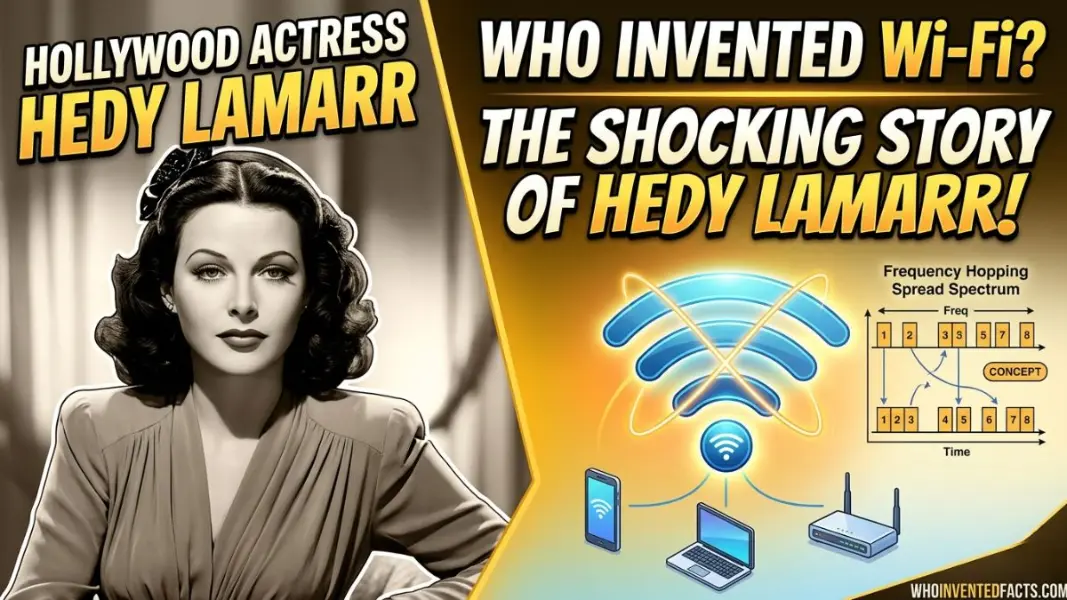
If I tell you that the founder of Wi-Fi wasn’t a computer scientist, but a Hollywood actress. Would you believe it? Yes! Billions of people use Wi-Fi every day, but most people still don’t know who invented Wi Fi.
These days, we can’t even think about living without Wi-Fi. Whether we’re at home, at work, or in a cafe, the first question is, What’s the Wi-Fi password?
The truth is, Wi-Fi was not invented by just one person. It came from many important discoveries over time. The early idea started with Hollywood actress Hedy Lamarr and composer George Antheil.
Many years later, scientists at CSIRO in Australia worked on radio signals while studying space. They found important technology that made modern wireless internet possible. Their work became a big part of Wi-Fi and later earned them a lot of money through patents.
So, the story of Wi-Fi is not simple. It is a mix of different ideas, science, and people who were not fully recognized at the right time.
Who Invented Wi Fi?
Hedy Lamarr and Frequency Hopping (1942)
Hedy Lamarr was born as Hedwig Eva Kiesler in Vienna, Austria in 1914. She came from a rich Jewish family. Her father worked as a bank director. As a child, she was very curious. Her father explained how machines, streetcars, and electricity worked. At just 5 years old, she opened a music box and carefully put it back together.
At age 16, she secretly visited a big movie studio to ask for acting work. She became famous very quickly. In 1933, she acted in a bold film called Ecstasy. The film was banned in many countries, including the United States and Germany.
A Hollywood studio boss called her “the most beautiful woman in the world.” She later moved to Hollywood and became a big star, acting with famous actors like Clark Gable and Judy Garland.
Even though she was a movie star, Hedy loved science. At home, she read engineering books and worked on inventions. She created many small ideas like:
- A better tissue box
- A glowing dog collar
- A special shower seat for older people
- A better water-to-soft-drink tablet idea with Howard Hughes
But her biggest idea came during World War II.
⚙️ The Invention of Frequency Hopping
In California, she met a composer named George Antheil, who created music using many synchronized player pianos.
Together, they tried to solve a serious war problem.
Enemy submarines were blocking radio signals used to control torpedoes. This made attacks fail.
So they created a new idea:
- Instead of using one radio signal
- The signal would keep changing many times per second
- This made it hard for enemies to block it
They used 88 frequencies because a piano has 88 keys. They also used player piano technology. Both the ship and the torpedo followed the same “music roll” pattern so they stayed in sync.
Hedy called this system frequency hopping.
Patent and Rejection
On August 11, 1942, U.S. Patent No. 2,292,387 was granted to Antheil and Hedy Kiesler Markey, her married name at the time. They donated the patent freely to the U.S. Navy.
But the Navy did not accept it. They thought it was too complicated and even joked:
“Do you want to put a player piano in a torpedo?”
The idea was stored away and not used during the war.
Long Wait for Recognition
The patent ended in 1959. Later, the same idea was finally used in military communication systems during the 1960s. In the 1970s and 1980s, it was used in early mobile phones.
By the 1990s, it became very important for secure wireless systems. It helped build modern technologies like Wi-Fi and Bluetooth.
Modern Impact
Today, this idea is part of:
- Wi-Fi networks
- Bluetooth devices
- Mobile communication
- Secure military systems
Late Recognition
Many years later, engineers discovered that Hedy Lamarr was behind the invention.
She finally received an award in 1997. Her simple response was:
“Well, it’s about time.”
In 2014, she was honored in the National Inventors Hall of Fame.
Final Life
Hedy Lamarr died in 2000 at the age of 85.
She never earned money from her invention, even though it helped create modern wireless technology used by billions of people today.
ALOHAnet and Wireless Packet Radio (1971)
In 1971, a computer scientist named Norman Abramson and his team created a system called ALOHAnet. It was one of the first wireless computer networks, and it connected university campuses across the Hawaiian Islands. They used radio signals because building cables between the islands was too expensive and difficult.
The main problem was how to let many computers share the same radio channel without interrupting each other. If two devices sent data at the same time, their signals would crash. To solve this, Abramson created a simple method called ALOHA.
In this system, each device sends data whenever it has information. It then checks if the data reached correctly. If there is a collision, the device waits for a random amount of time and tries again. This simple idea of “send, check, wait, and retry” helped computers communicate smoothly over the same channel.
Later, this system was improved into Slotted ALOHA, which made timing more organized. Even more importantly, it introduced the idea of packet switching, where data is broken into small pieces before being sent instead of sending everything at once.
These ideas became very important for modern internet technology. The random waiting and retry method helped inspire how Wi-Fi manages connections today.
In fact, when researchers later studied ALOHAnet, they used its ideas to build Ethernet for wired networks. After that, Wi-Fi engineers adapted those wired network ideas back into wireless systems. In this way, Abramson’s work became an important step in the development of modern internet communication.
Norman Abramson was later recognized for his contribution, but most people outside computer science still do not know his name, even though his ideas helped shape the way the world connects today.
The Legal Foundation: The 1985 FCC Ruling That Made Wi-Fi Possible
Wi-Fi was not only created because of science and engineering. It also needed government approval to exist in the real world.
In the early 1980s, radio signals were strictly controlled in the United States by the Federal Communications Commission (FCC). Every radio frequency needed a special license, and these licenses were expensive and limited. Without a license, using radio signals was illegal. Because of this, wireless internet for normal people was almost impossible at that time.
An engineer named Michael Marcus, working inside the FCC, believed this system needed to change. He suggested, some radio frequency bands should be open for everyone to use without a license. This was called “unlicensed spectrum.” He also said devices should use special methods to avoid interference, so they do not disturb each other.
At first, many telecom companies strongly disagreed with this idea because they wanted strict control over radio frequencies. But after long discussions, Marcus succeeded.
In 1985, the FCC made an important decision. It allowed unlicensed use of certain frequency bands under specific rules. One of these bands was the 2.4 GHz band, which later became the main band used for Wi-Fi.
The rules were simple: devices had to use smart signal techniques (like spread spectrum) and keep their power low so they would not cause interference.
This decision quietly changed everything. It made it legally possible for companies to build and sell wireless technology. Without it, Wi-Fi routers, wireless internet in homes, and even public Wi-Fi in cafés would not exist in the way we know today.
So, even though Michael Marcus is not a famous name, his work at the FCC in 1985 played a major role in making Wi-Fi possible for everyone.
The First Commercial Attempt: WaveLAN by NCR and AT&T (1988)
In 1988, engineers at NCR Corporation in the Netherlands, working with AT&T Bell Labs, created a wireless networking system called WaveLAN. It was made for places like supermarkets and warehouses where installing cables for internet connections was expensive and difficult. WaveLAN used radio signals in the 902 MHz band and could transfer data at speeds of up to 2 Mbps.
WaveLAN was a real product and it was sold commercially. It showed that wireless internet was possible and useful. However, it still had many problems. Different companies made systems that could not work together, so devices were not compatible. The signal was also not stable in all places, especially inside buildings where walls caused interference. Another big issue was that it struggled with signal reflections, which made performance unpredictable.
Even with these problems, WaveLAN proved very important. People wanted wireless networking, and it could actually work in real life. This created the need for a common global standard so all devices could work together properly.
Because of this, in 1990, engineers formed an IEEE group to design a universal wireless standard. The ideas from WaveLAN helped shape the early work of this group. One of the leaders, Victor Hayes, later said that WaveLAN made it clear that the world needed a proper standard for wireless networking.
So, WaveLAN was not Wi-Fi itself, but it was an important step that helped move the world closer to modern Wi-Fi.
The Core Engineering Breakthrough: CSIRO and the Indoor Wi-Fi Solution (1992)
The modern version of Wi-Fi has an important technical origin in Australia, and it started from a project that was not even focused on the internet.
A scientist named Dr. John O’Sullivan, working with Australia’s research agency CSIRO, was originally trying to detect very weak radio signals coming from exploding mini black holes. These black holes were only a theory suggested by Stephen Hawking, and they were never actually found.
The main goal failed, but team discovered something very important when they were working on radio signals. They faced a major problem called multipath interference. This happens when radio waves bounce off walls, furniture, and other objects. Because of these reflections, the same signal arrives at slightly different times, which creates distortion and makes wireless communication slow or unreliable indoors.
To solve this, O’Sullivan and his team (including Terence Percival, Diet Ostry, Graham Daniels, and John Deane) developed a smart mathematical method. They used a fast signal-processing technique (based on Fourier transform chips) to clean up distorted signals and remove the interference caused by reflections. This made it possible to send fast and reliable wireless data inside buildings for the first time.
CSIRO applied for patents for this technology in the early 1990s. They filed it in Australia in 1992 and later in the United States in 1996.
Other scientists had already studied similar ideas like OFDM, but the CSIRO team made an important improvement. They found a way to make it work properly inside real buildings like homes and offices, where signals usually bounce off walls and get distorted.
This practical solution made their invention very important and valuable.
Later, this patent became the center of major legal cases. In 2007, CSIRO won a lawsuit against Buffalo Technology in the United States. After that, they also settled cases with many big tech companies, including Intel, Microsoft, Apple-related suppliers, and others. In total, CSIRO earned around 430 million dollars in licensing fees. The money was then used to support further scientific research in Australia.
So, even though this research originally started as space science work, it later became a very important part of modern Wi-Fi.
It helped solve key problems in wireless communication and made it possible to get fast and stable internet inside homes, offices, schools, and public places.
Because of this work, Wi-Fi became more reliable and useful in everyday life.
The Universal Standard: Vic Hayes and the IEEE 802.11 Committee (1990 to 1999)
Even though CSIRO solved an important technical problem, Wi-Fi still needed one more thing to become successful, a global standard.
In the 1990s, many companies were making their own wireless networking systems. The problem was that these systems were different from each other. Devices made by one company often could not connect or communicate with devices made by another company.
The Institute of Electrical and Electronics Engineers (IEEE) helped solve this problem through a group called the 802.11 working group, which started in 1990. This group worked to create one common standard for wireless networking so devices from different companies could work together.
A Dutch engineer named Vic Hayes led this group from 1990 to 2000. He guided the project through many technical disagreements and business competition. Because of his important leadership, many people call him the Father of Wi-Fi.
The first 802.11 standard was approved in 1997. It had a maximum speed of 2 Mbps. It was not very successful because it was slow and expensive.
In 1999, 802.11b became the first major success. It offered speeds up to 11 Mbps on the 2.4 GHz band. Many products used it, including Apple AirPort.
Also in 1999, 802.11a was introduced. It used the 5 GHz band and offered faster speeds up to 54 Mbps, but its range was shorter.
In 2003, 802.11g combined the good range of 802.11b with the faster speed of 802.11a. It also reached 54 Mbps and became very popular.
In 2009, 802.11n added MIMO technology. This used multiple antennas to send and receive data at the same time. Speeds could reach up to 600 Mbps.
In 2013, 802.11ac brought even faster speeds, reaching gigabit levels on the 5 GHz band.
In 2019, Wi-Fi 6 was introduced. It improved performance in busy places with many connected devices and could reach speeds up to 9.6 Gbps.
In 2021, Wi-Fi 6E expanded into the new 6 GHz band, helping reduce congestion in apartments, offices, and stadiums.
In 2024, Wi-Fi 7 arrived with theoretical speeds above 40 Gbps.
Because of these global standards, Wi-Fi became faster, more reliable, and able to connect devices from different companies all over the world.
Understanding MIMO: How Multiple Antennas Changed Everything
MIMO is one of the biggest improvements ever made to Wi-Fi. The name MIMO stands for Multiple-Input Multiple-Output.
Before MIMO, most Wi-Fi devices used only one antenna to send data and one antenna to receive data. This limited speed and performance.
Older wireless systems also had another problem. Radio signals often bounce off walls, ceilings, furniture, and other objects. These bounced signals reach the receiver at different times and can cause interference. In the past, this was seen as a bad thing.
MIMO changed that idea. Instead of fighting those extra signals, MIMO uses them to improve performance.
A MIMO router has multiple antennas. It can send different pieces of data from different antennas at the same time. The receiving device also has multiple antennas. It collects all the signals, including the bounced ones, and uses smart calculations to separate them correctly.
This allows Wi-Fi to send more data at once.
For example:
- A 2×2 MIMO system uses two antennas for sending and two for receiving. It can give much higher speed than a single antenna system.
- A 4×4 MIMO system uses four antennas and can increase speed even more.
- Many modern Wi-Fi 6 routers support up to 8×8 MIMO.
Later, an even better version called MU-MIMO was introduced. MU-MIMO means Multi-User MIMO.
With normal MIMO, the router focuses on one device at a time. With MU-MIMO, the router can send data to several devices at the same time.
This means your router can handle many phones, laptops, TVs, and tablets together without slowing down as much.
Because of MIMO, modern Wi-Fi became faster, stronger, and much better at handling many connected devices at once.
The Brand and the Alliance: How Wi-Fi Got Its Name (1999)
In 1999, six companies, including 3Com, Nokia, Lucent Technologies, and Symbol Technologies, created a group called the Wireless Ethernet Compatibility Alliance. The main goal was to make sure wireless products from different companies could work together properly.
In 2002, the group changed its name to the Wi-Fi Alliance.
The Alliance hired a branding company called Interbrand to create a simple and friendly name for consumers. Technical names like “IEEE 802.11b Direct Sequence” were too hard for most people to understand or remember.
So, Interbrand created the name Wi-Fi. It was chosen because it sounded simple, modern, and easy to remember. It was also designed to sound similar to “Hi-Fi,” a popular term used for high-quality audio systems. The Wi-Fi Alliance has said that the name itself does not stand for anything.
The Wi-Fi Alliance also created a certification program. This program tested products to make sure that any Wi-Fi phone, laptop, or device could connect properly with any certified Wi-Fi router.
This trust helped Wi-Fi grow quickly around the world. People knew that devices from different brands would work together.
Today, the Wi-Fi Alliance has more than 300 member companies and has approved thousands of wireless products used worldwide.
How Wi-Fi Went Mainstream
A major turning point came on July 21, 1999, when Apple introduced the iMac with AirPort, one of the first popular home computers with built-in Wi-Fi. This made wireless internet easy for everyday users. Within the next two years, Wi-Fi became common in many laptops.
Coffee shops also helped Wi-Fi grow quickly. In 2002, Starbucks started offering Wi-Fi to customers. This made wireless internet a popular service in public places. By the mid-2000s, free Wi-Fi became something many cafés, hotels, airports, and libraries needed to offer.
The rise of smartphones made Wi-Fi even more important. When Apple launched the iPhone in 2007, it included Wi-Fi so users could connect to the internet without using as much mobile data. After that, almost every smartphone included Wi-Fi.
By 2010, smartphones were already using more Wi-Fi data than computers.
By 2025, there are more than 18 billion Wi-Fi devices being used around the world. Wi-Fi now carries over 60 percent of global internet traffic. It has become one of the most valuable technologies in the modern world, adding trillions of dollars to the global economy.
Wi-Fi Security: A History of Breaking and Fixing
The history of Wi-Fi security has been a long process of problems, fixes, and improvements. Many early Wi-Fi security systems were later broken, and newer versions were created to make wireless networks safer.
WEP (Wired Equivalent Privacy) was introduced in 1999 with early Wi-Fi systems. Its goal was to make wireless networks as secure as wired internet connections. However, WEP had serious weaknesses. Researchers discovered that its encryption system was poorly designed, and attackers could break into WEP networks very quickly. By the mid-2000s, it was widely known that WEP was not safe.
To solve this, WPA (Wi-Fi Protected Access) was introduced in 2003 as a quick replacement. It improved security and fixed some of WEP’s biggest problems without requiring users to buy completely new hardware. WPA was better than WEP, but later researchers also found weaknesses in it.
Then came WPA2 in 2004. It used much stronger encryption called AES and became the main Wi-Fi security standard for many years. In 2006, WPA2 became required for certified Wi-Fi devices. It was a major step forward and protected millions of home and business networks.
However, WPA2 was not perfect. In 2017, researchers discovered a serious weakness called KRACK (Key Reinstallation Attack). This flaw allowed attackers to target parts of the Wi-Fi connection process. Most companies fixed the issue through software updates, but it showed that WPA2 also had limits.
In 2018, WPA3 was introduced as the newest major security standard. It improved protection in several ways. It made password attacks much harder, improved privacy, and added better encryption even for open public networks like airports and coffee shops.
As of 2025, WPA3 is required for Wi-Fi 6 certification. If your router supports it, WPA3 with a strong and unique password is the best choice for home Wi-Fi security today.
Wi-Fi Direct: Connecting Without a Router
Most people think Wi-Fi always needs a router, but that is not always true. There is another type of Wi-Fi called Wi-Fi Direct, introduced by the Wi-Fi Alliance in 2010.
Wi-Fi Direct allows two devices to connect directly to each other without using a router or access point. One device temporarily acts like a small wireless hotspot, and the other device connects to it.
This direct connection can use normal Wi-Fi speeds and strong security like WPA2. The devices do not need to be connected to the internet or to a home Wi-Fi network.
Many people use Wi-Fi Direct without realizing it.
- Printing wirelessly to some printers
- Mirroring a phone screen to a smart TV
- Sharing files between devices using Android Quick Share
- Setting up smart home devices during first installation
Wi-Fi Direct is especially useful when two devices need to communicate quickly without using a router.
However, it also has limits. It is mainly made for short-distance connections between devices, not for full internet access. It can also be harder to manage many Wi-Fi Direct connections at the same time compared to a normal Wi-Fi network.
So, while routers are common, Wi-Fi Direct shows that Wi-Fi can also work device-to-device without one.
Is Wi-Fi Safe?
Many people worry about Wi-Fi, but much of this fear is not supported by science.
Wi-Fi uses non-ionizing radiation. This is very different from harmful radiation such as X-rays or gamma rays. Non-ionizing radiation does not have enough energy to break chemical bonds or damage DNA.
A normal Wi-Fi router usually sends out a very small amount of power, around 100 milliwatts. This is much lower than many other everyday devices. For example, a mobile phone can use much more power during a call when it is close to your head.
Scientists have studied wireless signals for many years. Major health organizations, including the World Health Organization, say there is no clear evidence that normal Wi-Fi exposure causes harmful health effects when used within safety guidelines.
Based on current research, normal Wi-Fi levels are not proven to cause cancer, genetic damage, or immediate health problems.
The Future of Wi-Fi
Wi-Fi 6, introduced in 2019, brought many important improvements. It added OFDMA, which lets one Wi-Fi channel serve many devices at the same time. This helps reduce slowdowns in busy homes, offices, and public places. It also introduced Target Wake Time, which helps save battery life on smartphones, tablets, and smart home devices.
Wi-Fi 7, approved in 2024, is even faster. It can reach very high theoretical speeds of up to 46 Gbps. It also uses Multi-Link Operation, which allows devices to use more than one Wi-Fi band at the same time for better speed and lower delay.
Mesh networking has improved Wi-Fi coverage in homes. Instead of using only one router, mesh systems use multiple connected devices called nodes. These nodes spread Wi-Fi signals across the whole house, giving stronger coverage in larger homes.
Another interesting technology is Li-Fi (Light Fidelity). It uses LED light instead of radio waves to send data. In lab tests, it has reached very high speeds. Because light cannot pass through walls, Li-Fi can offer better privacy and security in places like hospitals, offices, and airplanes.
Wi-Fi sensing is a new use of Wi-Fi signals. It can detect movement, breathing, and hand gestures by studying how signals bounce off people and objects. This can be useful for smart homes, health care, and security systems.
Services like Starlink and other satellite internet providers are also helping people in remote areas. They bring internet through satellites, and users can then connect their phones and computers through a normal home Wi-Fi router.
So Who Really Invented Wi-Fi? (Summary)
No single person invented Wi-Fi. The true answer is that Wi-Fi was created over many years by different people in different countries. Many of them were working on completely different problems and did not know they were helping build the future of wireless internet.
In 1971, Norman Abramson and the ALOHAnet team created some of the first important ideas for wireless data networks. They developed ways for many devices to share one channel and avoid signal collisions. Modern Wi-Fi still uses similar ideas today.
In 1985, Michael Marcus at the FCC helped make Wi-Fi legally possible. He supported opening certain radio bands for public use without expensive licenses. Without this decision, wireless products could not have been sold easily.
In 1942, Hedy Lamarr and George Antheil created the idea of spreading signals across many frequencies to reduce interference and blocking. Wi-Fi does not use their exact system, but their idea helped shape modern wireless communication.
In 1988, the WaveLAN team at NCR Corporation showed that wireless networking could be useful in the real world. Their product proved there was strong business demand and helped create the need for common standards.
Later, John O’Sullivan and the CSIRO team in Australia solved one of the biggest technical problems. They made wireless signals work more reliably indoors, especially where signals bounce off walls and objects. Their work became a key part of modern Wi-Fi systems.
Then Vic Hayes and the IEEE 802.11 committee created global standards. These standards allowed companies around the world to build devices that could connect and work together.
The Wi-Fi Alliance later created the Wi-Fi name and certification system. This helped customers trust that devices from different brands would work properly.
Each person had a different goal. Lamarr wanted to help stop Nazi submarines. O’Sullivan was studying space signals. Abramson wanted to connect university campuses across islands. Marcus wanted fair access to radio frequencies. The IEEE group wanted to stop technology companies from creating incompatible systems.
None of them planned to invent Wi-Fi. But together, they did.
Complete Timeline
- 1942 — Hedy Lamarr and George Antheil patent frequency-hopping spread spectrum (U.S. Patent 2,292,387)
- 1959 — The Lamarr-Antheil patent expires without commercial use
- 1962 — U.S. military implements frequency-hopping during the Cuban Missile Crisis
- 1971 — Norman Abramson develops ALOHAnet at the University of Hawaii, pioneering wireless packet radio
- 1985 — FCC opens the 2.4 GHz band for unlicensed use under Part 15 rules, largely due to Michael Marcus
- 1988 — NCR Corporation and AT&T develop WaveLAN, the first commercial wireless LAN
- 1990 — IEEE establishes the 802.11 working group, chaired by Vic Hayes
- 1992 — CSIRO team in Australia files its Australian patent for multipath interference solution
- 1996 — CSIRO files its U.S. patent
- 1997 — IEEE 802.11 ratified at 2 Mbps; Hedy Lamarr receives EFF Pioneer Award
- 1999 — IEEE 802.11b ratified at 11 Mbps; Apple introduces AirPort; Wi-Fi Alliance founded; the name Wi-Fi created; WEP security standard introduced
- 2000 — Hedy Lamarr dies at age 85
- 2001 — Researchers demonstrate WEP can be broken in minutes
- 2002 — Starbucks begins offering Wi-Fi in stores
- 2003 — WPA introduced as emergency replacement for broken WEP
- 2004 — WPA2 introduced using AES encryption
- 2007 — Apple iPhone launches with Wi-Fi; CSIRO files first patent lawsuit
- 2009 — CSIRO sues major tech companies; 802.11n introduces MIMO
- 2010 — Wi-Fi Direct introduced
- 2012 — CSIRO settles for approximately 430 million dollars
- 2014 — Hedy Lamarr inducted into the National Inventors Hall of Fame
- 2017 — KRACK vulnerability discovered in WPA2
- 2018 — WPA3 introduced
- 2019 — Wi-Fi 6 ratified
- 2021 — Wi-Fi 6E opens the 6 GHz band
- 2024 — Wi-Fi 7 ratified with speeds exceeding 40 Gbps
- 2025 — Over 18 billion Wi-Fi devices in use globally
FAQs
Who invented Wi-Fi?
No single person invented Wi-Fi. It was built over time by many people. Important names include Norman Abramson, Michael Marcus, Hedy Lamarr, George Antheil, John O’Sullivan, the CSIRO team, and Vic Hayes.
What did Hedy Lamarr do for Wi-Fi?
Hedy Lamarr and George Antheil created frequency-hopping technology in 1942. It helped inspire modern wireless systems like Wi-Fi and Bluetooth.
What does Wi-Fi stand for?
Wi-Fi does not stand for anything. It was created as a brand name in 1999. “Wireless Fidelity” is a myth.
How much money did CSIRO receive?
CSIRO earned about $430 million from Wi-Fi patent deals and settlements. The money was used for research in Australia.
Is Wi-Fi safe?
Yes. Wi-Fi is safe at normal levels. It uses non-ionizing radiation, which does not damage DNA.
What is the difference between Wi-Fi and internet?
Wi-Fi is a wireless way to connect devices to a network. The internet is the worldwide network itself. Wi-Fi helps you access the internet.
Which Wi-Fi security should I use?
Use WPA3 if available. If not, use WPA2 with a strong password. Avoid WEP and old WPA.
What is MIMO?
MIMO uses multiple antennas to send and receive more data at the same time. This makes Wi-Fi faster and stronger.
What is Wi-Fi Direct?
Wi-Fi Direct lets two devices connect directly without a router. It is used for printing, screen sharing, and file transfer.
What is the fastest Wi-Fi today?
Wi-Fi 7 is the fastest current version. It offers much higher speeds than older Wi-Fi versions.