
The History and Invention of Peanut Butter: The Surprising Truth Behind America’s Favorite Spread
Who invented peanut butter? Many Americans believe George Washington Carver invented peanut butter, but he did not. He made peanuts and peanut products popular around the world through his research and promotion.
Peanut butter was not invented by one person at one time. It was developed over many centuries by different cultures and later improved by inventors in the late 1800s who wanted to create a healthy, nutritious food. If one person deserves the most credit for helping peanut butter become popular, it is Dr. John Harvey Kellogg — the same man associated with Kellogg’s cereal.
Who Invented Peanut Butter? The Surprising Truth and Full History

Peanut butter is found in about 90% of American homes. People use it in school lunches, smoothies, baking, and even eat it straight from the jar. But one popular belief about peanut butter—that George Washington Carver invented it—is completely false.
The Ancient Origins: Long Before the Patent Office
The story of peanut butter did not start in a 19th-century American lab. It began thousands of years ago in South America.
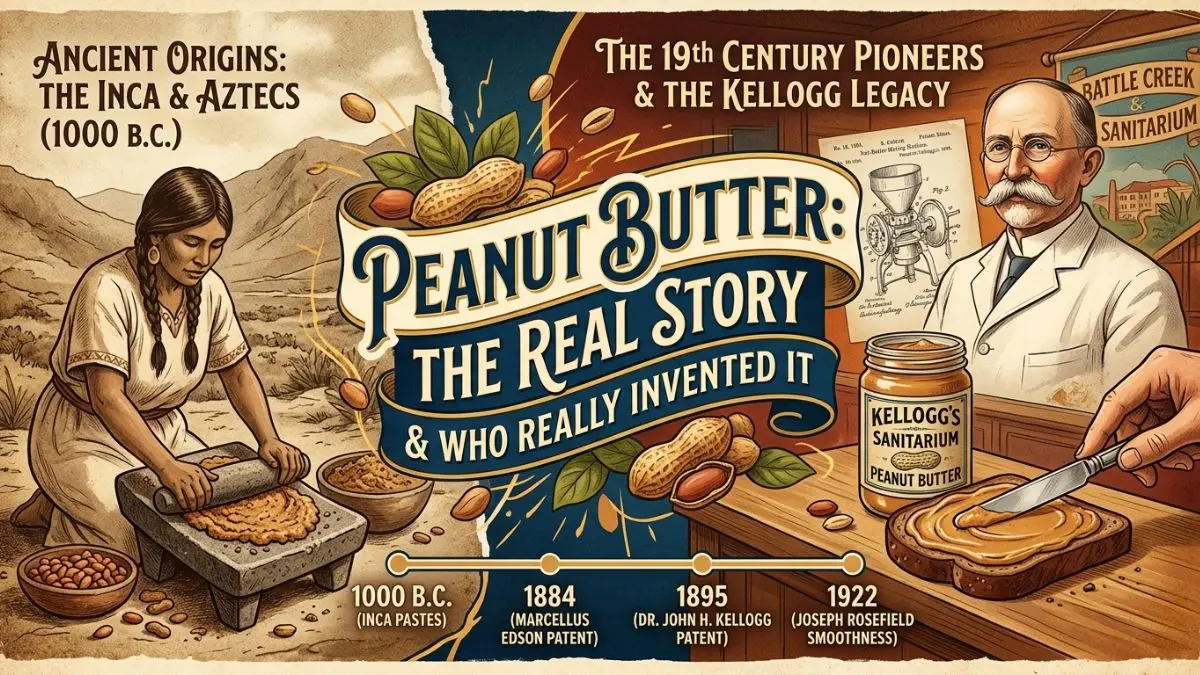
Peanuts originally came from areas that are now Peru and Brazil, where they were grown at least 3,800 years ago. Ancient people, Incas and Aztecs roasted peanuts and ground them into thick pastes. In parts of Bolivia and Peru, ground peanuts were even mixed with cocoa, creating an early version of the spread we know today.
Spanish explorers took peanuts to Europe in the 1500s, but they were not very popular there. Later, Portuguese sailors brought them to Africa, where peanuts became an important food. In North America, enslaved Africans brought peanuts with them, and the crop spread across Southern states like Georgia, Alabama, and Florida.
By the 1800s, peanuts were common, but modern peanut butter had not yet been created.
The Real Inventors of Modern Peanut Butter
Before patents were filed, there was at least one earlier story about peanut butter. Food historian Eleanor Rosakranse wrote about a New York woman named Rose Davis, who was said to be making peanut butter in the 1840s. Her son had seen women in Cuba grinding peanuts into a paste and spreading it on bread.
Although there are no official records like later patents, this story suggests that peanut paste used as a spread may have existed in North America long before it was legally registered.
Marcellus Gilmore Edson (1884)
The first modern peanut butter patent was filed by a Canadian chemist, Marcellus Gilmore Edson in 1884. He created a method of grinding roasted peanuts between heated surfaces until they formed a smooth, semi-liquid paste. When it cooled, the texture became similar to butter or lard.
He also added sweeteners and sold it as “peanut candy.”
Although Edson’s invention was an important early step, there is little evidence that he produced or sold it on a large scale. Still, he is credited with filing the first known patent for a peanut paste.
Dr. John Harvey Kellogg (1895)
Dr. John Harvey Kellogg was the first to patent a process for making peanut butter in 1895. He ran the Western Health Reform Institute (later the Battle Creek Sanitarium) in Michigan with his brother. Kellogg was a strict vegetarian and believed in plant-based foods for better health, especially for patients who had trouble chewing solid food.
In 1895, he patented a process for making peanut butter by boiling peanuts, drying them, and grinding them into a paste. The result was a soft, brown mixture he called “butter or paste.”
His work helped bring peanut butter into public attention. By 1897, his company was already selling nut butters, and by 1896 magazines were even suggesting people make peanut butter at home.
However, Kellogg’s version was quite different from today’s peanut butter. It was made from boiled peanuts, so it was mild and mushy, not the rich roasted flavor we are used to now.
George Bayle (circa 1894)
Some food historians say St. Louis entrepreneur George A. Bayle was selling peanut butter as early as 1894. It is believed the product was developed with a doctor who needed a soft protein food for patients who could not chew meat.
Bayle even marketed his product in cans, calling his company “The Originators of Peanut Butter.”
However, because he never filed a patent, he is rarely officially credited. Still, his business may have introduced peanut butter to everyday consumers before others did.
Dr. Ambrose Straub (1903)
In 1903, Dr. Ambrose Straub from St. Louis patented a machine designed specifically to make peanut butter. This invention was a major step forward because it moved peanut butter from small health institutions into large-scale commercial production.
Before this, making peanut butter was slow and difficult, often done with basic tools like mortars, pestles, or meat grinders. Straub’s machine made the process fast and efficient, allowing mass production.
One of his machines was used at the 1904 St. Louis World’s Fair, where vendor C.H. Sumner sold over $700 worth of peanut butter. This event helped introduce peanut butter to a wide American audience, alongside popular fair foods like ice cream cones, cotton candy, and Jell-O.
Must Read: Who Invented the Tea Bag? One Small Mistake that Revolutionized the World of Tea!
Joseph Lambert — The Man Who Industrialized It All
Kellogg’s influence also spread through his employee Joseph Lambert, who worked at the Battle Creek Sanitarium. He is believed to have been among the first to make Kellogg’s peanut butter recipe.
In 1896, Lambert left and started the Lambert Food Company. He built machines that could roast and grind peanuts on a large scale and sold both the peanut butter and the equipment to make it.
His innovations helped other companies produce peanut butter, allowing it to grow beyond a small health-food product and become widely available.
The Race to Market: Early Brands and the Boll Weevil Boom
The 1904 World’s Fair became peanut butter’s big public introduction, and commercial brands quickly followed. That same year, Beech-Nut became the first nationwide brand to sell peanut butter, distributing it across the U.S. until 1956. Heinz entered the market in 1909, and Ohio’s Krema Nut Company—founded by Benton Black—became the world’s oldest continuous peanut butter company, though it only sold locally due to spoilage issues in transport.
Demand grew further due to a major agricultural crisis. A boll weevil infestation destroyed cotton crops in the American South, pushing farmers to switch to peanuts. With support from George Washington Carver’s promotion of peanuts as a soil-friendly crop, production increased and peanut-based foods became more common.
In 1908, advertisements even claimed peanut butter was highly nutritious and energy-rich, helping it gain a reputation as a strong working-class food.
However, early peanut butter had a serious problem—it spoiled easily because the oil separated and turned rancid. In 1921, Joseph Rosefield solved this by using a stabilization process with partial hydrogenation, making peanut butter smooth, mixed, and shelf-stable.
Rosefield later launched the Skippy brand in the 1930s, introducing innovations like crunchy peanut butter and wide-mouth jars. Around the same time, brands like Peter Pan and Jif appeared, shaping the modern peanut butter industry.
Why Does Everyone Think George Washington Carver Invented It?
George Washington Carver was one of America’s most important agricultural scientists. He was born into slavery in Missouri around 1864. He earned a master’s degree in agriculture from Iowa State University and led the agriculture department at Booker T. Washington’s Tuskegee Institute in Alabama.
His goal was to help poor Black farmers in the South after Reconstruction. Because cotton farming had damaged the soil, he encouraged crop rotation with peanuts and sweet potatoes, which help restore soil nutrients. These crops also gave farmers a reliable source of food and income.
To make them more useful, Carver promoted hundreds of peanut-based products, including soap, paint, glue, and cooking ingredients. He did similar work with soybeans, pecans, and sweet potatoes, showing their economic potential.
He also created educational tools like the Jesup Wagon in 1906, a mobile classroom that brought agricultural training directly to rural farmers.
In 1916, he published a pamphlet titled “How to Grow the Peanut and 105 Ways of Preparing it For Human Consumption,” which included a peanut butter recipe. However, peanut butter had already been invented and patented long before his work.
Carver became so closely linked with peanuts that many people mistakenly believed he invented peanut butter. In reality, he helped promote peanuts as a valuable crop, but he did not create the product itself—and ironically, peanut butter was not one of his major inventions.
Carver’s Deepest Legacy: Sustainable Agriculture
Since his death in 1943, the importance of George Washington Carver’s work has become even clearer. Many of the ideas he promoted—such as crop rotation, organic fertilizers, and reusing food waste—are now key parts of modern sustainable farming.
Historian Mark Hersey of Mississippi State University argues that Carver’s most important contribution was his holistic view of agriculture. He linked the health of the land with the social and economic struggles of farmers, especially Black farmers in the South, long before the idea of environmental justice existed.
According to Hersey, Carver should be recognized as a major figure in the history of American conservation.
How Peanut Butter Conquered America
Several major historical events helped turn peanut butter from a niche health food into a national staple.
During World War I, meat shortages and government “Meatless Mondays” encouraged people to find alternatives, and peanut butter became a popular source of protein. By 1919, production had risen sharply to 158 million pounds per year.
The introduction of sliced bread in the late 1920s made peanut butter sandwiches easy to prepare, especially the now-famous PB&J.
During the Great Depression, peanut butter became even more important because it was cheap, filling, and did not require refrigeration.
In World War II, peanut butter was sent overseas with soldiers, while rationing at home increased its use among civilians.
Today, peanut butter is a common food in the United States. Most children eat it in sandwiches throughout their school years, and nearly 90% of American homes keep a jar in the pantry. Americans consume close to a billion pounds of peanut butter each year.
Its influence has even reached modern science and health research. During the COVID-19 pandemic, researchers used peanut butter as a simple smell test because it has a strong, familiar scent found in most homes.
Although still most popular in the U.S., peanut butter is now gaining popularity worldwide, even surpassing jam sales in the United Kingdom by 2020.
Key Milestones in Peanut Butter History
| Year | Milestone |
|---|---|
| ~1000 B.C. | Incas and Aztecs grind roasted peanuts into paste; some mixed with cocoa |
| 1840s | Rose Davis of New York reportedly making peanut butter after seeing Cuban women grind peanuts |
| 1884 | Marcellus Gilmore Edson patents peanut paste in Canada |
| ~1894 | George Bayle begins selling peanut butter commercially in St. Louis |
| 1895 | Dr. John Harvey Kellogg patents a peanut butter process in the U.S. |
| 1896 | Joseph Lambert leaves Kellogg’s sanitarium, founds Lambert Food Company with industrial grinding machines |
| 1897 | Kellogg’s Sanitas company advertises nut butters commercially; Good Housekeeping promotes homemade peanut butter |
| 1903 | Dr. Ambrose Straub patents a peanut-butter-making machine |
| 1904 | Peanut butter debuts at the St. Louis World’s Fair; Beech-Nut becomes first national peanut butter brand |
| 1906 | Carver launches the Jesup Wagon — a mobile agricultural classroom for poor farmers |
| 1908 | Loeber’s peanut butter ad claims 10 cents of peanuts equals 6x the energy of a porterhouse steak |
| 1909 | Heinz enters the peanut butter market |
| 1916 | George Washington Carver publishes his famous peanut pamphlet |
| 1921 | Joseph Rosefield patents hydrogenated, shelf-stable peanut butter; Carver dubbed “Columbus of the Soil” by Success Magazine |
| Late 1920s | Sliced bread introduced in St. Louis; PB&J becomes a childhood staple |
| 1930s | Skippy launches; crunchy peanut butter and wide-mouth jars debut |
| 1943 | George Washington Carver dies; leaves behind 300+ peanut innovations and no patents |
| 1958 | Jif launches, introducing a sweeter recipe |
| 2020 | UK peanut butter sales overtake jam sales for the first time |
Conclusion
Peanut butter was not invented by one person. Its history spans centuries and continents—from ancient peanut pastes in South America, to early patents in the 1800s, to later industrial improvements and mass production in the 1900s.
George Washington Carver’s true legacy was not inventing peanut butter, but transforming peanuts into an important crop for Southern farmers. He promoted sustainable farming methods and helped make peanuts economically valuable long before peanut butter became a household staple.
He did not invent peanut butter—but he helped create the conditions that made its popularity possible.
FAQs
Did George Washington Carver invent peanut butter?
No. Carver was an extraordinary agricultural scientist, but peanut butter already existed before his major work. Key patents were filed in 1884 and 1895 — decades before Carver became famous.
Who actually invented peanut butter?
No single inventor holds that title. Marcellus Gilmore Edson patented peanut paste in 1884, John Harvey Kellogg patented a peanut butter process in 1895, George Bayle was commercially selling it around the same time, Ambrose Straub mechanized production in 1903, and Joseph Rosefield made it shelf-stable in 1921.
When was peanut butter first made?
In some form, as early as 1000 B.C. by the Incas and Aztecs. The modern commercial version emerged in the late 1800s.
Why is Carver associated with peanut butter?
He became the most famous promoter of peanuts in American history, developing over 300 uses for the crop. Over time, people conflated his peanut advocacy with the invention of its most famous product.
What was Carver’s real contribution to peanuts?
He encouraged Southern farmers to rotate their depleted cotton fields with peanuts, boosted demand through hundreds of practical peanut innovations, and helped secure economic protections for the American peanut industry — laying the foundation for peanut butter’s eventual dominance.
Who made peanut butter shelf-stable?
Joseph Rosefield, who in 1921 applied partial hydrogenation to peanut butter, preventing oil separation and enabling national distribution. He later founded Skippy.