
When and Who Really Invented Ice Cream? A Delicious Mystery Through Time
Who Invented Ice Cream? Augustus Jackson is often called the “Father of Ice Cream” because he radically changed the way ice was made in 1832. He was an African American candy maker from Philadelphia and previously worked as a chef in the White House.
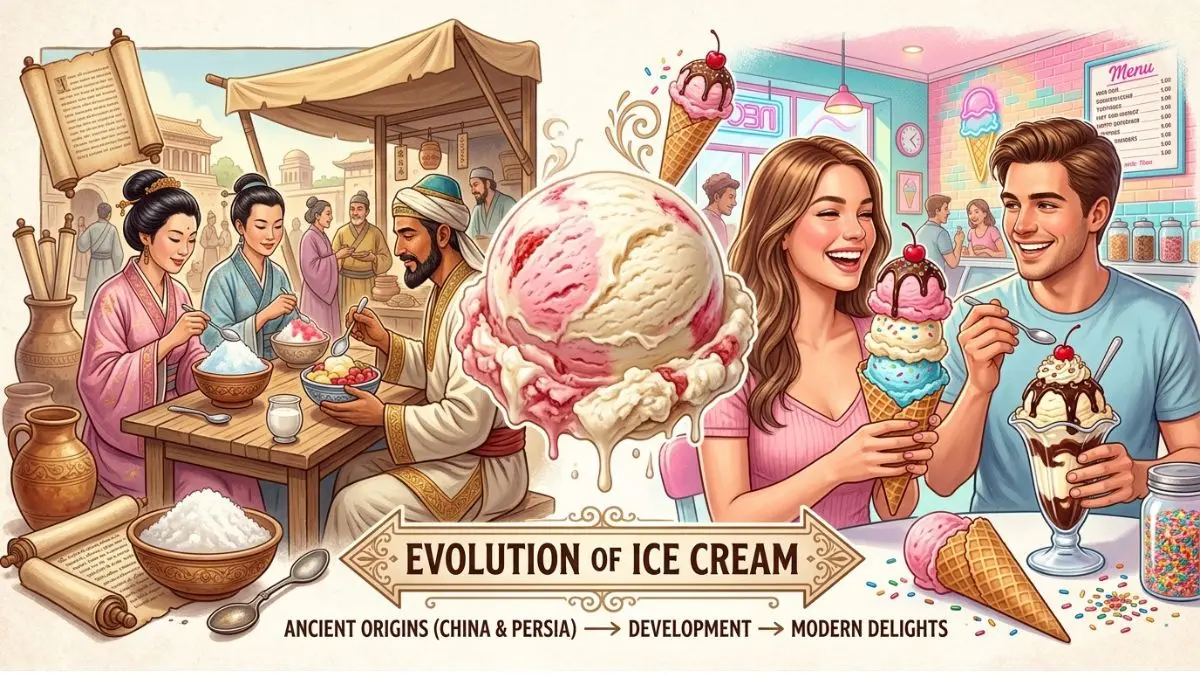
But ice cream has a long history. It wasn’t invented by a single person. It evolved over thousands of years from different countries to reach its present form. Initially, people used to eat ice with honey or fruit, but with time, milk and cream were added to it.
Ancient Beginnings: The First Frozen Treats (4000 B.C. – 400 B.C.)
Ice cream started a very long time ago, even before fridges and modern desserts existed. Around 4000 B.C., rich people in Mesopotamia (near the Euphrates River) made special ice houses to stay cool in hot summers. They also enjoyed cold, icy treats.
By 500 B.C., many civilizations were enjoying similar cool foods:
- In Ancient Greece, people ate snow mixed with honey and fruits. It was a popular and refreshing treat. Even Alexander the Great liked snow with honey during his travels.
- In Ancient Rome, Emperor Nero loved frozen desserts. He sent workers to bring snow from mountains, then mixed it with fruit juice and honey.
- In Persia (around 500 B.C.), people made an early version of ice desserts by pouring grape juice over snow. They stored ice in special underground buildings called yakhchals, so they could use it all year.
These early frozen treats were the beginning of what we now call ice cream.
The Eastern Innovations (200 B.C. – 900 A.D.)
Western countries were enjoying simple ice treats, but Eastern civilizations were creating much more advanced frozen desserts.
In China, during the Tang Dynasty (618–907 A.D.), people made an early form of ice cream. The emperor enjoyed a special mix made from buffalo milk (sometimes cow or goat milk), flour to make it thick, and camphor for flavor. First, the milk was heated and turned slightly sour like yogurt. Then it was frozen using metal containers placed in ice mixed with salt.
The Chinese royal kitchen even had many workers just to handle ice and keep these desserts cold for the emperor.
In India, the Mughal rulers enjoyed a dessert called kulfi, made from thickened milk that was frozen in molds. To make it, they even brought ice from far-away mountains using horse riders. They then mixed it with fruits, saffron, and other flavors to create rich frozen treats.
These early ideas showed how people in the past worked hard and used creative methods to enjoy cold desserts long before modern ice cream was invented.
The Game-Changer: Salt and Ice Method (1230–1500)
A major breakthrough in making ice cream came when people discovered, mixing salt with ice makes it much colder. This lowers the temperature so much that liquids can freeze properly.
This idea was started in China, but it was also used in India as early as the 4th century. Later, around 1230–1270 A.D., an Arab medical writer named Ibn Abu Usaybi recorded this method in writing.
This salty ice mixture helped create a very cold liquid (like a freezing bath). When people placed sweet mixtures inside it and kept stirring, it stopped large ice crystals from forming. This made the frozen dessert smooth and creamy.
This method spread across the Islamic world. In places like Turkey and Persia, people created popular frozen treats such as sherbet and faloodeh (a sweet frozen dessert with syrup and noodles).
This discovery made it possible to create ice cream-like desserts much more easily and consistently.
Must Read: Who Invented the Tea Bag? One Small Mistake that Revolutionized the World of Tea!
Must Read: The Accident That Changed The World: Origins and Development History of Tea
Europe Discovers Ice Cream (1500s–1600s)
The salt-and-ice method reached Europe around 1503 in Italy. At first, people thought it was just a fun chemistry trick using salt, ice, and water. But later, it became useful for making frozen desserts.
By the 1660s, chefs in cities like Naples, Florence, Paris, and Spain started making frozen drinks and desserts called sorbets (water ices). These became popular in royal banquets.
There are also many famous stories about how ice cream came to Europe, but most are not true:
- It is said Catherine de Medici brought ice cream recipes from Italy to France, but there is no real proof of this.
- Some believe Marco Polo brought ice cream from China, but historians doubt he even brought such recipes.
- Another story claims King Charles I of England loved ice cream so much he paid his chef to keep it secret, but this is also not proven.
What we do know is that real ice cream likely began in Italy in the early 1600s. By the 1620s, frozen desserts were served at parties in Italy, France, and Spain.
A big step came in 1693 when Antonio Latini published one of the first known recipes for a milk-based frozen dessert. This is often seen as the start of real modern ice cream.
French Improvements
The French made ice cream richer by adding egg yolks. This created a creamy style that became the base for modern gelato and premium ice cream. By the late 1600s, French recipes for frozen desserts became more advanced and popular.
Ice Cream in England
Ice cream reached England in the 1600s and was served at royal banquets. In 1671, it was even served at a royal feast at Windsor Castle, but only the king and special guests got to taste it. The first English recipe was published in 1718, because making ice cream was a closely guarded secret at that time.
Ice Cream Comes to America (1744–1790s)
Ice cream came to America with European settlers and quickly became a favorite treat for wealthy people.
The first known record is from 1744, when Maryland Governor William Bladen’s household served ice cream. It was one of the earliest fancy desserts in colonial America.
By this time, ice cream had already improved a lot in Europe. In the 1600s, it became more widely available. A Sicilian chef named Procope Couteau helped popularize it in Paris at the famous Café Procope, mixing milk, cream, butter, and eggs to make a richer version.
First American Advertisement
In 1777, ice cream was advertised in the New York Gazette by Philip Lenzi. The flavor mentioned was not vanilla, but orange blossom, showing early European-style tastes.
Famous Ice Cream Lovers
Some U.S. presidents also loved ice cream:
- Thomas Jefferson tried ice cream in France and loved it. He brought recipes back to America and even served ice cream at the White House. One of his recipes was a rich vanilla-style ice cream with egg yolks.
- Abraham Lincoln was also known to enjoy ice cream a lot. He reportedly spent large amounts of money on it during the Civil War.
- Dolley Madison served strawberry ice cream at a presidential inauguration in 1813.
Ice Cream as a Luxury
In the early days, ice cream was very expensive. People needed ice stored from winter, milk or cream, and a lot of effort to make it. That’s why only rich families could enjoy it until the 1800s.
The First Advertisement and Growing Availability
Philip Lenzi announced that ice cream was available “almost every day,” which was surprising because ice cream was still rare at that time.
By the late 1700s and early 1800s, ice cream became more common. More shops started selling it, and the business slowly grew.
Italian immigrants played a big role in this growth. They built ice storage houses and ran ice cream businesses in cities like Philadelphia and London.
In Philadelphia especially, many African American entrepreneurs also owned ice cream shops and became skilled ice cream makers during this period.
Ice cream was still not cheap or easy to make, but it was slowly becoming more available to ordinary people instead of only the rich.
Who Invented Ice Cream? Augustus Jackson
One important personality in ice cream history is Augustus Jackson.
He worked as a chef in the White House and also ran his own catering business in Philadelphia. Around 1832, he created new ice cream flavors and improved how ice cream was made. He also packed his ice cream mixtures in tin cans and sold them to ice cream shops in Philadelphia, which made him very successful.
He never patented his ideas, so he did not become rich from them, but many people still call him one of the “fathers of modern ice cream” because of his improvements.
The Industrial Revolution (1843–1900)
During the 1800s, ice cream changed from a luxury item into a popular everyday treat.
Around 1800, better ice houses were built, allowing ice to be stored all year. This made ice cream easier to produce.
In 1843, a simple ice cream machine was invented in both England and America. It used a wooden bucket filled with ice and salt around a metal container. A hand crank would stir the mixture, making ice cream smoother and creamier than before.
Before this, people had to stir and scrape ice cream by hand, which was slow and difficult.
First Big Ice Cream Factory
In 1851, Jacob Fussell opened the first large-scale ice cream factory in Baltimore. He realized he could earn more money by turning extra cream into ice cream instead of selling it fresh. This idea helped start the modern ice cream industry and made ice cream much cheaper for ordinary people.
Ice, Immigration, and Street Vendors
As ice became easier to transport from countries like Norway and Canada, ice cream became more common. Ice was stored in large ice houses and delivered to cities.
This growing industry brought many immigrants, especially from Italy and Switzerland, who worked in ice cream businesses.
In London, Italian workers lived in poor conditions but became well-known ice cream sellers. Large ice storage pits built by Carlo Gatti near King’s Cross are now historic sites.
On the streets, Italian vendors sold ice cream from pushcarts. People called them “hokey-pokey men” because they shouted “Ecco un poco,” meaning “Here’s a little!”
The Golden Age of American Ice Cream (1874–1904)
By the late 1800s, ice cream in America became more creative, popular, and widely available. Many new desserts and inventions appeared during this time.
New Ice Cream Treats
- In 1874, a Philadelphia pharmacist named Robert Green created the first ice cream soda, which quickly became popular in soda shops. This led to the rise of soda fountains and young workers called “soda jerks,” who served drinks and desserts.
- In the 1880s, edible ice cream cups were invented, making it easier to eat ice cream without dishes. Around the same time, milkshakes became popular. They were first seen as healthy drinks but soon became desserts.
- In 1881, the ice cream sundae was created in several American towns. The name likely came from “Sunday,” because soda was banned on Sundays in some places, so people served ice cream without soda and added toppings instead.
- In 1846, Nancy Johnson invented a hand-cranked ice cream freezer. This made it much easier for families to make ice cream at home.
Famous Ice Cream Innovators
- In England, Agnes Marshall, known as the “queen of ices,” helped spread ice cream recipes through her books. She even suggested using liquid nitrogen in 1894—long before it became common.
Ice Cream Cones and Street Vendors
- In 1903, Italian immigrant Italo Marchiony patented a machine to make ice cream cones. He originally sold ice cream from a cart in New York and wanted a better way for customers to hold it. His invention helped shape modern ice cream cones.
- In 1904, the ice cream cone became famous at the St. Louis World’s Fair. A vendor rolled a waffle into a cone shape to help an ice cream seller who had run out of dishes. This moment made cones popular across America.
By the 1920s, ice cream cones became a national favorite, with hundreds of millions eaten every year.
Frozen Treats for Everyone
- In 1923, the Popsicle was invented, making frozen treats even easier to enjoy.
- In the 1930s, companies like Dairy Queen introduced soft-serve ice cream.
- In the 1970s, frozen yogurt became popular as a lighter alternative to ice cream.
Refrigeration Changes Everything
For most of history, ice cream was hard to keep frozen. It had to be eaten quickly because people relied on natural ice, which was difficult to store and keep cold.
Everything changed in the late 1800s and early 1900s when mechanical refrigeration was invented. Using electricity and gas, machines could now keep things cold all the time. This meant ice cream could be made, stored, and transported easily throughout the year.
As technology improved, ice cream production became faster and more efficient. New inventions helped the industry grow, including:
- Steam-powered machines to help production
- Homogenizers to make ice cream smooth and creamy
- Electric motors to replace hand labor
- Packing machines for faster packaging
- Better freezing equipment for large-scale production
- Motor vehicles for quick delivery and distribution
By 1926, a continuous freezer was developed, allowing ice cream to be made on a large, nonstop scale. This was a major turning point that helped turn ice cream into a worldwide mass-produced product.
Because of these changes, ice cream became cheaper, easier to produce, and available to almost everyone—not just the rich.
The 20th Century and Beyond
Ice cream became a big part of American life in the 1900s.
During World War II, the U.S. military even competed to give soldiers the best ice cream. In 1945, they built a floating ice cream shop in the Pacific Ocean for sailors. After the war ended in 1946, Americans celebrated by eating huge amounts of ice cream—about 20 quarts per person.
As supermarkets became common, pre-packaged ice cream replaced many small ice cream parlors and soda fountains. These old-style shops slowly disappeared. However, in recent years, they have made a comeback with modern dessert shops and creative ice cream flavors.
Ice Cream Goes to Space
Ice cream even traveled into space. In 1968–1969, astronauts on the Apollo missions ate freeze-dried ice cream. It wasn’t creamy like normal ice cream, but it became a famous symbol of space travel and American innovation.
Modern Ice Cream Innovations
In the late 1900s and 2000s, new technology changed ice cream again:
- In 2006, some shops began using liquid nitrogen to make ice cream. It freezes the mixture instantly at extremely low temperatures, making it very smooth and creamy. It also creates a dramatic fog effect that looks like smoke.
- This idea was actually suggested more than 100 years earlier by Agnes Marshall, but it only became practical in modern times.
Ice Cream Statistics and Fun Facts
Today, ice cream is one of the most popular desserts in the world. Here are some easy and interesting facts:
- In the U.S., over 6.4 billion pounds of ice cream are made every year.
- The average American eats about 20 quarts per year, more than any other country.
- About 87% of people in the U.S. keep ice cream in their freezer at all times.
- Most popular flavors are:
- Vanilla (about 33% of sales)
- Chocolate (about 19% of sales)
- To make just 1 gallon of ice cream, it takes about:
- 5.8 pounds of milk
- 1 pound of cream
- It takes around 50 licks to finish a single ice cream cone.
- One dairy cow can produce enough milk in her life for about 9,000 gallons of ice cream.
- California produces the most ice cream in the U.S.
- Most ice cream is made in June, and July is National Ice Cream Month in the U.S.
Fun Records and Facts
- The record for most scoops on one cone is 125 scoops (Italy, 2018).
- The tallest ice cream cone was about 2.81 meters (9 feet) tall (Italy).
- By 1924, Americans were eating 245 million cones per year—today it’s over 1 billion cones annually.
Ice Cream Around the World
Even scientists in Antarctica enjoy ice cream! At McMurdo Station, they eat soft-serve ice cream made with special machines.
The Truth About Ice Cream’s Invention
So, who really invented ice cream?
The simple answer is: no single person invented it.
Ice cream is not the creation of one mind or one country. Instead, it slowly developed over thousands of years through many cultures and people.
It began with ancient civilizations like Mesopotamia, where people stored ice. Then came Chinese emperors who enjoyed frozen milk desserts, Persian innovators who used salt and ice to freeze drinks, and later Italian chefs who refined recipes into smoother, richer desserts. Finally, American inventors and businesses made ice cream mass-produced and affordable for everyone.
Each culture added something new—honey, fruit, milk, cream, eggs, and spices. Every improvement helped turn simple frozen snow into the creamy dessert we enjoy today.
Many famous stories, like those about Marco Polo or Catherine de Medici, are interesting—but they are mostly myths. The real history is much bigger and more fascinating, shaped by countless unknown inventors over centuries.
Ice cream is really the result of human creativity across the world, not one invention at one moment.
So every time you enjoy ice cream, you’re tasting a long journey of history, science, and imagination—built by many generations working together, even without knowing it.