
Who Invented the Ice Cube Tray? The Surprising Full History Of Ice Cube Trays
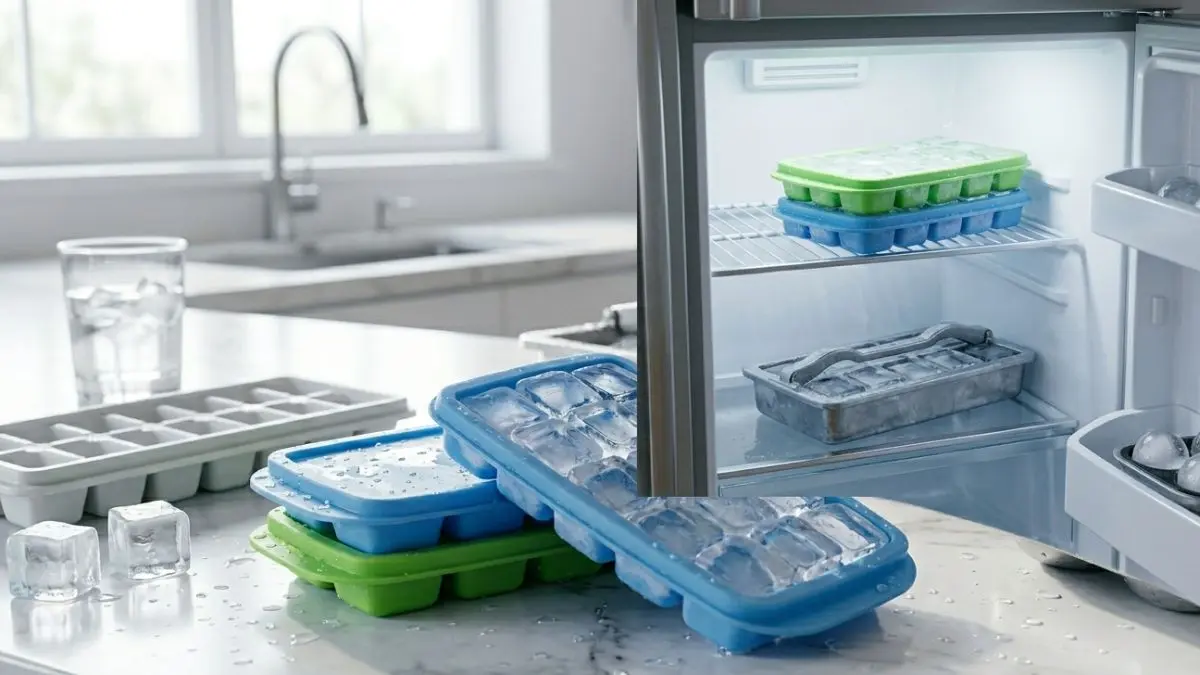
Who Invented the Ice Cube Tray? Dr. John Gorrie Started It All
Think about the last time you took ice out of the freezer. You opened the tray and cubes popped out. It took just 3 seconds. Most of us don’t even think about it. But it took nearly 200 years to perfect this simple thing. It involved old patents, fierce competition, and a smart idea from the snowy forests of Michigan.
So who invented the ice cube tray? History doesn’t give credit to just one person. It’s a story of several smart people that’s been around for years. Each person contributed a piece to this puzzle. They transformed a simple medical tool into a modern-day kitchen item.
Who Invented the Ice Cube Tray?
Dr. John Gorrie (1844) : The Visionary
The idea of ice cube trays was first introduced by Dr. John Gorrie in 1844. Dr. John Gorrie, a 30-year-old physician from South Carolina, arrived in the small town of Apalachicola, Florida, in 1833. He was treating patients suffering from yellow fever and malaria. At that time, the “miasma theory” was prevalent—that is, people believed that “dirty air” spread diseases.
Dr. John Gorrie noticed that his patients’ pain worsened in the heat. He believed that cooling the air might alleviate their pain. This idea sparked new hope, and gave birth to new hope.
To cope with Florida’s intense heat, Gorrie started experimenting with thermodynamics. In 1844, he invented a machine that lowered temperatures using compressed air. He used wooden buckets and metal containers to freeze water into blocks of ice. This was the first point where the basic concept of the “ice tray” was born.
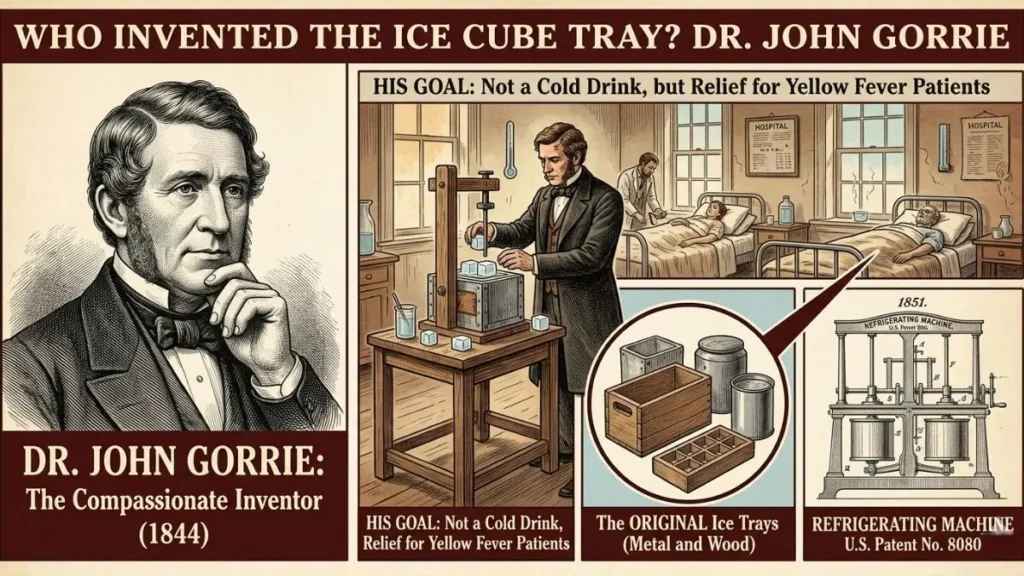
Process: The machine compressed air, heating it, and then removed the heat through water. When the air was allowed to expand rapidly, it absorbed the heat around it, cooling the environment.
Result: His original purpose was to create air conditioning, but this machine was so efficient that it turned water into ice inside metal containers.
The Birth of the “Ice Mold” and Patents
Dr. Gorrie used brick-shaped metal molds and churn-shaped vessels in his cooling machine, for making easy to freeze and dispense ice. He also experimented with lime-covered beds and plain metal basins to cool patients’ rooms.
These inventions are considered the foundation of today’s modern ice cube tray and the beginning of refrigeration. To protect his invention, he obtained two significant patents:
British Patent: August 1850.
U.S. Patent: May 1851.
Opposition to “Ice King” Frederick Tudor
The biggest obstacle to Gorrie’s progress was Frederick Tudor, known worldwide as the “Ice King.” Tudor had a large business selling natural ice and feared that Gorrie’s machine would destroy his business.
Tudor’s Campaign:
Bad Propaganda: Tudor mocked the newspapers, claiming that machine-made ice was “unnatural” and harmful to health.
Name of Religion: He claimed that ice-making was “God’s work,” and Gorrie was going against nature.
Money Block: Tudor, using his influence and influence, prevented investors from supporting Gorrie.
A Regrettable End and a Great Legacy
These intrigues and lack of money took their toll on Dr. Gorrie. He died in 1855 at the age of just 52—poor and considered a failure.
But today he is known as the “Father of Refrigeration and Air Conditioning.” Florida founded the Washington, D.C. His statue has been installed in the museum and his museum bears witness to his great inventions which made today’s modern world possible.
Fred W. Wolf (1903 – 1914): Early Trays
Fred W. Wolf Jr. is the man who took the ice cube tray out of the laboratory and made it a part of the American kitchen. Dr. John Gorrie proved that ice could be made, but Fred Wolf proved that every home could make and use it.
Fred W. Wolf Jr. was an engineer and the son of a famous refrigeration pioneer (Fred W. Wolf Sr.). His father worked on large-scale industrial refrigeration systems, but Wolf Jr.’s priority was to make the technology affordable and practical for home use.
The DOMELRE (1914)
In 1914, in Chicago, Wolf started the Mechanical Refrigerator Company and launched the DOMELRE (Domestic Electric Refrigerator).
Design: This was not a full refrigerator, but a refrigeration unit was placed on top of an existing wooden icebox.
Mechanism: It used an air-cooled compressor and sulfur dioxide, which was safer for the home than ammonia.
First Ice Tray: The DOMELRE was the first commercial home unit to include a simple metal ice cube tray.
The Idea of an “Ice Habit”
Before Wolf, people bought large ice blocks weighing 25 to 100 pounds, which were messy and melted quickly.
Cube Concept: Wolf realized that people didn’t need such large ice cubes; they just wanted cold drinks.
He introduced a small tray that created equal-sized cubes.
Standardization: This idea led to the ice tray becoming a must-have feature in every refrigerator.
Expensive Luxury
The DOMELRE was a brilliant invention, but very expensive.
Price: In 1914, it cost approximately $900.
Today’s Price: In 2026, it would be approximately $27,000.
Result: Only the wealthy could afford, it became a status symbol. His Company in Chicago produced an estimated several hundred to a few thousand units total between 1914 and ~1916.
Business Failure and General Motors
Wolf was a great engineer, but not very strong in business.
In 1916 Wolf sold the rights to Henry Joy (Packard Motor Car Company), who rebranded it as the ISKO and continued limited production in Detroit. They sold roughly another ~1,000 units before the company went bankrupt in 1922.
Later, William C. Durant (founder of General Motors) purchased the business. This led to the creation of the Frigidaire brand. GM brought Wolf’s ideas to the general public through mass production.
Note: If Gorrie taught how to make ice, Fred Wolf turned every home into its own ice factory.
Lloyd Groff Copeman (1928) Found the Rubber Fix
Lloyd Groff Copeman was collecting maple sap from his family’s sugar bush on a cold February day in 1928, in the snowy woods of Metamora, Michigan. He was wearing rubber boots to keep his feet dry. As snow and water accumulated on his boots, he noticed something strange: the snow and snow weren’t sticking to his boots.
When he pressed one boot against the other, the frozen slush simply cracked and popped right off.
He sat down in the snow, fascinated. Ice refused to adhere to rubber. At home, people were still struggling with the rigid metal ice trays that had been standard since the DOMELRE introduced the first commercial metal tray in 1914.
Getting ice out of metal trays often required holding them under hot water or hitting them hard, which sometimes caused the ice to break or even hurt your hands. Copeman quickly realized that this problem could be solved with a flexible rubber tray. Simply twist or bend the tray, and the ice would easily come out.
From Idea to Invention: Back home, Copeman immediately began experimenting, using rubber cups from his laboratory. He realized the idea worked perfectly.
The next morning, he excitedly wired his patent lawyer and asked him to prepare applications for three designs:
A completely flexible rubber tray
A metal tray with rubber separators
A metal tray with separate removable rubber cube cups
The commercial version that later became popular was a flexible all-rubber tray (or trays with rubber compartments) that could be twisted to easily extract perfect ice cubes without the need for tools or melting.
In 1912, he founded the Copeman Electric Stove Company, which was later acquired by Westinghouse. He held over 650–700 patents throughout his life.
He married Hazel Dawn Berger in 1904, and they had three children. Hazel was also an inventor. She came up with the idea for the automatic “flip-flop” toaster and helped build a prototype using hairpins. Her name appears on the 1914 toaster patent. (Copeman was also the maternal grandfather of the famous singer Linda Ronstadt.)
Making It Big: In 1929, Copeman received important patents for “sharp freezing containers,” including U.S. Patent No. 1,777,483 and related reissues (such as RE17,278).
He licensed these rights to General Motors, who used the flexible rubber ice trays in their famous Frigidaire refrigerators.
This invention was very successful. It earned Copeman approximately $500,000 to $1 million in royalties (according to different sources), which translates to approximately $9–18 million today.
After this success, Copeman began to live a comfortable life and lived in a large estate. He continued inventing until 1956, but his most famous legacy remained the rubber ice cube tray.
Guy L. Tinkham (1933) and the Metal McCord Tray
Before Guy L. Tinkham’s 1933 invention, rubber trays had already been on the market and were flexible, but they had two major issues:
Bad Taste: Old rubber would leach a bad sulfur flavor into ice, which would spoil the taste of water or beverages.
Durability: Rubber would thin and weaken over time, and break.
Guy L. Tinkham and McCord Tray (1933)
Guy L. Tinkham, who worked at General Utilities Manufacturing Company, wanted to create a tray that had the strength of steel but the flexibility of rubber.
5-Degree Draft (The Science of Pressure)
Instead of keeping the walls of the tray perfectly vertical, Tinkham gave them a 5-degree slant on both sides.
How it worked: When ice accumulates, it expands. Ice would expand in straight walls, but because of the 5-degree slant, when you flexed the tray, the slant exerted “upward pressure” on the ice. This pressure caused the ice cubes to slide upward and out.
- The “Flex and Crack” Action
Taking advantage of the flexibility of stainless steel, Tinkham divided the ice-removal process into two parts:
The Crack: Twisting the tray caused the ice to break away from the points where the compartments were formed.
The Force: The same twist and a 5-degree angle pushed the ice free from the metal grip and out.
Patent No. 1,894,897: This ingenious invention of his received a US patent in 1933.
The Pioneer of “Twist-to-Crack”
The McCord Tray made ice extraction incredibly cheap and easy:
Cheap Price: This tray was available for just 50 cents, making it within the reach of the average person.
Industry Impact
This invention introduced the “twist-to-crack” habit to kitchens around the world. Tinkham proved that a small engineering change (a 5-degree slant) could solve a daily life problem. This is why the McCord tray is still considered a revolution in ice freezing methods.
1940s–1950s: The Age of Aluminum
After the McCord tray, aluminum became the preferred material for ice trays because it was light, inexpensive, and cooled quickly.
Jiffy Cube (Plastic)
Sometimes you only need one cube. Standard Products Company created the Jiffy Cube. It consisted of a rigid aluminum frame into which individual plastic cups fitted. Its advantage was that you could remove just one cube without having to “crack” the entire tray.
1949: GE Redi-Cube (The Famous Lever)
The most famous design was created by Edward H. Roberts, who worked at General Electric (GE). He didn’t like twisting cold metal trays with his hands.
The Invention: In 1949, he received a patent for the lever-action tray (US Patent No. 2,622,410).
How it worked: There was a large lever in the center of the tray. When you pulled up on the lever, it would move a metal grid (channels) inside the tray.
The Sound: When the ice broke, it made a loud “squeaky crack” sound, which became a hallmark of cocktail parties. Roberts also designed the diamond-shaped cubes.
Magic Touch Presto (General Motors)
To compete with GE, Arthur J. Frei of General Motors (Frigidaire) invented the Magic Touch Presto.
The difference: Its grid not only moved but also scraped the bottom of the tray. This allowed the ice to flow completely out, leaving no lumps trapped inside.
1978: Ice Cube Bags (The Party Hack)
By the 1970s, cheap plastic trays had supplanted metal. But Erling Vangedal-Nielsen, a Danish inventor, found a new way.
When he ran out of ice at a party, he collected water in ordinary plastic bags and tore them apart. This gave him the idea for single-use ice cube bags.
Benefit: These bags were free of spills, and the ice didn’t have the unpleasant smell of the freezer.
From 2007 to Today: The Silicone Shift
Although the first automatic ice maker (Servel Electrolux) was installed in main refrigerators in 1953, but the “Special drinks” craze came in the 2000s and ice trays were again in use and popular.
Tovolo and the Perfect Cube (2007)
In 2004, Matthew Frank launched the Tovolo brand and in 2007 launched the “Perfect Cube” mold, made from food-grade silicone.
Benefits of silicone: It’s as flexible as rubber but has no odor or off-taste. It’s very long-lasting and doesn’t spoil.
Today’s trends: These same silicone molds are still used to make large spheres and clear cubes for whiskey, which are very popular in bars and homes.
FAQs
Who invented the ice cube tray?
No one person did it alone. Dr. John Gorrie made cooling pans in 1844. Fred Wolf sold a tray with a fridge in 1914. Lloyd Copeman made the first rubber tray in 1928. Guy Tinkham made the flex-metal tray in 1933.
What was the McCord Ice Tray?
Guy Tinkham patented it in 1933. It was a stainless steel tray with a 5-degree slant. The slant stopped ice from sticking tightly. You could just twist it to pop the ice out. It cost 50 cents.
What was the GE Redi-Cube?
Edward H. Roberts invented this in 1949. It was the famous aluminum tray with a big lever. Pulling the lever popped the ice out with a loud squeak and crack.
Is Lloyd Copeman related to Linda Ronstadt?
Yes. Lloyd Copeman, who invented the rubber ice tray and an electric stove, is the grandfather of the famous singer Linda Ronstadt.
Why did people switch from Aluminum to Plastic and Silicone?
Metal trays bent out of shape and cost too much to make. Plastic was cheap and light, but it cracked. Silicone is the best right now. It lasts forever, does not trap smells, and makes fun shapes.
Conclusion
The journey from Dr. John Gorrie’s 1844 machine to today’s silicone molds is a best example of human ingenuity. Ice, once an expensive “medical tool” or luxury item, has now become a cost-effective staple in every kitchen. Thanks to the all inventors. This coolness reveals centuries of hard work and great minds.
Old Memories: Do you remember those aluminum trays from your childhood and the “crack” sound of their levers?
Best Way: What do you prefer for freezing ice—old metal trays, modern automatic ice makers, or new silicone molds?
Fair Facts: What surprised you most about this method—Dr. Gorrie’s inanity or the $27,000 price tag of a 1914 refrigerator?
The Taste Test: Have you ever noticed the strange smell of freezer ice in your ice?
Tell us in the comments, will you thank Dr. Gorrie or Fred Wolf next time you open your freezer?”