
Invention of the First Mirror: The Surprising History of Mirrors From Water to Modern Glass
Who Invented the Mirror? The modern mirror was made possible by Justus von Liebig, a German chemist, in 1835.
We stand in front of a mirror daily and look at ourselves, but have you ever wondered what the world was like before mirrors? Humans have always tried to see their reflection.
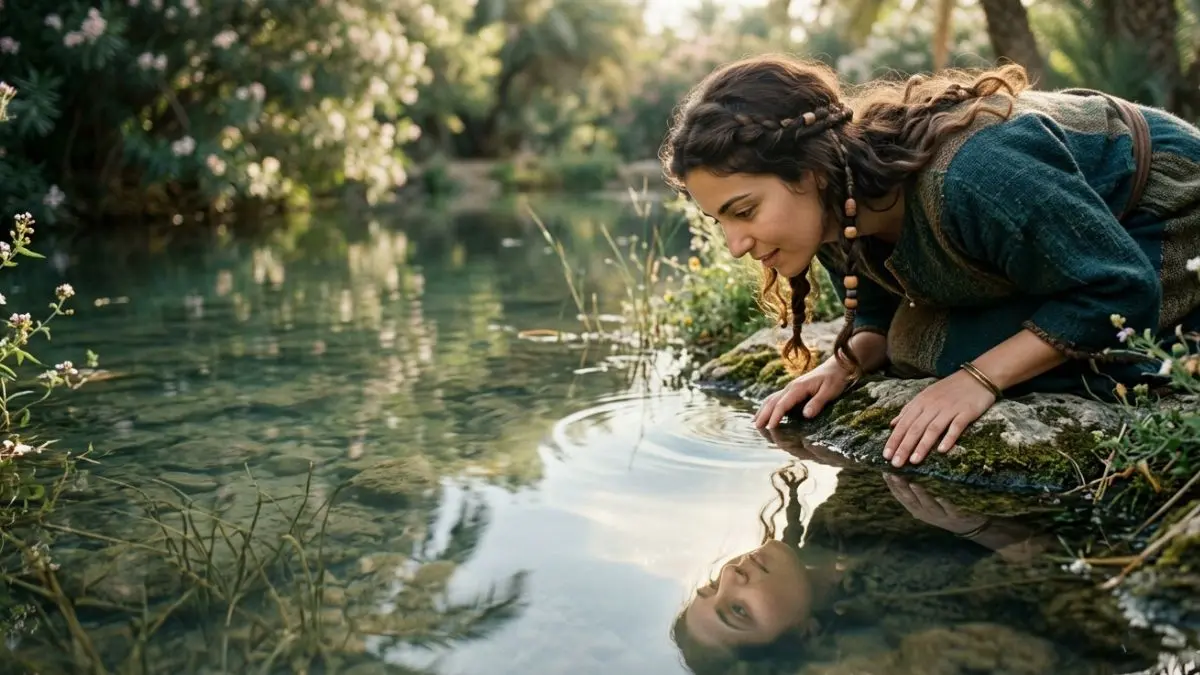
Mirror is one of the oldest inventions in the world, but the modern mirrors we see in our homes today were not like this earlier. In the beginning, humans had only one way to see their faces: clean, still water. People used to sit on the banks of ponds and rivers to see their reflections. However, it wasn’t possible to carry water everywhere, so artificial mirrors became necessary.
What Is a Mirror, Exactly?
Before learning about the history of mirrors, it is helpful to understand what a mirror really is. A mirror is any surface that is smooth and shiny enough to show a clear image of whatever is in front of it.
A mirror can be made from different materials such as still water, polished stone, metal, or glass with a shiny metal coating on the back. The basic science is simple: light hits the smooth surface and bounces back, allowing you to see a reflection of the object or person standing in front of it.
Even though the science is simple, mirrors have had a much deeper meaning in human life. They have been important in culture, art, beauty, and even psychology for thousands of years.
The word mirror comes from the old French word mirour, which came from the Latin word mirari, meaning to admire or feel wonder. The Romans also used the word speculum, which came from another Latin word meaning to look or observe. That is why modern English words like inspect, speculate, and spectacular are also connected to the idea of seeing or looking.
Who Invented the Mirror: Full History of Mirror
Long before humans made tools or pottery, our ancestors already had mirrors — still water. Calm ponds, pools, puddles, and quiet rivers acted like natural mirrors. When people leaned over the water, they could see their own reflection looking back at them. According to Jay Enoch, writing in Optometry and Vision Science in 2006, quiet pools of water were almost certainly the first mirrors ever available to humans.
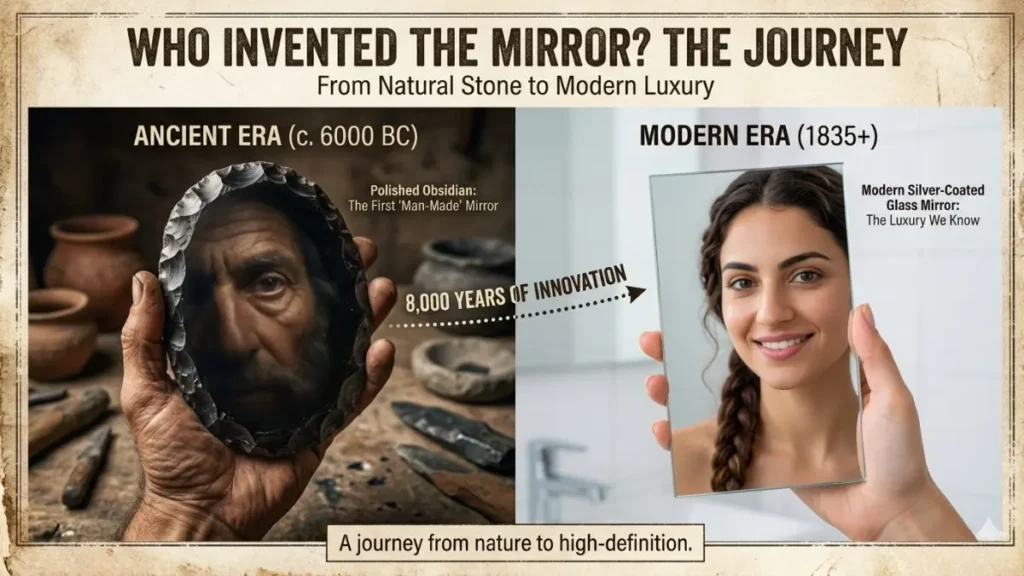
Obsidian: The First Man-Made Mirror, circa 6200 BCE
The oldest man-made mirrors ever found were discovered at Çatalhöyük, one of the world’s earliest cities, near modern-day Konya in Turkey. These mirrors date back to around 6200 to 6000 BCE.
They were made from obsidian, a black volcanic glass formed when lava cools very quickly. People carefully polished small pieces of obsidian until the surface became smooth and shiny enough to reflect a face, though the image was dark and not very clear.
These mirrors were small enough to fit in the hand. For that time, they were an amazing achievement and showed great skill. People may have used them for grooming, but archaeologists also believe they had spiritual or religious importance.
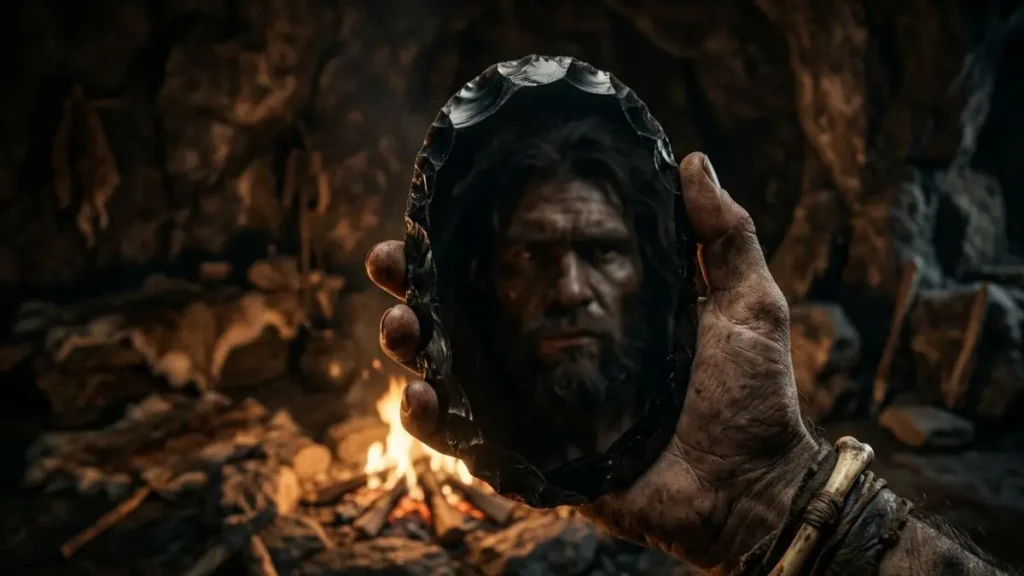
Some experts think these mirrors were used for divination, meaning people may have looked into them to seek signs or predict the future. Others believe they were placed in graves as sacred objects to accompany the dead into the afterlife.
Obsidian was chosen for a reason. In many ancient cultures, it was seen as a mysterious stone connected to hidden powers, visions, and the spirit world.
In ancient Mesoamerica, the Aztec god Tezcatlipoca was known as “Smoking Mirror.” He was often linked with an obsidian mirror and was believed to use it to see all of creation and look into the hearts of people.
Some stories say that when Emperor Moctezuma II first heard about the arrival of Spanish conquerors, he used obsidian mirrors to seek answers about these mysterious strangers.
Centuries later, in 16th-century England, John Dee, an adviser to Elizabeth I, used an obsidian mirror he called a “shew-stone” for scrying, or trying to receive visions. That mirror is still kept today in the British Museum.
People in Central and South America also made polished stone mirrors on their own. Early craftsmen in China later developed similar ideas as well.
This makes obsidian mirrors one of history’s best examples of parallel invention — different cultures, separated by oceans, coming up with the same idea independently.
The Age of Metal Mirrors: Copper, Bronze, and Gold, circa 4000 to 500 BCE
When humans learned metalworking, mirrors entered a new era. Polished copper mirrors appeared in ancient Mesopotamia and Egypt around 4000 BCE. These mirrors gave clearer reflections than obsidian mirrors.
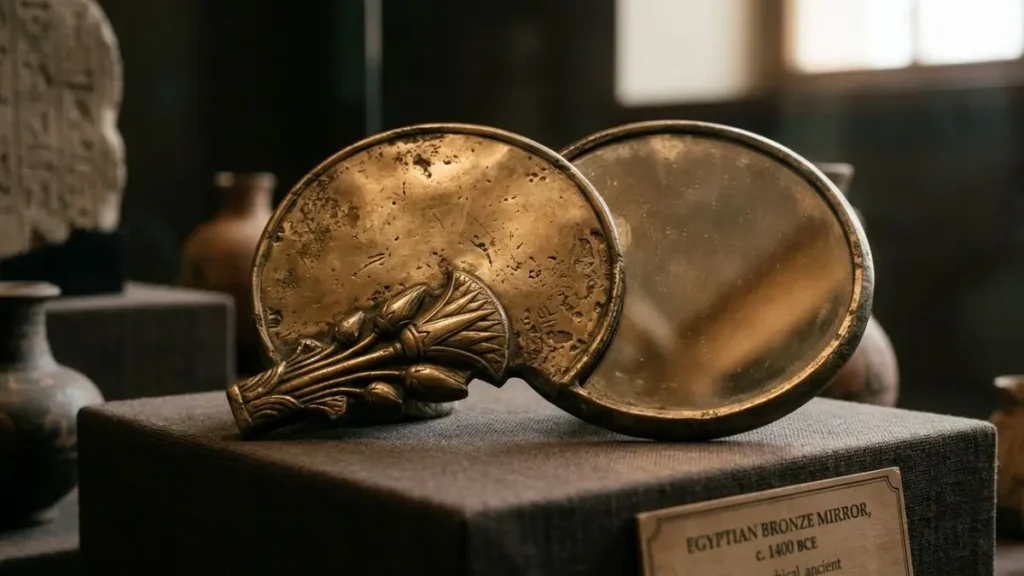
By 3000 BCE, Egyptians began making mirrors from polished bronze, a mixture of copper and tin. Many were shaped as round discs like the sun, honoring the sun god Re. Their handles were often made from wood, metal, or ivory and sometimes carved in the shape of the goddess Hathor or papyrus plants.
These mirrors were not only used for beauty and grooming. Egyptians placed them in tombs and temples because they believed they were sacred enough to accompany the dead into the afterlife.
Mirrors Across Ancient Civilizations
Metal mirrors spread across many cultures.
In ancient Sumer, a noblewoman called the Lady of Uruk reportedly owned a mirror made of pure gold around 2000 BCE.
In ancient China, records from 673 BCE mention a queen wearing a mirror at her waist, showing mirrors were already common.
In ancient India, copper and bronze mirrors appear in Sanskrit texts and were called adarshah.
In Persia, Darius the Great is said to have decorated his throne room with mirrors to reflect royal splendor.
Greek and Roman Mirrors
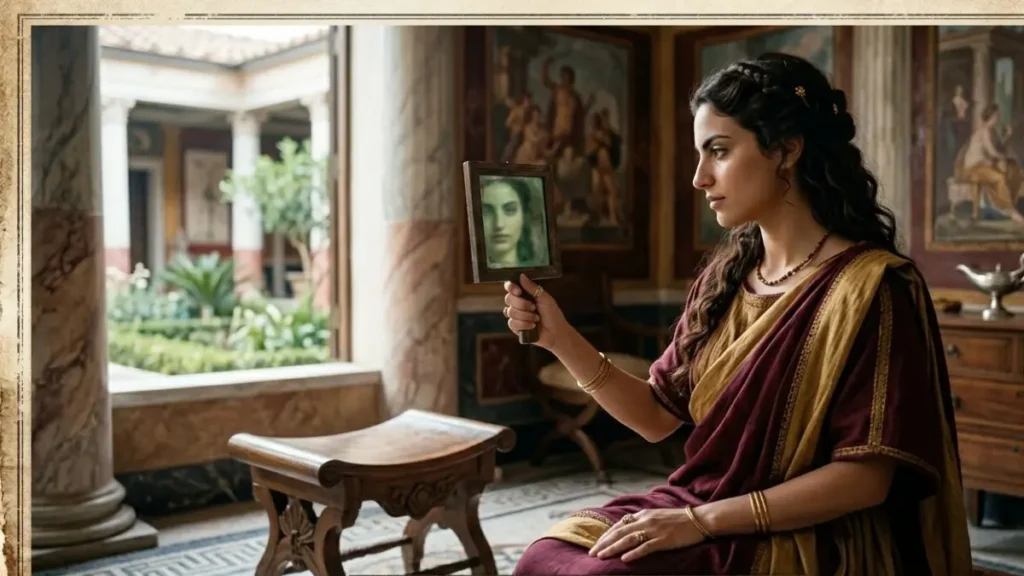
In ancient Greece and Rome, mirrors became more advanced.
By the time of Seneca the Younger in the 1st century CE, some mirrors were large enough to show a full-body reflection.
Many were still small, round hand mirrors with handles or protective covers. Some even worked like the world’s first compact mirrors.
They were often decorated with images of gods like: Pan, Eros, and Aphrodite
Some silver and gold mirrors were so expensive they were considered luxury treasures.
Sacred Mirrors in Japan
Around 300 CE, bronze mirrors reached Japan from China, but they became much more than decoration.
In Shinto belief, the sun goddess Amaterasu gave a sacred mirror to her grandson. That mirror, called Yata no Kagami, remains one of Japan’s imperial treasures.
Mirrors were placed in shrines to connect with the gods. Many people also hung mirrors at home entrances to protect against evil spirits.
Archimedes and the Burning Mirrors Legend
One famous story connects mirrors to warfare.
According to legend, Archimedes used polished bronze shields like mirrors during the Siege of Syracuse around 212 BCE. Soldiers supposedly reflected sunlight onto Roman ships and set them on fire.
Historians still debate whether it truly happened. But the story shows ancient people understood that mirrors could be powerful tools, not just objects for reflection.
The First Glass Mirror: Sidon, circa 400 BCE
One of the biggest breakthroughs in mirror history happened about 2,400 years ago near Sidon in present-day Lebanon. This is where the first glass mirrors were created.
Phoenician craftsmen, who were skilled in glassmaking, developed a clever method. They blew molten glass into a thin bubble and poured hot lead inside while the glass was still warm. The lead coated the inner surface and made it reflective.
After the glass cooled, it was broken into curved pieces. Each piece worked as a small mirror.
These mirrors gave clearer reflections than polished bronze mirrors, although the images were curved and sometimes distorted, much like funhouse mirrors today. The glass was often bubbly or colored because people had not yet learned how to make perfectly clear glass.
Even with these flaws, this was a revolutionary invention.
The Phoenicians were famous traders, and their trade routes spread across the Mediterranean, from Lebanon to Spain. Because of this, the new mirror technology spread quickly.
By the 1st century CE, Pliny the Elder wrote about glass mirrors in his work Naturalis Historia, although they were still rare and not common in ordinary homes.
Archaeologists have even found small glass mirrors from the 3rd century CE. Many were convex, meaning they curved outward, and were attached to metal backing.
Their reflections were often dim and dark. This may be why Paul the Apostle wrote the famous line, “For now we see through a glass, darkly.”
The first glass mirror was not perfect, but it changed the history of reflection forever. It was the beginning of the mirror as we know it today.
The Dark Ages of the Mirror: 500 to 1200 CE
After the fall of the Western Roman Empire in the 5th century, many advanced crafts in Europe declined, including mirror-making. Trade routes collapsed, glassmaking knowledge was lost in many places, and luxury goods became harder to produce.
For a time, progress in mirror-making slowed greatly in Europe.
But innovation continued in the East, especially in China.
Around 500 CE, craftsmen began experimenting with a new method. They used a mixture of silver and mercury on the back of glass to create brighter and more reflective mirrors.
This was a major improvement. These mirrors were much clearer than earlier ones.
Mercury worked well because it is a liquid metal and could bond with silver to form a shiny reflective coating.
But this method had a hidden danger.
Mercury is highly poisonous. People did not know this at the time. Mirror makers breathed mercury fumes for years while making mirrors.
Many suffered from shaking hands, memory problems, illness, and even death, without understanding the cause.
For centuries, mirror-makers and their families lived with mercury poisoning.
A similar problem later happened to hat makers who used mercury in their trade, which gave rise to the saying “mad as a hatter.”
Mirror-makers suffered much the same way.
Even though mercury mirrors were a big technological step forward, they came at a heavy human cost.
It would take more than a thousand years before a safer mirror-making method replaced this dangerous process.
Venice and the Mirror Monopoly: 1200 to 1665 CE
By the 12th century, mirror-making began improving again in Europe. In 1373, the first recorded guild of mirror makers was formed in Nuremberg. Soon after, another important center rose in Venice.
Venice soon become the world leader in mirrors.
Murano and the Secret of Venetian Mirrors
In 1291, Venice moved its glassmakers to the island of Murano. Officially, this was to reduce fire risks from hot furnaces, but it also helped keep glassmaking secrets protected.
On Murano, craftsmen perfected large flat glass mirrors backed with a tin-mercury coating. These mirrors were clearer, larger, and more beautiful than any others in the world.
Many were placed in elaborate gold frames and became luxury treasures.
A Powerful Trade Secret
Mirror-making brought huge wealth to Venice. For more than 150 years, Venetian mirrors dominated Europe.
The techniques were guarded as state secrets.
Master glassmakers enjoyed special privileges and could even marry into noble families. But they also lived under strict control.
If a craftsman left Venice, his family could be held hostage. Those who shared secrets risked severe punishment, even death.
Some accounts say the powerful Council of Ten even sent agents to hunt down runaway glassmakers.
Mirrors Worth More Than Land
Venetian mirrors were so expensive they were owned mostly by royalty and nobles.
A French aristocrat, the Countess de Fiesque, is said to have traded farmland for a single mirror because she thought its beauty was worth more than land.
For many noblewomen, a Venetian mirror may have been their most valuable possession.
The Precious “Looking Glass”
At the same time, some wealthy collectors bought mirrors made from polished rock crystal, a clear quartz gemstone.
Francis I of Mantua even installed such mirrors in the Castle of San Giorgio.
During this period, the term “looking glass” became popular, often referring to these expensive wall mirrors and distinguishing them from smaller hand-held mirrors.
The mirror had now become more than a tool — it was a luxury, a symbol of status, and one of Europe’s most guarded technologies.
Louis XIV and the Hall of Mirrors (1665–1800)
Venice did not keep its mirror monopoly forever. In 1665, Louis XIV and his finance minister Jean-Baptiste Colbert decided France should make its own luxury mirrors instead of buying expensive Venetian ones.
Colbert secretly brought twenty Venetian glassmakers to France. Venice was furious and tried to stop them, but the plan worked.
France Enters the Mirror Trade
France created the royal mirror company Saint-Gobain, originally called the Manufacture Royale des Glaces de Miroirs. It began producing high-quality mirrors in France and broke Venice’s long control of the mirror trade.
Remarkably, Saint-Gobain still exists today.
The Hall of Mirrors at Versailles
The greatest symbol of this new French mirror power came in 1678 at the Palace of Versailles. Architect Jules Hardouin-Mansart built the famous Hall of Mirrors. It was about 73 meters long and contained 357 mirrors facing 17 large windows.
The mirrors reflected sunlight from the gardens and filled the hall with extraordinary brightness.
Visitors were amazed by its beauty. It became one of the most famous rooms in the world and showed how mirrors could transform architecture. The Hall of Mirrors remains one of Europe’s greatest artistic achievements.
Mirrors Become Fashion and Art
During the 18th century, mirrors became important decorative objects across Europe. Famous English designers created elegant mirror styles:
- Thomas Chippendale made richly carved frames.
- George Hepplewhite became known for oval mirrors.
- Thomas Sheraton created stylish convex mirrors.
- Scottish architect Robert Adam also designed beautiful looking glasses.
Mirrors were no longer only practical objects. They had become symbols of elegance, wealth, and interior design.
Even in the young United States, imported looking glasses were expensive treasures and often listed in wills among a family’s most prized possessions.
The Modern Mirror Is Born: Justus von Liebig, 1835
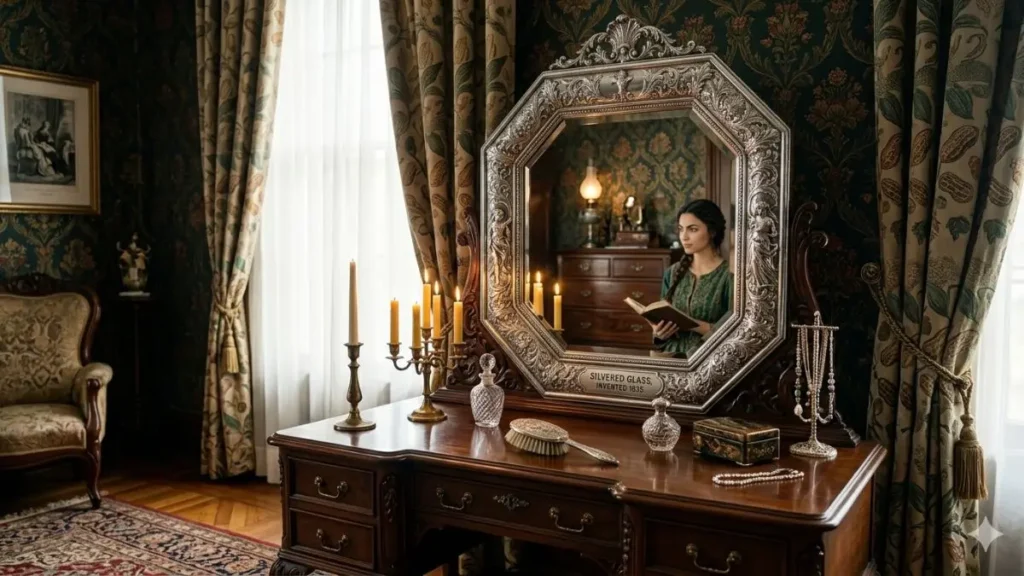
The mirrors we use today in bathrooms, bedrooms, and hallways exist because of a major scientific breakthrough in 1835. It was made by a German chemist named Justus von Liebig.
Von Liebig discovered a simple and reliable method to coat glass with a very thin layer of silver. This process was called silvering. He used a controlled chemical reaction to place an even layer of metal on one side of a glass sheet.
This created mirrors that were:
- clear
- flat
- bright
- and free from distortion
For the first time, mirrors could be made in large sizes at a low cost. Ordinary people could finally afford them.
Ending Dangerous Methods
This new method was also very important for safety. Before this, many mirrors were made using mercury-based coatings. Mercury is highly poisonous, and long-term exposure made many workers sick. Von Liebig’s method removed this danger and made mirror production much safer.
How Mirrors Evolved Over Time
The silvering process was the final step in a long journey of mirror development:
obsidian → copper → bronze → glass and lead → mercury coating → silver coating
Each stage made mirrors clearer and more advanced than before.
Modern Mirror Technology
Today, mirrors are made using even more advanced methods. Instead of mercury or simple silvering, manufacturers often use:
- silver
- aluminium
- chrome
These metals are applied using vacuum sputtering, a modern industrial process that creates very smooth and precise reflective surfaces.
A Lasting Legacy
Justus von Liebig is also known for other inventions, such as fertilizers and the bouillon cube. But his mirror-making process is one of his most important contributions. It made mirrors cheap, safe, and widely available — and shaped how billions of people see themselves every day.
Mirror Technology in the Modern Era
Modern mirrors are far more advanced than early simple glass mirrors. Today, they are used in science, technology, medicine, energy, and daily life in many different ways.
Advanced Types of Mirrors
Modern technology has created special kinds of mirrors:
First-surface mirrors have their reflective coating on the front of the glass. This removes double or “ghost” reflections. They are used in telescopes, cameras, and precision instruments.
Two-way mirrors reflect light on one side but allow visibility from the other side. They are commonly used in security rooms, police interrogation rooms, and magic shows.
Smart mirrors combine reflection with digital technology. They may include LED screens, touch controls, and sensors. These are now used in modern homes and high-end stores.
Mirrors in Astronomy
Mirrors play a major role in space science.
Isaac Newton invented the reflecting telescope in 1668. Instead of lenses, he used curved mirrors to collect and focus light. This solved problems like image distortion and made larger telescopes possible.
Modern astronomy still depends on mirrors:
- Hubble Space Telescope
- James Webb Space Telescope with its large gold-coated mirror
- European Extremely Large Telescope with a 39-meter mirror
These instruments help scientists study distant galaxies and the universe itself. Modern astronomy is deeply connected to mirror technology.
Mirrors and Solar Energy
Mirrors are also used to produce clean energy.
Large solar power plants use curved mirrors called heliostats or parabolic mirrors. These mirrors focus sunlight onto a central point, creating heat that produces electricity.
One example is the Ivanpah Solar Electric Generating System in the Mojave Desert, which uses over 170,000 mirrors.
This idea is similar to the ancient legend of Archimedes using sunlight as a weapon, but today it is used for clean energy instead of destruction.
Mirrors in Medicine
Mirrors are also used in healthcare.
Mirror therapy, developed in the 1990s by neuroscientist V. S. Ramachandran, helps treat phantom limb pain in amputees.
In this method, a mirror is placed so the reflection of a healthy limb looks like the missing one. This can trick the brain and reduce pain.
Everyday Uses of Mirrors
Mirrors are part of daily life in many ways:
- Dentists use small mirrors to see inside the mouth
- Cars use rear-view and side mirrors for safety
- Shops use mirrors to improve customer experience and increase sales
A Huge Global Industry
Today, mirrors are a major global industry worth billions of dollars. They are used in buildings, vehicles, science labs, hospitals, and renewable energy systems.
From simple reflection to advanced technology, mirrors have become one of the most important tools in modern life.
Missing Chapter: Mirrors, Selfies, and the Psychology of Self-Image
One part of mirror history that is often not discussed is how mirrors affect human psychology and self-image. Mirrors do not only show our face — they also influence how we think and feel about ourselves.
For most of human history, people had very limited access to clear reflections. In medieval Europe, a poor person might never see a sharp image of their own face in their entire life. Only wealthy people had good metal mirrors, and even clearer glass mirrors were extremely rare and expensive.
So, for thousands of years, seeing yourself clearly was a luxury for a small elite group. This changed in the 19th century when silver-coated glass mirrors became widely available. From that time, ordinary people could see their own face in detail for the first time.
This change was not only technological — it was also psychological. It affected how people understood their identity, appearance, and self-worth. It also increased self-awareness and comparison with others, and these effects are still present today.
Mirrors in the Age of Smartphones
In modern times, smartphones have taken this even further. The front-facing camera works like a digital mirror. It can capture, store, and share our reflection instantly. This has led to selfie culture, where self-image and appearance play a major role in daily life, especially for younger generations.
Studies suggest that too much focus on mirrors and selfies can increase self-consciousness and social comparison. In some cases, it may even contribute to body image problems like body dysmorphia.
Interestingly, the same mirror that once fascinated ancient civilizations and frightened some isolated tribes is now inside almost every pocket in the world.
Fear of Mirrors and Psychological Effects
Not everyone is comfortable with mirrors. A small number of people suffer from a condition called eisoptrophobia, which is an intense fear of mirrors or seeing one’s own reflection.
Psychologists have also studied other related conditions, such as body dysmorphic disorder, anxiety, and eating disorders, where mirrors can sometimes worsen symptoms.
This shows that mirrors are not emotionally neutral objects. They can affect people in deep and complex ways.
Mirrors in Culture and Belief
In many cultures, mirrors are also believed to have spiritual or energetic effects.
In traditional Chinese feng shui, mirrors are used to influence the flow of energy in a home. They are carefully placed and never positioned directly facing the front door or bed. It is believed that improper placement can disturb harmony or sleep.
Whether or not people believe in these ideas, they show an important truth: across history, mirrors have always been seen as more than simple objects. They are powerful symbols that influence how humans experience themselves and their surroundings.
Superstition, Myth, and the Supernatural Mirror
Every culture that has used mirrors, people have believed they hold supernatural power. This is not surprising, because a mirror shows a strange version of reality — a world that looks exactly like ours but is reversed. It shows your face, but in a way that feels slightly different and unfamiliar.
Ancient Beliefs and Superstitions
In ancient Rome, people believed that life renewed itself in cycles of seven years. This idea led to a famous superstition that still exists today: breaking a mirror brings seven years of bad luck.
Romans also believed that mirrors could capture a person’s soul. So if a mirror broke, it was thought that the soul inside it was also broken and needed time to heal.
Mirrors and Death Rituals
In some Jewish mourning traditions, mirrors are covered in a home when someone dies. This practice, known as aninut, is done to show respect for the dead and to prevent the soul from becoming trapped in reflections. This tradition is still followed in some communities today.
Mirrors as Magical Objects
Many cultures believed mirrors were not just objects, but gateways to other worlds.
Some Chinese folklore spoke of mirror spirits or demons that could come out at night if mirrors were left uncovered. In Europe, there was a belief that vampires had no reflection because they had no soul, and mirrors were thought to reveal the truth of the soul.
Because of this, silver-backed mirrors were also believed to protect people from evil, since silver was considered a pure and powerful metal.
Protective and Spiritual Uses
In many regions, including the Mediterranean and the Middle East, mirrors were worn as protective charms. They were believed to reflect the “evil eye” back to the person who sent it.
Similar beliefs existed in Persian, Greek, and Egyptian cultures, where mirrors were seen as protective spiritual objects.
Mirrors in Myths and Stories
Mirrors also play a major role in mythology and literature:
- In the Greek myth of Perseus, a polished shield is used like a mirror to defeat Medusa without looking directly at her.
- In the myth of Narcissus, a young man falls in love with his own reflection, which leads to his downfall.
- In Snow White and the Seven Dwarfs, the magic mirror speaks and tells the truth about who is the fairest.
- In Through the Looking-Glass, Alice enters a mirror world where everything is reversed.
These stories show how mirrors became symbols of truth, danger, and imagination.
Mirrors and First Contact Fear
A powerful example of how humans react to mirrors comes from the 1970s, when anthropologists visited the Biami people of Papua New Guinea, a community that had never seen reflective surfaces before.
When they were shown mirrors, many people reacted with fear instead of curiosity. They did not recognize their own reflections.
This shows an important fact, understanding mirrors is not instinctive. It is something humans learn over time through experience and culture.
The Mirror in Art and Science
The mirror has had a deep influence on Western art, and its impact is hard to measure fully. During the Renaissance, artists used mirrors to understand how flat images could create the illusion of depth and 3D space. These studies helped develop the rules of perspective that became the foundation of Western painting from the 15th century onward.
Leonardo da Vinci called the mirror the “master of painters” in his notebooks. He advised artists to use mirrors to check their paintings and compare them with real life, helping them improve accuracy.
In the Dutch Golden Age, the painter Jan van Eyck used a small convex mirror in his famous painting Arnolfini Portrait (1434). The mirror reflects the entire room, including details that are not directly visible in the main scene. This showed how mirrors could expand what art can show.
Later, the Spanish painter Diego Velázquez used a mirror in his work Las Meninas (1656). In this painting, the mirror reflects the royal couple while the artist himself is shown inside the scene. It creates a complex idea of seeing and being seen, making the painting one of the most studied artworks in history.
Mirrors in Modern Art
In modern art, mirrors are still widely used to challenge perception.
Cloud Gate, also known as “The Bean,” is a large polished steel sculpture that reflects the city skyline and the people around it. It changes how viewers see themselves and their surroundings.
Artist Olafur Eliasson also uses mirrors in his installations. His works often change light and space, making visitors question what is real and what is reflection.
Mirrors in Neuroscience
Mirrors have also helped scientists understand the brain. In the 1990s, researchers at the University of Parma discovered special brain cells called mirror neurons. These cells activate when a person performs an action and also when they watch someone else doing the same action.
Many scientists believe these neurons help with empathy, learning, and imitation. They may explain how humans understand each other’s actions and emotions.
A Deeper Meaning of the Mirror
Today, the mirror is not just a physical object. It is also a scientific and psychological concept.
It helps us understand:
- how we see the world in art
- how the brain learns and feels empathy
- how humans understand themselves and others
In this way, the mirror is both a tool for seeing and a key to understanding the human mind.
FAQs
When was the mirror invented?
The first man-made mirrors appeared around 6200 BCE. They were made from polished obsidian (a volcanic glass) at Çatalhöyük in ancient Anatolia. If we include natural mirrors, then still water like ponds and rivers acted as mirrors long before humans created tools.
Who invented the glass mirror?
The first glass mirrors were made around 400 BCE by Phoenician craftsmen in the city of Sidon (modern-day Lebanon). They used early glass-blowing techniques and metal coatings to create reflective surfaces. The modern silver-backed glass mirror was invented in 1835 by German chemist Justus von Liebig.
Why do mirrors reverse images?
Mirrors do not actually reverse left and right. They reverse front and back. When you look into a mirror, it reflects light back toward you. Your brain imagines turning the image around to face the same direction, and that mental rotation creates the illusion of left-right reversal.
So, the mirror itself does not flip left and right — it only reflects light directly back.
Why does breaking a mirror bring seven years of bad luck?
This belief comes from ancient Rome. Romans thought mirrors contained a person’s soul.
If a mirror broke, they believed the soul inside it was damaged. Since they also believed life renewed every seven years, they thought the soul would take seven years to recover.
What is the rarest type of mirror?
In history, mirrors made from rock crystal (a clear form of quartz) were extremely rare and valuable.
Today, some of the most advanced mirrors are:
- First-surface mirrors used in scientific instruments
- Gold-coated mirrors used in space telescopes
How much is the global mirror market worth?
The global mirror industry is worth over 15 billion dollars in 2025.