
Who Invented Socks? The Complete History of Socks From 3300 BC to 2026
You wear socks every morning, but have you ever thought where they came from? This simple thing in your hand is actually the result of 5,000 years of hard work and science.
The origin of socks isn’t just fashion, it’s also a fascinating story. It involves the politics of kings, ancient inventors, and legal battles.
Who invented socks? When did they begin? And how did an ancient animal skin transform into today’s high-tech fabric?
Here is the complete history of socks—every new trend from the Stone Age to 2026.
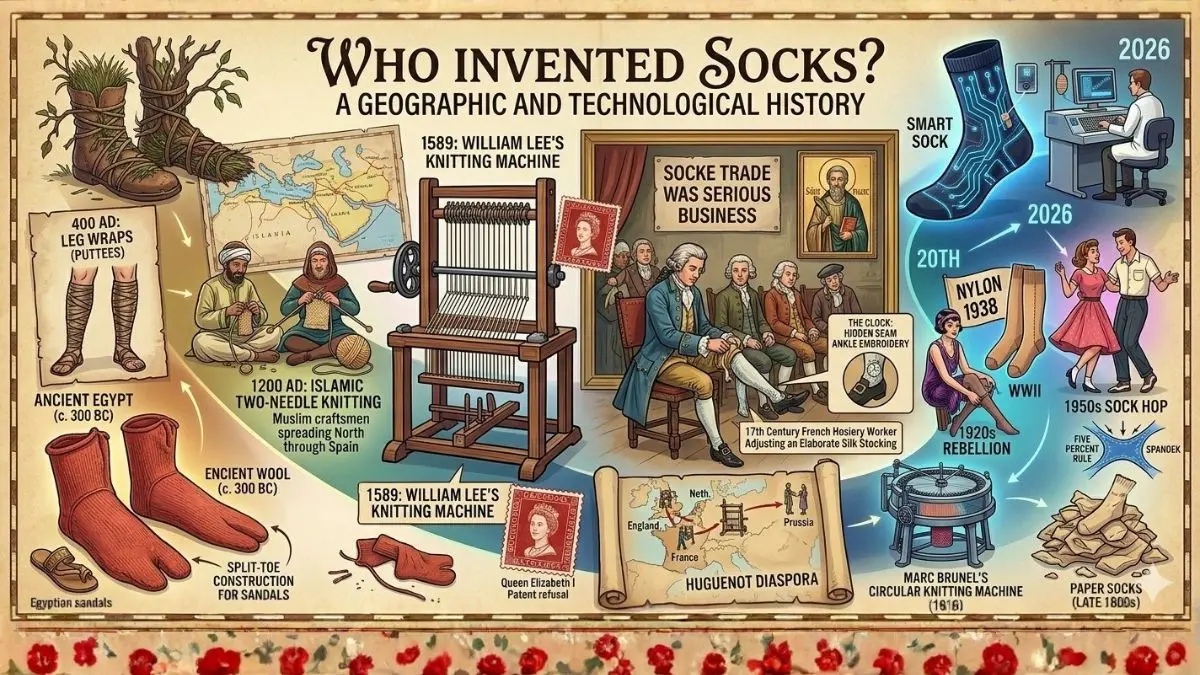
Who Invented Socks? Full History
Before Socks Existed — The World of Bare Feet and Foot Wraps (5000 BC to 500 BC)
The Caveman Era: The First Foot Protection
The story of socks doesn’t start with machines or knitting needles. It starts with the simple need to survive. Ancient cave paintings and old remains from around 5000 BC show that Stone Age humans were already protecting their feet. They used animal skins and dried grass to shield themselves from freezing cold and sharp rocks.
These early coverings weren’t like the socks we know today. They were basically small bags made of animal hide. To keep them in place, people tied them around their ankles with leather strips or animal tendons.
The grass stuffed inside served two main jobs. It kept the feet warm and soaked up moisture from the wet ground. Even though they looked different, their goal was exactly the same as a modern sock—keeping the foot warm, dry, and safe.
Animal skins and grass absorbed moisture but did not let it dry out. This made the inside of the wrap warm and damp, which was a perfect place for germs and tiny bugs to grow. Because of this, ancient humans often had foot diseases. Their foot wraps fixed one problem but created another.
Ötzi the Iceman: The Oldest Foot Insulation (3300 BC)
The history of socks dates back much further than Egypt. We learned about this through a remarkable discovery in the 20th century.
In 1991, a frozen human corpse was found in mountains on border of Austria and Italy. This man was named “Ötzi the Iceman.” He died around 3300 BC and remained preserved in ice for 5,000 years. When researchers examined his feet, they found something very surprising. His leather shoes had a special lining inside, filled with tree bark and soft grass.
This filling of grass was no accident. It was a deliberate design that performed much like modern socks. It keeps the feet soft, and provides warmth. The grass wicked away sweat and protected from the cold. The net of tree bark held everything in place so that the feet didn’t feel the hardness of leather.
Ötzi’s method predates the Egyptian socks, often considered the oldest known, by 2,000 years. In fact, he wasn’t wearing a knitted sock, but it was for same purpose. This suggests that a sock isn’t simply a name for a particular method of socking. It is an invention that provides comfort and protection to the feet.
Ancient Egypt: The First Knitted Socks and Split-Toe Designs
When people ask about invention of socks, most experts point to ancient Egypt. There’s a good reason for this. The oldest specimens of knitted socks have been found in the Egyptian caves. These socks were made so precise that it seems people were master of knitting at that time.
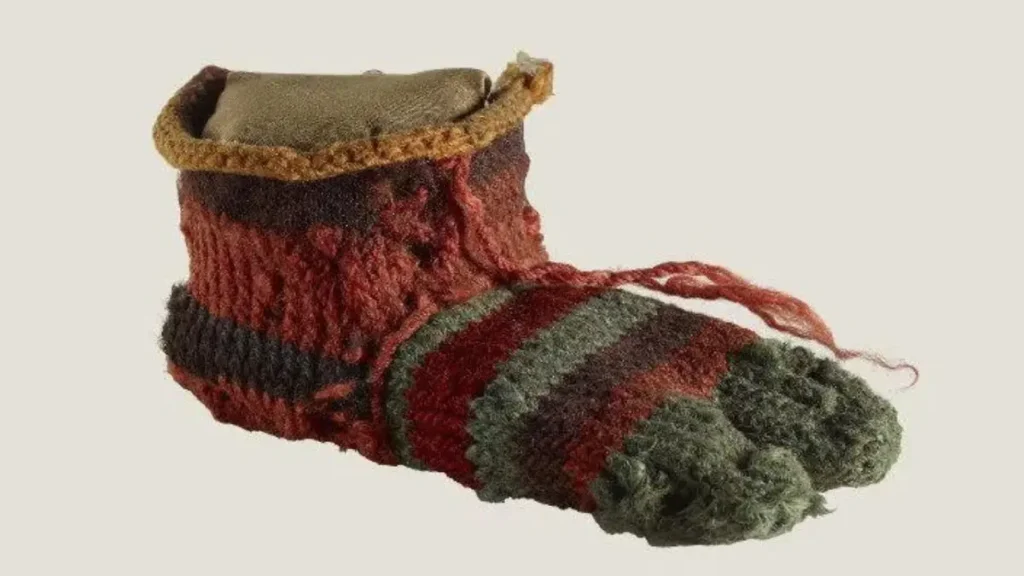
Egypt’s most famous socks are currently housed in the Victoria and Albert Museum in London. These socks are approximately 250 to 420 AD old. They were discovered in the 19th century.
The most special thing about these socks is their design. They have a “split-toe” design, meaning there’s a separate space for the big toe and another for the other four fingers. It was just like gloves have a dedicated space for the thumb.
This design was made to be worn with sandals. At the time, sandals had a thong between the toes, making regular socks uncomfortable. The split-toe design solved this problem simply and effectively.
Evidence from the ancient Egyptian tombs (Antinean Tombs) suggests that initially, socks were worn only by the wealthy and powerful people. What everyone owns today was once considered a luxury.
Another interesting fact is that traces of nylon fabric dating back to 1500 BC have been found in Denmark and Germany. It means that the method of making socks may have started in Europe and Egypt at different times, but no complete sock of that time could be found.
Naalbinding Technique: How Early Socks Were Made
Keep in mind that ancient Egyptian socks weren’t knitted with two needles like we do today. A special method was used at that time, called “Naalbinding.” This means “tying with a needle.”
Naalbinding used a single, narrow needle, and the thread was already cut into pieces. The knitter would pass the needle and the entire thread through each loop. This was completely different from today’s knitting. The cotton made this way was harder, stronger, and firmer, but it required a lot of effort and time to make.
All the oldest socks found in Egypt and the Mediterranean region are made using this technique. When we talk about invention of socks, we must distinguish between “socks” and “the method of making them.”
Socks, as an invention, existed thousands of years before today’s knitting.
Ancient Greece and Rome: Piloi, Udones, and the Comedy Shoe
In ancient Greece, people wore foot coverings called piloi, that was made from pressed animal hair. They were not knitted like modern socks. These were like soft pads and placed inside sandals or basic shoes. Very simple, but provided minimal barrier between feet and ground.
The Romans improved this idea. They played an important role in the history of socks in a way most people don’t know. In fact, the word “sock” comes from Roman theater.
Two types of shoes were popular in Roman theater:
Cothurnus: These were tall and heavy boots worn by tragic figures.
Soccus: These were light and low shoes worn by comedy figures. “Soccus” was actually a light shoe or a thick sock.
This Latin word “soccus” later became the English word “sock.” This means that socks are associated with ancient comedy theater.
By the 2nd century AD, Roman artisans knitted cotton into “Udones.” These were shaped exactly like modern socks, with openings for the toes and heel. They were made from wool and fitted the feet snugly.
Furthermore, Roman soldiers would tuck long strips of cotton inside their boots during long journeys and battles to protect themselves from the cold and prevent blisters. These were called “Faciae.” So, the Romans made socks not just a necessity but a complete design.
The Middle Ages: When Socks Became About Status and Power (400 AD – 1588)
The Puttees of 400 AD: Purity and Status
Around the year 400 AD, people in Europe wore long strips of cloth wrapped around their legs called puttees. These wraps started at the ankle and went all the way up to the knee.
On a practical level, these cloths were great for keeping the legs warm and protected. However, they were also used to show how important a person was in society. If a man wore these leg wraps, it was a sign of cleanliness and high social status.
The logic was simple, if your legs were neatly wrapped in cloth, you clearly weren’t working in the muddy fields. Only people who didn’t have to do dirty manual labor could keep their leg wraps clean. This started a tradition that lasted for hundreds of years where covering your feet and legs was a sign of being wealthy or powerful.
When Your Socks and Pants Were One Piece
Just imagine if your socks and pant were one and the same garment. During the Middle Ages, people wore something called ‘stockings,’ which covered everything from their toes to their waist. This garment was essentially one long, knitted tube for the lower body. To prevent it from slipping down, you had to fasten it to your underpants with strings.
Eventually, this design changed for a very simple reason, hygiene. Because people walked on dirty ground and filthy streets, the foot section got dirty much faster than the leg section.
It was a huge chore to wash the entire, heavy outfit every time the feet got dirty. To solve this, they eventually split the garment into two separate parts. That way, people had a long stocking for their legs and a separate, smaller foot section that was much easier to wash regularly.
Muslim Craftsmen Bring Knitting to Europe (1200 AD)
The sophisticated art of knitting with two needles did not originate in Europe. It actually came from the Islamic world, via Spain.
Around the year 1200 AD, skilled Islamic artisans worked at the Spanish royal courts. They brought knitting techniques from Arab countries that Europe had never seen before. Before that, making socks was a very slow process called “needle binding,” which used a single needle. The new Islamic style was much faster and made it possible to produce much better socks.
From Spain, this new technique spread northward and eastward across the rest of Europe. It completely changed the way clothing was produced. This was a very important moment in history, but it is often overlooked. Many history books act as if Europe invented knitting itself, but in reality, the entire sock industry was built on technology from the Islamic world.
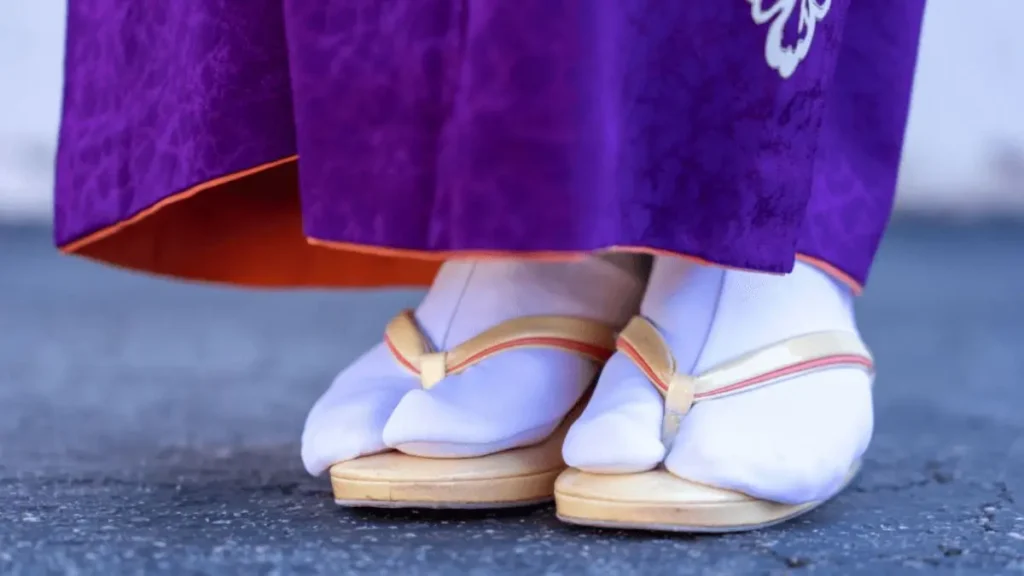
Japan’s Independent Solution: Tabi Socks (1400s)
While Europe was doing its thing, Japanese craftspeople were independently developing their own distinctive foot covering. The tabi sock emerged in the 1400s with split-toe construction — visually similar to the ancient Egyptian design but developed completely independently.
Japanese traditional sandals — geta and zori — both had thongs passing between the toes. The split-toe tabi allowed these sandals to be worn with foot coverings comfortably. The tabi is still used in Japan today with traditional kimono and formal dress. It represents one of the longest unbroken traditions in hosiery history.
Socks as a Symbol of Danger
Once, wearing socks actually made people suspicious of you. In early Europe, covering your feet was seen as a sign of a liar. People believed honest folks had nothing to hide and should stay barefoot. If you wrapped your feet, neighbors might treat you like a dangerous outcast.
This thinking eventually changed. Socks later became a symbol of wealth and cleanliness instead of trickery. It remains a strange moment in history when socks were a warning sign rather than a fashion choice.
The Argyle Pattern and Scottish Clan Identity
The argyle pattern is that famous diamond design often seen on socks. It actually started centuries ago with a Scottish group called Clan Campbell of Argyll. Originally, this pattern was woven into fabric to show which family or territory a person belonged to.
Later, people began knitting this design into socks. It became a global fashion trend in the 1920s. While it looks like a simple modern style, its roots are deeply tied to ancient Scottish history and family pride.
The Ankle Clock
If you look at the side of a formal dress sock, you might see a small embroidered design. Almost nobody knows that this decoration is called a clock.
The sock clock first became popular in the 1500s. People think the name might come from the word “cloak” because the design was used to hide the seam where the fabric was joined at the ankle. Even today, this tiny detail remains a part of high-end fashion and history.
Saint Fiacre: The Patron Saint of Sock Makers
Almost nobody knows that sock makers actually had their own patron saint. In the 17th century, the French stocking industry chose a 7th-century Irish monk named Saint Fiacre to be their protector.
The sock trade was considered a very serious business back then. The guilds of makers held special feast days, said prayers, and performed official ceremonies to honor him. To these workers, making hosiery was not just a job, but a professional craft protected by a saint.
The Machine Revolution (1589 – 1800)
The Invention of the Knitting Machine (1589)
The biggest change in sock history happened in 1589 when a man named William Lee invented the world’s first knitting machine. The speed was incredible. A fast person could knit 100 stitches a minute by hand, but Lee’s machine could do over 1,000. This invention changed how clothes were made forever.
Why Queen Elizabeth Refused the Machine
William Lee showed his machine-made stockings to Queen Elizabeth I, hoping to get a patent. She said no. Officially, she complained the fabric felt too rough compared to her expensive silk stockings. However, her real fear was for her people. Thousands of poor families made money by knitting at home, and she knew this machine would put them all out of work.
How the Technology Spread
Because England rejected him, Lee moved his machine to France where the King supported him. Later, a group of workers called the Huguenots had to flee France because of religious trouble. As they moved to countries like the Netherlands and England, they took their sock-making secrets with them. This spread the technology across the world in a way no one expected.
The Secret Invention: The L-Shaped Heel
For a long time, socks were just straight tubes that constantly slipped off the foot. In the 1500s, hand-knitters invented a clever technique to create a curved, L-shaped heel. This tiny change allowed the sock to actually stay on the foot. It is one of the most important inventions in clothing, yet almost nobody knows it even happened.
The Industrial Revolution (1800s)
The End of the Back Seam (1816)
For over 200 years, every machine-made sock had a stitched line, or seam, running up the back of the leg. This was because the early machines could only knit flat pieces of fabric. In 1816, an engineer named Marc Brunel changed this by inventing a circular knitting machine. By arranging the needles in a ring, the machine could knit in a continuous circle. This created a perfect tube with no seam and no extra labor required, which is how almost all socks are made today.
The Failure of Paper Socks
Not every industrial invention was a success. In the late 1800s, companies tried to sell disposable socks made of paper so people wouldn’t have to wash them. However, these socks were a disaster. They were very uncomfortable, they didn’t let the feet breathe, and they fell apart as soon as they got wet. Since they weren’t even that cheap, the idea was quickly abandoned.
The Big Win: Cleaner Feet
The core benefit of factory-made socks was better health. Before this, socks were expensive, so most people had only one or two pairs and didn’t wash them often. When machines made socks cheaper, people could buy more pairs. Changing socks daily, which was once only for the rich, became normal and helped keep feet cleaner and healthier.
The 20th Century: Synthetic Materials Change Everything
Flapper Girls and Fashion Rebellion (1920s)
In the 1920s, young women called flappers broke old rules. They rolled their stockings down below the knee instead of wearing them properly. This showed their knees, which shocked people. Some even put red makeup on their knees to get attention. This style became a symbol of freedom.
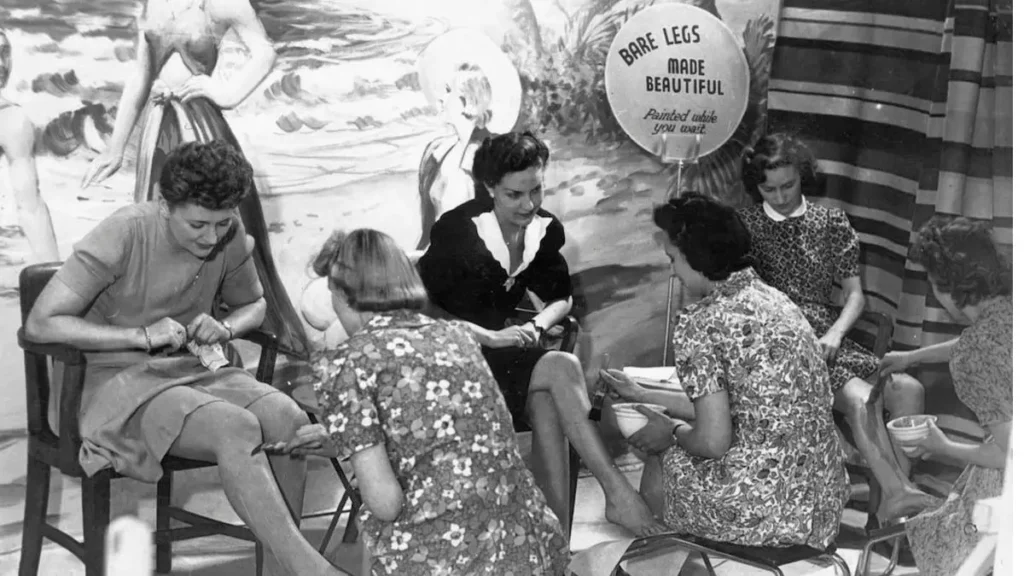
With Nylon Stockings Scarce, Women would Paint their Legs so it Looked like Stockings, 1940s – Rare Historical Photos
Nylon Changes Literally Everything (1938)
The most transformative material innovation came in 1938 when DuPont introduced nylon — the first fully synthetic fiber. For socks, nylon provided three things simultaneously, greater durability than silk or wool, natural elasticity that allowed stretch and recovery, and enough grip to stay on the leg without support.
That change ended a whole industry. Sock garters and suspenders, which people had used for centuries to keep socks up, were no longer needed.
World War II immediately diverted nylon to parachutes. American women, unable to buy nylon stockings, famously drew lines on their bare legs to simulate stocking seams. When nylon returned after the war, demand was explosive.
Nylon made it possible to mix different types of fibers together. Today, good quality socks use a mix of materials—merino wool for softness, cotton to keep feet cool, polyamide for strength, and spandex to help the sock keep its shape.
There is also a simple “5% rule.” About 5% spandex is best. If there is less, the sock becomes loose. If there is more, it feels tight and rubber-like.
The Sock Hop Era (1950s)
In 1950s, school dances called “sock hops” became very popular among American teenagers. They were called this because students had to take off their shoes and dance in their socks to protect the shiny floors. During this time, rock and roll music and socks became closely connected in people’s memories.
The Modern Era: NASA, MIT, and Smart Socks (2000 – 2026)
NASA Pioneers the Smart Sock
NASA’s development of the Liquid Cooling and Ventilation Garment for astronauts included specialized foot coverings designed to actively manage foot temperature. These weren’t socks that merely covered the foot — they managed it physiologically.
This idea led to the development of smart socks. Today, companies make socks with built-in sensors, special conductive threads, and temperature-control materials. These socks are used for medical health tracking, sports performance, and improving blood circulation.
MIT and the Future: Custom Socks on Demand
Researchers at MIT are creating smart knitting systems that use computers, modern machines, and AI together. These systems can design and make socks that fit your exact foot size. They can also customize how tight the socks are and what materials are used, and produce them on demand.
This isn’t available to consumers yet, but the direction is clear. The future of socks may be as individually fitted as a handmade shoe, produced industrially from a digital file.
Where We Are in 2026
Today’s sock market is divided into basic socks, premium natural fiber socks, sports performance socks, and smart socks. Socks are made from materials like merino wool and cashmere for comfort, and synthetic fibers like polyamide and spandex for strength, flexibility, and durability.
Computer-aided design (CAD) makes it possible to create very detailed and complex sock patterns that were not possible before. Dye sublimation printing can also transfer high-quality, photo-like images directly onto fabric. Because of this, modern novelty socks can have bright, full-color, and highly detailed designs that were impossible in the past.
FAQs
Who invented socks?
No single inventor. Foot coverings date to 3300 BC with Ötzi the Iceman. The oldest knitted socks are Egyptian, dating to 250 to 420 AD. William Lee mechanized production with his 1589 stocking frame.
What is naalbinding?
A single-needle technique using pre-cut yarn. Older than two-needle knitting and produces denser, more durable fabric. Used to make the oldest surviving Egyptian socks.
Why is the word sock connected to Roman comedy?
The Latin soccus was the light slipper worn by comic actors in Roman theater. It became socc in Old English and eventually sock in modern English.
What is the five percent spandex rule?
Premium sock manufacturers have found that approximately five percent spandex provides optimal shape retention without making the fabric feel synthetic. Less and it loses shape. More and it feels rubbery.
What were sock hops?
School gymnasium dances in 1950s America where participants removed shoes to protect polished floors, dancing in only their socks. The term became synonymous with wholesome rock and roll teenage culture.