
The Complete History of Soap: From Ancient Accident to Modern Essential (5,000 Years Explained)
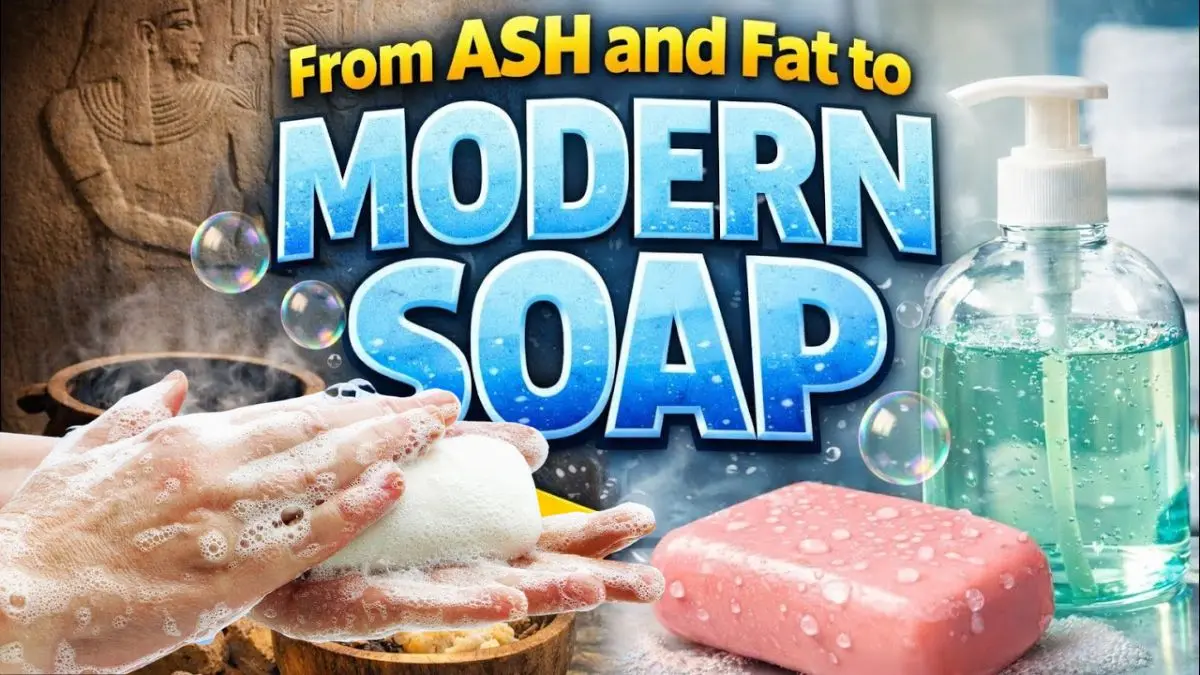
Who Invented Soap? No one person invented soap… it was accidentally discovered over 4,000 years ago!
Today, we care a lot about skin health and personal cleanliness. It is hard to imagine daily life without soap. We use it every day without even thinking about it. But have you ever thought when people first realized water alone was not enough? At some point, humans discovered they needed something smooth and cleansing to wash better.
The invention of soap did not happen in a single day. It was not one sudden discovery or one person’s idea. Soap developed slowly over thousands of years through trial, observation, and early chemistry.
Who Invented Soap? Full History of Soap
Today, the global soap industry is worth more than $50 billion – and it’s still growing. We can’t live without this everyday product that started with a happy accident around an open fire.
How Was Soap Invented? The Accidental Discovery
The first soap was probably invented by accident. Long ago, people cooked meat over a fire. The fat from the meat dripped into the wood ash.
Someone noticed that this mixture of fat and ash really cleaned their hands and utensils. Without knowing it, they made soap through a chemical process.
The ancients didn’t understand science or why it worked. They just saw that it cleaned things, and that was enough for them. They used it for thousands of years before anyone figured out how it actually worked.
The Babylonian Breakthrough (2800 BC)
The earliest clear evidence of soap comes from ancient Babylon. Around 2800 BC, archaeologists found clay cylinders with instructions for making soap. The recipe was surprisingly simple.
People used animal fat, wood ash, and water. They boiled these ingredients together to make a cleaning paste.
But here’s something many people don’t know — Babylonians did not make soap for bathing. They mainly used it for practical and medicinal purposes.
Early soap helped wash textiles and clean wool before dyeing. People also used it to treat wounds and skin problems. In many cases, it served as a medicine.
Personal hygiene was not the main purpose of soap. This idea came much later.
Ancient Egypt: Beauty, Medicine, and Early Soap (1500 BC)
The ancient Egyptians, known for their beauty rituals, also made soap. The Ebers Papyrus, a medical text from around 1500 BC, describes a mixture of animal and vegetable oils combined with alkaline salts.
Egyptians did not mainly use it for bathing. They used it to treat skin diseases and wounds. It also helped soften skin as part of beauty routines and was used in medicine and ceremonies.
Even earlier, a Sumerian text from around 2200 BC mentions washing a person with a skin condition using soap. This shows ancient healers believed soap had healing powers.
They were not wrong. Modern science now confirms that soap is one of the best tools ever discovered for preventing the spread of disease.
What Is Saponification? The Science Behind the Suds
Before going further, it helps to understand why soap works. The process is called saponification, and the formula is simple:
Fat + Alkali = Soap + Glycerol
When fats mix with alkaline substances like lye from wood ash, they create soap molecules with two special ends.
One end attracts oil and dirt. The other end attracts water.
These molecules act like tiny cleaners. When mixed with water, they form small structures called micelles. Micelles surround dirt and oil, trap them inside, and help wash them away.
Ancient civilizations discovered this process by accident thousands of years before they understood the science. In many ways, soap was one of the world’s first practical chemistry experiments.
Ancient Greece and Rome: Oil, Scrapers, and Hair Dye
If Babylonians and Egyptians did not bathe with soap, you might think the Romans did. After all, they loved their famous baths. But not quite.
In ancient Greece and Rome, people mostly used soap for other purposes. They used it to wash clothes and even dye hair. The Gauls, for example, made soap from fat and ash to give their hair a reddish color.
The Roman Bathing Ritual
Romans had a very different way of bathing. Instead of washing with soap, they covered their bodies with oil. Then they scraped off the oil, sweat, and dirt using a tool called a strigil. After that, they rinsed off.
The Roman writer Pliny the Elder mentioned soap in his book Naturalis Historia around 77 AD, but mainly as a product for hair care.
Later, the Greek physician Galen became one of the first people in recorded history to recommend soap for personal hygiene. At the time, this was a new and unusual idea.
The Legend of Mount Sapo
The word soap came from an old Roman legend. According to the story, there was a place called Mount Sapo where people sacrificed animals. When it rained, animal fat and ash from the fires washed down into the Tiber River.
Women washing clothes in that part of the river noticed their laundry became cleaner. People believed this mixture of fat and ash created a natural soap.
Over time, the name Sapo may have evolved into the word soap.
Historians debate whether this story is truly accurate, but it is one of the most famous origin stories linked to soap.
The Middle Ages: From Simple Soap to Luxury
The Middle Ages got a bad reputation for poor hygiene, but that is not the full story. This period actually turned soap into a valuable luxury product.
The Crusades and Aleppo Soap (12th Century)
During the Crusades, European travelers brought back Aleppo soap from Syria. This famous soap was made with olive oil and laurel oil.
Soap makers in the Middle East had already mastered the art of making hard, refined soap from vegetable oils. Some historians even consider it one of the earliest vegan soaps.
Castile Soap: Europe’s Answer (13th Century)
Mediterranean soap makers could not easily get laurel oil, so they used pure olive oil instead. This led to the creation of Castile soap, named after the Crown of Castile in Spain.
Castile soap became known for its firm white bars and high quality. Even Queen Elizabeth I reportedly loved using it. Among royalty and the wealthy, soap became a symbol of status and refinement.
Soap Traditions in Africa
At the same time, West Africa developed its own soap tradition. People made Dudu-Osun, often called African black soap, from the ash of local plants and peels. It formed a dark bar with unique cleansing properties.
Soap for the Rich and Poor
For rich families, fine soap became a luxury item. For ordinary people, soap remained homemade, basic, and often rough-smelling. Most people could not afford the refined soaps used by nobles.
When Bathing Fell Out of Fashion
In a strange twist, just as soap improved, bathing became less popular in Europe during the 1600s.
Many people believed hot water opened the pores and allowed disease into the body. Because of this fear, regular bathing declined.
Even King Louis XIV of France reportedly bathed only a few times in his life, though he cared greatly about clean clothes and appearance.
During this time, people mostly used soap for laundry rather than personal hygiene. Soap existed, but bathing with it was still far from common.
The Soap Tax: 141 Years of Expensive Cleanliness (1712–1853)
In 1712, the British government introduced a soap tax that had a major impact on public health. This decision made soap much more expensive for ordinary people.
The price of even basic soap increased sharply. In many cases, it nearly tripled. Soap makers also faced strict rules, and they had to lock up their equipment when it was not in use.
The government forced manufacturers to produce soap in very large batches, which small producers could not afford. Because of this, many soap makers moved their businesses to Ireland to avoid the tax. At the same time, soap smuggling also became common.
This tax stayed in place for a very long time. The British government finally removed it in 1853, after 141 years.
During this period, many poor people in Britain could not afford regular soap. This made proper cleaning difficult and helped diseases spread more easily.
The Industrial Revolution: Soap Goes Big (1850s Onwards)
By the time Britain removed the soap tax, the Industrial Revolution had already started to change how people made goods. Soap production benefited a lot from this shift.
The scientific breakthrough that changed everything
In 1791, French chemist Nicolas Leblanc found a way to turn common salt into soda ash. Soda ash became a key ingredient in soap making. This discovery made soap cheaper to produce and supported large-scale manufacturing.
The rise of factory-made soap
Small handmade soap businesses slowly lost ground to factories. Soap production grew quickly during the 1800s and became one of the major industries of the time.
Several factors drove this growth:
- Factories increased production and reduced costs
- Cities grew, and more people needed basic hygiene products
- Companies started using mass advertising to sell soap to the public
Soap stopped being a luxury item and became a common household product.
Soap Saves Lives: The Medical Revolution (1850s–1860s)
In the mid-19th century, soap became more than a cleaning product. People started using it as a life-saving medical tool.
Ignaz Semmelweis and the handwashing discovery
Before Florence Nightingale, Ignaz Semmelweis, a Hungarian doctor, made a major discovery that changed medicine forever. Many doctors later ignored his work, even though it saved lives.
In 1847, Semmelweis worked in a Vienna maternity hospital. He saw that many new mothers died from a disease called puerperal fever. In some wards, 25–30% of women died after childbirth.
He studied the pattern and noticed something important. Doctors who performed autopsies often went directly to treat mothers without washing their hands. In contrast, midwives did not work with dead bodies and had much lower death rates.
Semmelweis concluded that doctors carried harmful particles from dead bodies on their hands. He asked them to wash their hands with a chlorinated lime solution before treating patients.
After this change, death rates in his ward dropped sharply from about 16% to nearly 1%. Even with these results, many doctors did not believe him. They mocked him and rejected his ideas. Eventually, he was sent to a mental institution, where he died in 1865. Ironically, he likely died from an infection.
Years later, scientists like Louis Pasteur and Joseph Lister proved germ theory. Only then did the medical world accept that Semmelweis had been right all along.
Florence Nightingale and Mary Seacole
Florence Nightingale and Mary Seacole changed nursing during the Crimean War. They built their care on one simple rule: always wash hands with soap.
Nightingale strongly believed in hygiene. In her 1860 book Notes on Nursing, she wrote that nurses should wash their hands very often during the day.
Soap Goes to War
When the American Civil War began in 1861, the U.S. military started supplying soap to field hospitals. Soldiers and doctors used it to clean their hands regularly.
This simple practice made a big difference. Handwashing with soap reduced deaths caused by infections on the battlefield.
The company Procter & Gamble also supplied soap to soldiers during the war. When soldiers returned home, they continued the habit of using soap. They also spread this practice to their families and communities. As a result, Procter & Gamble became a well-known household brand.
Why this Matters Today
Health experts still consider soap one of the simplest and most powerful tools for preventing disease.
The CDC reports that washing hands with soap can prevent about 30% of diarrhea-related illnesses and around 20% of respiratory infections. These illnesses still cause many deaths, especially in young children around the world.
Even today, handwashing habits are not strong everywhere. Global studies show that only about 19% of people wash their hands with soap after using the toilet.
Health experts believe that proper handwashing could save around 1 million lives every year.
The Liquid Soap Revolution (1865–1980)
The First Patent (1865)
Liquid soap has existed for a long time. In 1865, William Shepphard filed the first patent for liquid soap. His product, called “Improved Liquid Soap,” mixed regular soap with ammonia compounds to create a thick liquid.
For many years after that, people did not use liquid soap at home. Hospitals and factories mainly used it because it was more practical for cleaning in large settings.
The Minnetonka Breakthrough (1980)
Liquid soap only became common in homes in 1980. The Minnetonka Corporation in Minnesota launched a product called Softsoap, which became the first mass-market liquid soap for everyday use.
Minnetonka did not just focus on the soap. They also focused on the packaging. At that time, only a few companies in the U.S. made plastic pump dispensers. Minnetonka bought almost all available pumps in the country.
This move gave them a strong advantage over competitors. Their product dominated the market before other companies could react. Later, Colgate-Palmolive bought Minnetonka in 1987. Business schools still study this strategy as a smart example of market control.
The 1980s Boom
During the 1980s and 1990s, liquid soap and body wash became very popular. Companies used marketing to promote the idea that bar soap was less clean and could carry germs.
A study in 1988 showed that this fear was mostly not true. However, people still believed it. By the 1990s, liquid soap replaced bar soap in many homes and became the standard choice in bathrooms.
Modern Innovations: Beyond Basic Soap
What Most “Soaps” Actually Are
Today, many products labeled as “soap” are not real soap in the traditional sense. Most are synthetic detergent bars, also called syndets. These appeared during World War II when companies could not easily get the raw materials needed for traditional soap making.
Modern cleansing bars often include:
- Mild cleansing agents like sodium cocoyl isethionate and sodium glycinate
- Moisturising ingredients such as oils, glycerin, and petrolatum
- Special additives for skin problems like acne, eczema, and sensitive skin
Liquid Body Washes and Facial Cleansers
From the 1970s and 1980s, soap products became much more diverse. Companies introduced deodorant soaps, novelty shapes, soap on ropes, and eventually liquid body washes. These liquid products now dominate most stores.
Facial cleansers also became a separate category. They usually include:
- Very mild cleansing ingredients for delicate facial skin
- Fewer heavy oils to avoid leaving residue
- Active ingredients for skin care, including anti-ageing and soothing compounds
Faith in Nature: a natural soap pioneer (1974)
In the early 1970s, Rivka Rose, a trained herbalist from the United States, moved to Scotland. She could not find natural, plant-based skincare products, so she began making her own.
In 1974, she sold her jewellery to buy ingredients and started the brand Faith in Nature. It became one of the early natural soap companies in the world.
Her first product, Orange Vegetable Soap, still remains popular nearly 50 years later.
Where Soap Technology Is Heading
The soap industry keeps changing as technology advances. Companies now focus on personalisation, sustainability, and smart systems.
In August 2025, Unilever announced an AI-driven partnership for personalised skincare. This system helps tailor soap and skincare products based on individual skin needs.
In September 2025, Procter & Gamble launched a new range of biodegradable soaps. These products aim to reduce environmental impact and break down more easily after use.
In late 2024, Kao Corporation introduced smart IoT-enabled soap refill machines in Tokyo train stations. These machines allow users to refill soap containers more easily and track usage through connected technology.
Bar Soap’s Big Environmental Comeback (2019–Present)
Bar soap has made a strong comeback after being seen as outdated for many years. Today, environmental concerns mainly drive this shift.
In 2019, consumers in the UK bought about 4% more bar soap than the previous year. This trend has continued to grow each year.
The Environmental Case for Bar Soap
Bar soap offers clear environmental benefits compared to liquid soap.
- Plastic bottles from liquid body washes create over 500 million units of plastic waste each year in the United States, and only about 29% get recycled
- Many bar soaps use biodegradable or compostable packaging, and brands increased FSC-certified paper packaging by about 41% in 2023
- Bar soap has a lower carbon footprint because it contains no added water, so it weighs less and costs less to transport
For people who want to reduce waste, bar soap offers a simple and effective alternative to bottled products.
Soap by the Numbers: 2025 Market Statistics
| Global soap market value (2025) | $50.68 billion |
| Projected market value by 2034 | $87.36 billion |
| Market growth rate (CAGR) | 6.32% |
| Bar soap’s share of market | ~51% |
| Asia Pacific market share | 39.25% |
| Handmade/artisan soap market | $158.79 million |
| People without soap/water access | 3 billion |
| Lives potentially saved by handwashing annually | ~1 million |
Bar soap alone — the category that was declared dead in the 1990s — is projected to reach $43 billion by 2030.
FAQs
When was soap invented?
The earliest evidence of soap comes from around 2800 BC in ancient Babylon. People used a mixture of animal fat, wood ash, and water. Some historians believe people may have discovered soap even earlier by accident near cooking fires.
What is saponification?
Saponification is the chemical reaction that produces soap. When fats or oils mix with an alkali like lye, they react and form soap and glycerol. This process is the basic science behind soap making, both in ancient times and today.
Is bar soap more hygienic than liquid soap?
A 1988 study found no major difference in hygiene between bar soap and liquid soap. Both remove germs effectively when used properly. The idea that bar soap is “dirty” mainly came from marketing in the 1980s.
Is bar soap better for the environment than liquid soap?
Yes, in most cases. Bar soap uses less packaging, often just paper. It contains no added water, so it is lighter to transport and creates a smaller carbon footprint. In contrast, liquid soap contributes to hundreds of millions of plastic bottles each year.
Why didn’t the Romans use soap for bathing?
Romans used oil instead of soap for bathing. They covered their bodies in olive oil and then scraped it off using a tool called a strigil. They mainly used soap for washing clothes and hair dyeing, not bathing.
What is Castile soap?
Castile soap is made from pure olive oil instead of animal fat. It originated in Spain in the 13th century. It became popular across Europe and was even used by royalty. Today, it is still known for being gentle and natural.
What is the difference between soap and synthetic detergent?
Traditional soap is made by mixing fats with an alkali in a process called saponification. Synthetic detergents are lab-made cleansing agents. Most modern “soap” bars are actually synthetic detergents because they are milder and work better in different water conditions.
How much is the global soap industry worth?
The global soap market was valued at about $50.68 billion in 2025. It is expected to grow to around $87.36 billion by 2034.
Conclusion
Next time you lather up, remember you are part of an ancient habit. This simple act connects you to Babylonians who washed wool with early soap, Egyptian healers who used oils for skin care, and Roman women who cleaned clothes along the Tiber River.
It also connects you to Ignaz Semmelweis, the Hungarian doctor who proved handwashing saves lives, even though many rejected his idea. It links you to Crimean War nurses like Florence Nightingale and Mary Seacole, who used soap to prevent infections and save soldiers. Today, it connects you to people in 2025 who choose eco-friendly bar soap instead of plastic bottles.
Soap is more than a cleaning product. It is one of humanity’s key chemical discoveries. It has improved public health, built a global industry, and shaped daily life for thousands of years.
Whether you use bar soap or liquid soap, scented or plain, you are using a 5,000-year-old invention that has helped protect human life.