
Strange Story History of Toilet Paper that Will Surprise You!
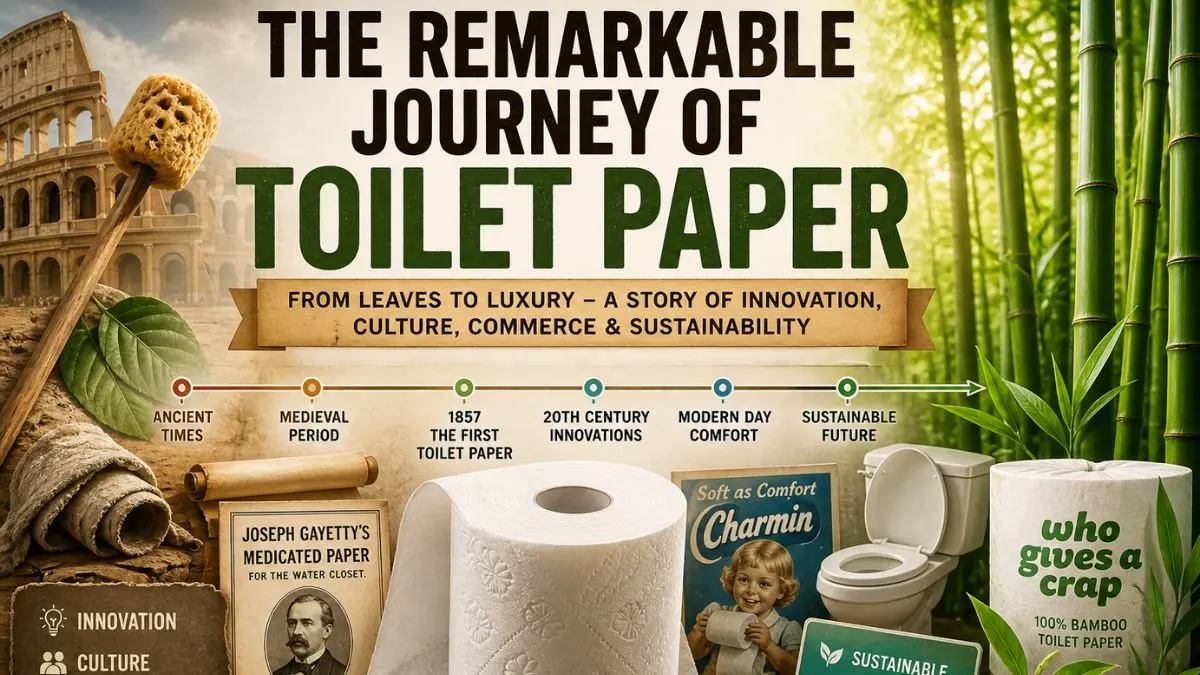
Who invented toilet paper? Joseph Gayetty (1857, USA): He is credited with introducing the first commercially sold toilet paper called “Gayetty’s Medicated Paper”. It came in flat sheets, not rolls.
Toilet paper is an important part of our lives but we don’t think much about it. Can you imagine that until the 1930s, some toilet paper even contained small splinters or rough materials that made it uncomfortable to use?
Behind this simple invention are stories from ancient China, early paper-making techniques, and even failed attempts. Over centuries, people used corn cobs, stones, and cloth before modern toilet paper became common.
How we moved from rough and uncomfortable alternatives to this soft rolls, and how inventors transformed personal hygiene forever.
PART 1: BEFORE COMMERCIAL TOILET PAPER
The creative solutions of ancient civilizations
Long before the invention of industrial toilet paper, people used many ingenious methods for personal hygiene. These techniques varied greatly depending on geography, available resources, and social status.
What ancient people actually used
Archaeological evidence and historical texts reveal that our ancestors used whatever was available: leaves, grass, moss, hay, wood shavings, sand, stones, shells, and even snow. In some coastal areas, sailors reportedly used a rope dangling overboard—a practice that highlights how creative humans became out of necessity.
Wealthier people enjoyed considerably more comfort. Those of high status used wool, hemp, lace, or even expensive fabrics. These materials were valuable in ancient times, making their use for hygiene a sign of luxury. In Herculaneum, Italy (buried by the eruption of Mount Vesuvius in AD 79), archaeologists found small fabric fragments in sewage systems that likely served this purpose.
A striking detail from ancient records suggests that using cloth for cleaning was considered “equivalent to using the softest and most expensive modern three-ply tissue.” Since cloth was handmade, it was a costly and luxurious item—far more expensive in relative terms than modern toilet paper is today.
Ancient innovations: Tersorium and beyond
The ancient Romans developed what can be considered one of the first “tools” for personal hygiene: the tersorium (also called the xylospongium). This clever invention consisted of a sponge attached to the end of a wooden stick. The sponge was stored in a bucket of water or vinegar solution for reuse.
PART TWO: ASIA’S TOILET PAPER MONOPOLY
China’s industrialization of toilet paper production
As paper production developed and became more widespread in China, its use also expanded into personal hygiene. By the 14th century, the Chinese had already industrialized toilet paper production to an extraordinary extent—centuries before the Western world even recorded its existence.
Imperial luxury and mass production
In 1391, during the Ming Dynasty, the Imperial Court commissioned the production of scented paper sheets specifically for the Hongwu Emperor and his royal family. These were not merely functional items—they were luxury products infused with fragrance, showing that the imperial court valued comfort and refinement even in personal hygiene.
More impressively, by the 14th and 15th centuries, China was producing millions of paper packs annually, each containing between 1,000 and 10,000 sheets. Some historical estimates suggest production may have exceeded 700,000 sheets per year for imperial use alone. (Note: exact figures vary in historical records)
China had already industrialized toilet paper production in the 14th and 15th centuries, Europe still largely relied on cloth, rags, or other basic materials. This gap of several centuries highlights the remarkable level of innovation and technological advancement in China during the Middle Ages.
The water-based alternative: a parallel development
It is important to note that while China pioneered paper-based hygiene practices, many other cultures continued to rely on water-based cleaning methods. These systems, which used water for cleansing, were often more hygienic and efficient in many environments.
PART III: EUROPE’S SLOW ADOPTION AND RELUCTANCE
Medieval and Renaissance Europe: A continent stuck in old ways
China had been producing toilet paper for centuries, but Europe remained largely uninterested in—this innovation. Instead, Europeans developed their own hygiene solutions based mainly on available resources, and this reluctance persisted far longer than one might expect.
Class divisions in sanitation
Europeans used different materials depending on their social status. Wealthy people used rags, wool, hemp, and lace, while common people relied on straw, hay, or fabric scraps—whatever was available. In some cases, individuals even used their own sleeves, a practice that sounds unpleasant but was reportedly not uncommon among the poorest groups.
By the 16th century, as paper became more widespread in Europe thanks to the printing press, people began repurposing printed material for personal hygiene. Interestingly, one of the earliest references to toilet paper in Europe appears in 16th-century writings by François Rabelais, who was clearly not fond of the idea. This suggests that although paper was available, its use for hygiene was not yet socially accepted and was sometimes viewed with skepticism.
“Bum-fodder”: the colorful language of disposal
In 17th-century England, a vivid term emerged that perfectly captured the practical use of printed waste: “bum-fodder.” This expression referred to pamphlets, flyers, and handbills produced during the rapid expansion of printing. These inexpensive printed materials—often containing advertisements or political messages—were frequently reused for personal hygiene, giving them an unexpected secondary purpose.
The term became so widely used that it survives today in shortened forms such as “bumf” or “bumpf,” meaning unnecessary paperwork or written clutter.
PART IV: CREATIVE SOLUTIONS IN NORTH AMERICA
American ingenuity at its finest
While Europe was slowly adapting to paper-based solutions, North America developed its own unique toilet paper subculture that reflected frontier resourcefulness and everyday practicality.
The clever “toilet toolkit”
In the 1700s and 1800s, North Americans used whatever was readily available for personal hygiene. Common materials included corn husks, seashells (which were not very comfortable), and various natural substances. However, by the late 19th century, as paper became more widely available, a distinctly American solution emerged.
One of the most iconic examples was the Sears, Roebuck & Co. catalog, which became a surprising part of rural American life. It was widely used because:
- It was printed on relatively soft paper compared to other materials of the time
- It was distributed freely or very cheaply across the country
- It reached even remote rural households
- It was regularly updated and easy to replace
Because of these qualities, it became an effective and convenient option for personal hygiene in outdoor toilets.
This is where American ingenuity truly stands out: the company eventually recognized this secondary use and adapted to it. They began punching a hole in the top corner of the catalog so it could be hung inside outhouses, making it easier to access and tear pages as needed.
Similarly, The Farmer’s Almanac, first published in 1818, became another widely used household publication. Its publishers reportedly responded to this practical usage as well, eventually adding a hole in the top corner around 1919. This small adjustment is often cited as an early example of adapting product design based on real user behavior rather than ignoring it.
Cultural impact
These catalogs became so widely associated with rural life that the Midwest was jokingly referred to as the “Corn and Catalog” region, highlighting the two most common tools used by homesteaders during that era.
PART V: INVENTION OF COMMERCIAL TOILET PAPER
The story of industrial toilet paper began in 1857 with Joseph Gayetty, a New York entrepreneur who introduced one of the first commercially marketed products designed specifically for personal hygiene.
Who Invented Toilet Paper? Joseph C. Gayetty (1857)
Joseph C. Gayetty is credited with creating one of the first commercially available toilet papers in America. His product was called “Gayetty’s Medicated Paper for the Water-Closet,” and it represented a significant innovation—paper specifically designed and manufactured for hygiene use, rather than being repurposed from scrap materials.
Key features of Gayetty’s innovative product:
- Made from sheets of pure manila hemp paper
- Infused with aloe vera, which Gayetty claimed had medicinal properties for treating hemorrhoids (a claim not entirely unfounded, as aloe vera is still used in skincare today)
- Sold in packs of 500 sheets for 50 cents—a very high price at the time, roughly equivalent to a day’s wages for many workers
- Each sheet was watermarked with “J.C. Gayetty N.Y.”—reflecting early branding and product identity
- Packaged in boxes similar to modern facial tissue boxes—an early innovation in consumer packaging design
- Marketed as “The Therapeutic Paper” and “The Greatest Necessity of the Age”
Gayetty’s uphill battle: Why his product failed
Despite its innovation, Gayetty’s product was not an immediate commercial success and is often considered a commercial failure. One of the reasons was its high price, which made it inaccessible to most consumers.
Additionally, his marketing emphasized health concerns about using newspapers and magazines, which contained ink that could be harmful in direct contact with the body. While this concern was not entirely unreasonable, it was not enough to convince the public to adopt a new and expensive product.
Gayetty introduced a new and good idea, but toilet paper became common only when later generations invented cheaper and better methods.
PART SIX: THE REVOLUTION OF THE TOILET ROLL
The invention of the perforated roll (1871–1890)
Gayetty’s flat sheets were an important innovation, but true revolution came with the invention of the perforated toilet paper roll. This advancement defined the product for the next 150+ years and reshaped everyday hygiene in a lasting way.
Seth Wheeler’s decisive patent (1871)
In 1871, Seth Wheeler patented a perforated design for toilet paper. This innovation allowed individual sheets to be easily torn apart, eliminating the need for cutting or awkward tearing by hand.
Wheeler’s design was simple yet highly effective: evenly spaced perforations that ensured clean, consistent tears. His approach proved so successful that the basic perforation pattern remained largely unchanged to this day—a testament to excellent engineering and a reminder that the simplest innovations are often the most enduring.
Every time you tear toilet paper along those dotted lines, you are using a design concept first developed by Seth Wheeler in 1871.
The great roll mystery: who truly commercialized it first?
The history of the first commercially produced toilet paper roll is complex and somewhat disputed, with multiple contributors and overlapping claims.
Scott Brothers’ claim:
- Thomas Seymour Scott, Edward Irvin Scott, and Clarence Wood Scott reportedly began selling a form of rolled toilet paper in 1867 from a pushcart in Philadelphia
- In 1879, they founded the Scott Paper Company
- Several historical sources credit them as early pioneers in producing toilet paper on a roll
- By the 1890s, the Scott Paper Company had introduced widely distributed branded toilet paper products, helping popularize the concept in American households
However, historical records are not entirely clear on the exact form of their earliest products, and there is ongoing uncertainty about how closely they resembled the modern toilet paper roll.
PART VII: THE MANUFACTURING STRUGGLE
The fragmentation crisis
Early manufacturing methods sometimes left tiny wood fibers embedded in toilet paper, creating an uncomfortable and irritating experience for users across all brands. Imagine expecting a soft, gentle product only to discover sharp or rough fragments instead. This was not a rare issue—it was common enough to significantly affect consumer satisfaction.
The problem originated from the mechanical pulping process used in paper production. Despite ongoing improvements, some wood fibers were not fully removed during processing and remained in the final product. As a result, toilet paper of that era could sometimes be unpleasant and irritating to use.
The 1935 solution: marketing genius by Northern Tissue
In 1935, the Northern Tissue Company introduced and advertised the first “splinter-free” toilet paper, marking a major improvement in product quality. What makes this development especially interesting is that it came more than 50 years after Joseph Gayetty’s initial product in 1857—showing how even simple everyday items can take decades to fully refine.
The innovation was not only technical but also marketing-driven. By promoting their product as “splinter-free,” Northern Tissue indirectly highlighted a known issue in competing brands. This was a clever advertising strategy that encouraged consumers to switch brands by emphasizing a clear quality advantage.
Ultimately, this improvement marked an important step in the evolution of toilet paper toward the soft, safe, and reliable product we know today.
PART VIII: OVERCOMING SOCIAL STIGMA AND MARKETING TALENT
The great shame: why people didn’t buy toilet paper
Despite its practicality, toilet paper faced a strong cultural barrier that persisted well into the 20th century. For a long time, social embarrassment made people reluctant to buy, advertise, or even openly discuss it. This was more than simple Victorian modesty—it was a genuine social taboo that companies had to overcome through creative marketing strategies.
Breaking the taboo: creative marketing solutions
Over time, different companies developed remarkably innovative approaches to address this stigma.
Hakle’s genius workaround (Germany)
In Germany, a company called Hakle created a clever slogan:
“If you don’t want to mention toilet paper, ask for a roll of Hakle.”
This marketing approach solved a real social problem. It allowed customers to purchase the product without directly naming it, reducing embarrassment in public settings. Instead of asking for “toilet paper,” customers could simply request “Hakle,” turning the brand name into a discreet code word.
This was a masterclass in understanding consumer psychology—offering not just a product, but a socially comfortable way to buy it.
Charmin’s emotional distraction (USA)
In the United States, Charmin took a different psychological approach. Instead of encouraging people to talk directly about the product, they shifted attention away from the subject entirely.
Their advertising focused on comfort, softness, and appealing visuals, often using pleasant and attractive imagery to create positive emotional associations. Rather than emphasizing function alone, they made the product feel gentle, clean, and even enjoyable to think about.
This strategy worked extremely well, and Charmin’s branding became one of the most recognizable in the industry. Over time, its marketing evolved but continued to rely on comfort and emotional appeal as its core message.
PART IX: THE AGE OF MODERN INNOVATION
Once the social stigma surrounding toilet paper began to fade, the industry rapidly expanded. Companies started competing for softness, strength, absorbency, and features that Joseph Gayetty could never have imagined.
1942: The softness revolution — two-ply toilet paper
For nearly a century, toilet paper was single-ply—thin, often rough, and prone to tearing. In 1942, the St. Andrews Paper Mill in England revolutionized the industry by introducing double-layered toilet paper during World War II.
This simple yet powerful improvement significantly enhanced:
- Softness – making it far more comfortable to use
- Strength – reducing tearing and the need for excessive sheets
- Absorbency – improving overall effectiveness
The innovation was so successful that two-ply toilet paper became the standard in many countries and remains the most common form today. Once consumers experienced the difference in comfort, there was no going back to single-ply (although many public restrooms still use it as a cost-saving measure).
1954: Colored toilet paper — a short-lived fashion trend
In 1954, colored toilet paper made its debut as a brief but notable trend. Products were produced in shades such as pink, blue, and even red, marketed as luxury items for upper-middle-class consumers.
Some households adopted these colorful variations as a sign of style and modern living, and manufacturers promoted them as a premium upgrade to ordinary white tissue.
However, the trend was short-lived and eventually disappeared, marking one of the more unusual experiments in consumer bathroom products.
1964: Scented toilet paper — the fragrance experiment
In 1964, scented toilet paper was introduced, adding fragrance to an otherwise purely functional product. This was another attempt to transform toilet paper into a luxury experience.
While it appealed to consumers looking for novelty and freshness, scented versions never fully replaced standard products. Concerns about sensitivity and practicality limited widespread adoption, and the trend remained a niche innovation rather than a global standard.
PART X: NOTABLE FACTS AND CULTURAL EVENTS
NASA’s space toilet paper: the final frontier
NASA used specially designed hygiene paper for space missions.
In a zero-gravity environment, regular toilet paper behaves unpredictably—it can float, clump, and create serious hygiene challenges inside the confined spaces of spacecraft. Without gravity or running water, proper sanitation becomes significantly more complex.
As a result, NASA developed specially engineered materials and systems designed to function reliably in microgravity conditions. This represents a full-circle moment in human innovation: even a simple product like toilet paper requires advanced engineering when used in extreme environments.
The Johnny Carson incident (1973): when comedy became reality
A fascinating anecdote in toilet paper history involves comedian Johnny Carson, illustrating the unexpected power of mass media and public perception.
In 1973, Japan faced an oil crisis and economic uncertainty. During this period, concerns about shortages led some people in Japan to begin stockpiling toilet paper as a precaution. While this reaction was partly driven by economic anxiety, it reflected how quickly supply fears can spread during uncertain times.
The moment:
On The Tonight Show, Johnny Carson jokingly mentioned a supposed toilet paper shortage in Japan during one of his monologues. His show was extremely popular and reached millions of viewers across the United States.
The result:
Many viewers misunderstood the joke as factual news. This triggered a wave of panic buying in parts of the United States, where people rushed to store toilet paper unnecessarily.
The incident became a well-known example of how media influence and misinformation—even unintended—can create real-world economic reactions.
PART ELEVEN: THE MANUFACTURING AND COMMERCIALIZATION TIMELINE
| Year | Development | Company / Person |
|---|
| 1857 | First commercial toilet paper (flat sheets) | Joseph C. Gayetty |
| 1867 | Began selling toilet paper from push cart in Philadelphia | Scott Brothers |
| 1871 | Patented perforated toilet roll design | Seth Wheeler |
| 1879 | Founded company; created toilet paper rolls | Scott Paper Company |
| 1879 | Created toilet paper rolls with perforation | Walter Alcock |
| 1880 | Individual square sheets in wooden boxes | British Perforated Paper Company |
| 1885 | Patented packaging & manufacturing process | Oliver Hewlett Hicks |
| 1890 | Waldorf brand toilet paper rolls available | Scott Paper Company |
| 1896 | Arthur Scott joins company | Scott Paper Company |
| 1919 | Farmer’s Almanac with pre-drilled hanging hole | Farmer’s Almanac |
| 1921 | Waldorf brand reaches 64% of total sales | Scott Paper Company |
| 1928 | First toilet paper roll seller in Europe | Hans Klenk |
| 1932 | Four-roll packs introduced | Charmin |
| 1935 | First splinter-free toilet paper advertised | Northern Tissue Company |
| 1942 | Two-ply toilet paper invented | St. Andrews Paper Mill |
| 1954 | Colored toilet paper introduced | Various manufacturers |
| 1960 | First toilet flushing shown on screen | Psycho |
| 1964 | Perfumed toilet paper introduced | Various manufacturers |
| 1973 | Improved softness, strength & absorbency | Industry-wide |
| 1973 | National toilet paper shortage triggered by TV joke | The Tonight Show Starring Johnny Carson |
| 1973 | Term “toilet paper” allowed on TV | FCC / Network regulation change |
| 1987 | Angel Soft® launches in stores | Angel Soft |
| 1990s | Aloe-infused toilet paper reintroduced | Various manufacturers |
| 2015 | Lavender scented tube introduced | Angel Soft |
PART XII: THE ENVIRONMENTAL CRISIS — A HIDDEN COST
Understanding global toilet paper consumption
Modern toilet paper production also brought a significant environmental challenge that outweighed its convenience benefits.
Staggering resource consumption statistics
Global toilet paper consumption is enormous and continues to grow:
- Approximately 42 million tons of toilet paper are used worldwide every year—enough to fill thousands of Olympic-sized swimming pools
- The average person uses around 50 kg (about 22.7 kg is likely intended to be corrected to ~50 kg annually in your text) of toilet paper per year
- China leads global consumption, using billions of units annually
- The United States ranks second in consumption, despite having a much smaller population. Per-person usage is significantly higher compared to the global average
- Globally, around 83 million rolls of toilet paper are produced every day, highlighting the massive scale of the industry
- Only about one-third of the world’s population regularly uses toilet paper, yet these users account for the majority of global consumption
These numbers become even more striking when considering that a relatively small portion of the global population is responsible for most of the world’s toilet paper usage.
Deforestation: the primary environmental impact
One of the most serious environmental consequences of toilet paper production is deforestation—the large-scale cutting of trees for wood pulp.
To meet global demand, vast areas of forest are harvested every year. This contributes to:
- Loss of natural habitats
- Reduced biodiversity
- Increased carbon emissions
- Disruption of ecosystems
Because toilet paper is typically made from virgin wood pulp rather than recycled materials in many regions, its environmental footprint remains significant.
PART FOURTEEN: THE FUTURE — SUSTAINABLE OPTIONS AND SOLUTIONS
As awareness of toilet paper’s environmental impact has increased—especially over the past couple of decades—companies and consumers have begun embracing more sustainable alternatives.
Bamboo toilet paper: a sustainable winner
Bamboo has emerged as a true environmental champion, offering a sustainable alternative to virgin forest fibers.
Why bamboo works:
- It grows at an extraordinary rate—some species of bamboo can grow up to 3 feet in just 24 hours
- Unlike trees, it regenerates naturally without needing to be replanted after harvesting
- It can be cultivated and harvested sustainably, without the destructive practices associated with conventional toilet paper production
- It causes minimal ecological disruption to existing ecosystems
- It biodegrades quickly and efficiently
Sustainability math:
- Bamboo production requires only a fraction of the water used in virgin wood pulp production
- It often reduces or eliminates the need for intensive chemical processing
- It lowers carbon emissions by reducing logging, manufacturing, and long-distance transportation of wood pulp
- It supports sustainable agriculture instead of deforestation
Companies like Who Gives A Crap have built entire businesses around bamboo toilet paper and have committed to donating a portion of their profits to help build toilets and improve sanitation access worldwide—linking toilet paper consumption with global hygiene solutions.
Recycled toilet paper: closing the loop
Another sustainable option is toilet paper made from post-consumer recycled materials.
Key benefits:
- Reduces pressure on virgin forests by using alternative fiber sources
- Diverts waste paper from landfills
- Reduces overall landfill volume
- Lowers environmental impact compared to virgin wood pulp production
Environmental Impact
- 27,000 trees harvested daily for toilet paper
- 15 million trees per year globally
- 17 trees required per ton of toilet paper
- 33 gallons of water per single roll of 2-ply
- 42 million tons used annually worldwide
- 15% of global deforestation caused by toilet paper production
- 26 million metric tons of carbon released annually from boreal forest logging alone
- 1.7 trillion liters of water used annually in American toilet paper production
- 250,000 tonnes of bleach used annually
- 2.6 billion miles of toilet paper consumed annually in the U.S. (equivalent to 9.18 trips to Mars and back)
- 4 billion miles consumed annually in China
- Only 30% of world population uses toilet paper, yet consumes 42 million tons annually