
An Invention That Changed the World—but Ruined its Inventor
Who Invented the Cotton Gin? Eli Whitney
If you look at American history, the cotton gin was one of the inventions that drastically changed the world. It was a simple machine that helped make the United States a major economic power, but it also came with tragic consequences.
A boy picked up his father’s watch, opened it—just to see what’s inside. Then he put it back together, perfect. The watch worked. His father had no idea. This was Eli Whitney. Machines were his life—from childhood until death. He made fiddles in his father’s workshop so well that musicians from across the area brought him broken instruments to fix.
In this post, we’ll learn the story of the cotton gin, its inventor, and its profound impact on history.
Eli Whitney and Cotton Gin
Who Was Eli Whitney?
His full name was Eli Whitney Jr. His father was Eli Whitney Sr., and in 1820 Whitney gave his own son the same name—creating three Eli Whitneys in one family. History remembers one. The others fade into the background.
When Whitney was 11, his mother, Elizabeth Fay, died. His father remarried, and his stepmother opposed his dream of going to college. Whitney didn’t give up. He worked on farms, taught school, saved money, studied at Leicester Academy, and later prepared for college under Reverend Elizur Goodrich in Connecticut. In 1789, at age 23, he entered Yale University. Just three years later, he graduated with Phi Beta Kappa, one of Yale’s highest academic honors. His success was no accident.
Even as a boy, Whitney showed remarkable mechanical talent. In his father’s workshop, he built fiddles so well that musicians from around the region brought him broken instruments for repair. During the American Revolutionary War, at just 14 years old, he ran a profitable nail-making operation in that same workshop. He made canes. He made hatpins. This wasn’t random talent—it was a pattern.
Cotton’s Story Began Thousands of Years Before Whitney
About 10,000 years ago, Neolithic farmers began domesticating cotton. By 2000 BC, people in India were weaving cotton cloth, something supported by archaeological evidence. From there, cotton knowledge spread to Egypt and along the coast of East Africa. By 1100 AD, cotton growing and weaving were common across West Africa.
One of history’s most famous examples comes from Mansa Musa, ruler of the Mali Empire and often called the richest person in history. During his famous pilgrimage to Mecca in 1324, his enormous caravan reportedly included tens of thousands of people and camels loaded with gold. Accounts from the time describe members of his entourage wearing finely woven cotton clothing, while Musa himself wore luxurious cotton threaded with gold.
On the other side of the world, when Francisco Pizarro arrived in Peru in 1532, he found cotton widely used there too—though he was far more interested in gold.
And when Christopher Columbus reached the West Indies in 1492, he mentioned cotton again and again in his journals. In one entry, he described finding a house containing 12,000 pounds of cotton.
Cotton was already everywhere in the world. And wherever cotton existed, there was one constant problem: separating the fibers from the seeds. That need would eventually lead to a machine.
The Cotton Gin Existed Before Whitney
The cotton gin did not start with Eli Whitney. Different versions of this machine had been around for hundreds of years.
Some of the earliest evidence comes from Buddhist paintings in the Ajanta Caves around 500 AD, showing a simple cotton gin called the churka. It used a single roller to help separate cotton fibers from seeds.
By the 12th and 14th centuries, people in India and China were using improved double-roller churkas. Some were worked by foot, while others used water power. Over time, this technology spread to Europe and later to the Caribbean. By the 1700s, people in the American colonies were already changing and improving these machines.
So what did Whitney do? He did not create the cotton gin from nothing. Instead, he made a new version called the saw gin. It used metal teeth instead of rollers to pull cotton fibers through. This made cleaning cotton much faster, although it could also damage the cotton.
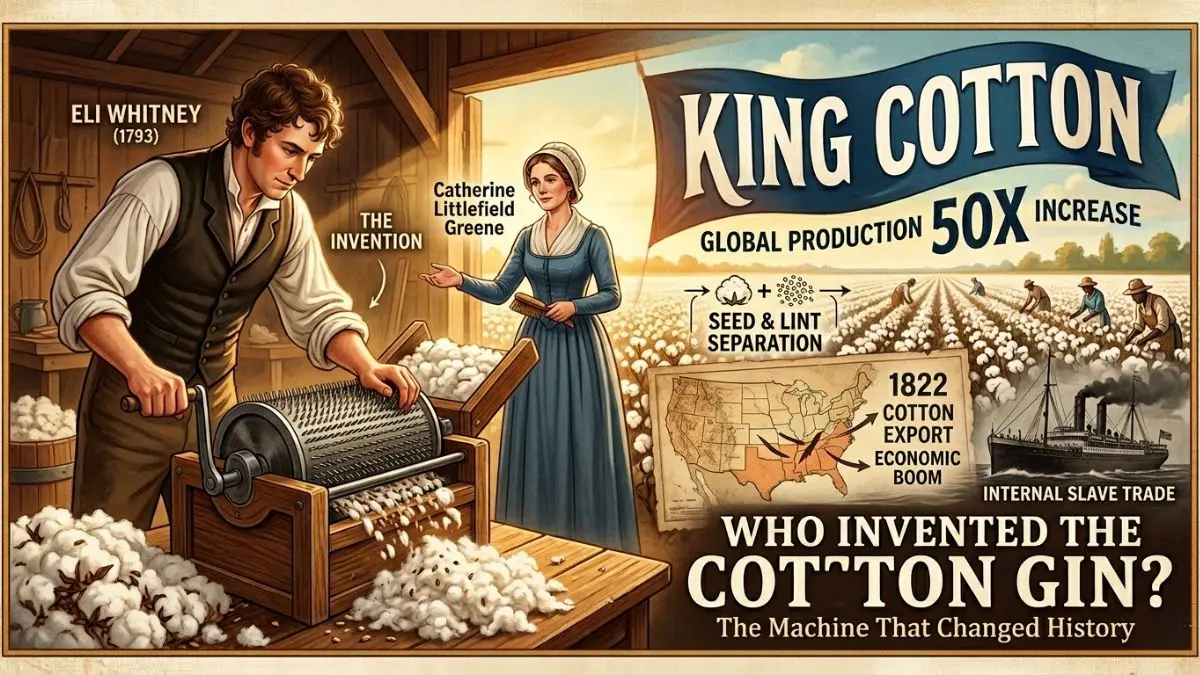
Whitney’s design may have also been based on earlier ideas. Some historians say it was partly inspired by methods enslaved workers already used by hand to separate cotton fibers. Catherine Greene is also often credited with sharing important ideas that helped improve the design, though historians still debate how much she contributed. Some even believe she suggested using wire teeth instead of wooden pegs.
Then in 1796, inventor Hogden Holmes received a patent for a cotton gin that used circular saws instead of spikes, though the patent was later canceled.
In the end, most of the credit went to Whitney alone. History often remembers one name, even when many people played a part.
From Yale to Georgia — A Tutor Becomes an Inventor
After graduating from Yale in 1792, Yale University, Eli Whitney had no money and no clear future plan. He wanted to study law, but first he needed to pay off his debts. He planned to go to South Carolina for a tutoring job.
But during his journey by ship, he met Catherine Greene, the widow of Revolutionary War hero General Nathanael Greene. She invited him to stay at her plantation, Mulberry Grove, near Savannah in Georgia.
The plantation mainly grew rice, and cotton was only a secondary crop. There, Whitney also met Phineas Miller, another Yale graduate who managed the plantation and later became Catherine Greene’s husband.
One day, several local plantation owners visited. They all complained about the same problem: short-staple cotton was very hard to clean because removing the seeds by hand took too much time. Because of this, they believed cotton could never be a profitable crop. Catherine Greene then pointed Whitney toward the problem.
Whitney started working in a secret workshop on the plantation. His idea came from a simple observation—watching a cat trying to pull a chicken through a fence. The cat could only pull out feathers, not the whole bird. That image gave him the idea for a machine that would pull cotton fibers through while leaving the seeds behind.
Within just a few weeks, he built a working model.
Machine Mechanism
- The cotton gin had four parts: Hopper – where the cotton was fed
- Revolving cylinder – which was fitted with wire hooks
- Mesh screen – through which the seeds could not pass, only the fiber
- Brush cylinder – which separated the clean cotton
Smaller gins could be operated by hand. Twelve versions by horse or water. Whitney wrote to his father:
“One man and a horse will do more than fifty men with the old machines. ‘Tis generally said by those who know anything about it, that I shall make a Fortune by it.”
That fortune never came.
Industrial Revolution in Cotton Production
Earlier, cotton production was very slow. One worker could only produce about 1 pound of cotton per day by hand.
Then Eli Whitney invented the hand-powered cotton gin, which made the process much faster. Now production increased to about 50–55 pounds per day per worker.
By the time of the Civil War, steam-powered cotton gins made production even higher — up to 2,500 pounds per day.
This invention completely changed the economy:
- In 1790, the U.S. produced less than 9,000 cotton bales
- By 1800, it increased to over 200,000 bales
- In 1793, cotton exports were less than 500,000 pounds
- By 1810, they rose to 93 million pounds
Later:
- From 1820 to 1860, cotton made up more than half the total value of U.S. exports
- By 1850, cotton accounted for 50% of America’s GDP, even more than manufacturing and railroads combined
The United States supplied about 75% of the world’s cotton. This cotton also powered the British Industrial Revolution, because their spinning and weaving factories depended heavily on raw cotton.
Business Model — and Why It Failed
Eli Whitney and his partner Miller had a clear business plan. They did not want to sell cotton gins directly. Instead, they wanted to install gins across the Southern states themselves—just like gristmills or sawmills worked.
Farmers were not allowed to own the machines. They had to bring their cotton to Whitney’s gins for processing. In return, Whitney would take 2/5 of the cotton as payment instead of cash.
But farmers saw this as an unfair and very expensive system. They called it an “excessive tax.” So, many farmers started copying Whitney’s design illegally and building their own machines.
At the same time, Whitney and Miller could not produce enough gins to meet demand. Because of this shortage, other manufacturers entered the market and started selling their own versions.
Whitney applied for his patent on October 28, 1793, and received it on March 14, 1794. But there was a major legal problem: under the Patent Act of 1793, it was very difficult to win patent lawsuits in court.
Because of this:
- Their company shut down in 1797
- A law change in 1800 allowed better legal protection, but by then only one year of patent life was left
- By 1807, the patent protection was practically useless
In simple terms: legal protection came too late—the market had already been taken over.
The problems didn’t stop there:
- Whitney’s factory in New Haven burned down
- Legal battles nearly bankrupted him
- Even though the business made around $90,000 gross, the actual profit was almost nothing
After some recognition of the patent:
- South Carolina offered to buy rights for $50,000, but delayed payment
- North Carolina earned about $30,000 through licensing
- Tennessee paid around $10,000
- Georgia courts still said protection did not fully apply
Whitney tried twice (in 1808 and 1812) to get Congress to renew his patent—but both times he was rejected.
In the end, Whitney famously said:
“An invention can be so valuable as to be worthless to the inventor.”
Slavery’s Impact — One of History’s Darkest Chapters
Before 1790, slave labor in the South was mostly used for crops like rice, tobacco, and indigo—but these crops were not very profitable. Even cotton was not profitable at that time because removing seeds from cotton was very difficult.
Everything changed after the invention of the cotton gin. It made cotton farming highly profitable, and this increased the demand for slave labor.
The numbers show how huge the change was:
- In 1790, there were about 6 slave states and around 790,000 enslaved people
- By 1860, there were 15 slave states and about 4 million enslaved people — an increase of more than 550%
Between 1790 and 1808, before the U.S. banned the import of enslaved Africans, Southern traders still brought in about 80,000 Africans. By 1860, roughly 1 in every 3 Southerners was an enslaved person.
As cotton became more profitable:
- Tobacco farmers, whose crops were declining in value, sold enslaved people to cotton plantation owners
- Some farmers who wanted to free enslaved people could not do so because they would suffer major financial loss
- Even in the North, where slavery was slowly being abolished, enslaved people were sometimes sold to the South for profit
- Free Black Americans were also at risk, as some were kidnapped and sold into slavery in the South
Over time, about one million enslaved people were forcibly sold within the United States. This internal slave trade became one of the largest forced migrations in history, breaking apart countless families.
Many historians believe the cotton gin indirectly helped set the stage for the Civil War, because it strengthened the Southern plantation economy so much that the South became willing to fight to protect its way of life.
Trail of Tears — Cotton’s Hidden Cost
In 1803, the Louisiana Purchase opened up the Mississippi River Valley for farming and agriculture. But this land originally belonged to Native American tribes.
In 1830, President Andrew Jackson signed the Indian Removal Act, which forced Native Americans to leave their ancestral lands. As a result, at least 50,000 Native Americans were forcibly removed from their homes.
During this forced migration, many people suffered from hunger, cold, disease, and exhaustion. Thousands died along the way, and this tragic journey became known as the “Trail of Tears.”
After they were removed, their lands did not remain empty. These areas were quickly taken over and turned into cotton plantations, which became highly profitable due to the cotton boom.
Why Immigrants Avoided the South (1850s)
In the 1850s, most immigrants settled in the Northern states—about 7 out of 8 immigrants chose the North. This is because the North had around 72% of America’s manufacturing industry, offering more jobs in factories and cities.
The South, however, was very different:
- Its economy depended mainly on cotton plantations
- Land and enslaved labor were very expensive
- There was very little industry or factory development
Because of this, the South became a single-crop economy (cotton only), which made it less diverse and economically weaker compared to the North.
Whitney’s Musket Contract — The Surprising Story
In 1798, Eli Whitney was almost bankrupt when he received a government contract worth $800,000 to produce muskets and cannons. This was during fears of war with France.
The terms were strict:
- He had to deliver 10,000–15,000 muskets by 1800
- He had never built guns before
- He still got the contract due to political connections and confidence in his ideas
Later, Whitney began talking about interchangeable parts (parts that can be swapped between machines). He demonstrated this idea in 1801 to government officials.
However, historians later found that:
- The demonstration was likely staged
- The system was not fully working at that time
- Whitney had already moved focus back to his cotton business during much of this period
The idea of interchangeable parts also was not entirely his:
- Earlier engineers in France like Gribeauval, Blanc, and de Tousard had already developed similar ideas
- In America, John H. Hall and Simeon North actually achieved working systems before Whitney’s success
Whitney’s musket deliveries were also delayed by about 9 years, finally completed in 1809 instead of 1800.
Whitney’s Real Contribution
Even though many of his claims about invention were overstated, Whitney did make a real and lasting contribution:
- He helped develop early ideas of cost accounting
- He showed how to calculate the true cost of production, including hidden expenses like insurance and machinery
- This improved understanding of industrial efficiency and pricing
Connections Saved Whitney
Eli Whitney was not just an inventor—he was also very skilled at using his social and political connections, especially from Yale University.
In his arms manufacturing business, many government contracts came to him because of these connections:
- Oliver Wolcott Jr., the U.S. Treasury Secretary, was also a Yale graduate
- James Hillhouse, a powerful political leader and developer in New Haven, supported him
- These relationships helped Whitney get trust and opportunities in government work
In 1817, Whitney married Henrietta Edwards, which further strengthened his position in elite society. She came from a very influential family:
- Her grandfather was the famous religious leader Jonathan Edwards
- Her father, Pierpont Edwards, was a leader of the Democratic Party in Connecticut
- She was also related to Timothy Dwight, the president of Yale
Through this marriage, Whitney became part of Connecticut’s powerful ruling elite. In a business that depended heavily on government contracts, these connections were extremely important—not just helpful, but almost necessary.
Milling Machine — Another disputed credit
Historian Joseph W. Roe later credited Whitney (around 1818) with creating one of the first milling machines.
But later research showed:
- Many inventors were working on similar machines between 1814–1818
- Some were more important contributors than Whitney
- The machine Roe saw may have even been built after Whitney’s death (around 1825)
So, like the interchangeable parts idea, the milling machine was not solely Whitney’s invention.
Final years
In his last years, Whitney suffered from prostate cancer. Even while sick, he continued inventing simple mechanical devices to reduce his pain. He remained an inventor until the end.
He died on January 8, 1825, in New Haven, Connecticut, just one month before his 59th birthday.
His son, Eli Whitney III, later managed the Whitney Armory and helped develop the New Haven water system.
Eli Whitney’s cotton gin made the South extremely rich by boosting cotton production. At the same time, his manufacturing ideas helped the North become strong enough to win the Civil War.
In a strange twist of history:
- The same invention that helped protect slavery in the South
- Also helped create the industrial power that destroyed it in the North
As the U.S. National Archives explains:
“If his genius led King Cotton to triumph in the South, it also created the technology with which the North won the Civil War.”
Conclusion
Whitney’s life started humbly. He was a curious child who fixed and rebuilt his father’s tools. Despite family opposition, he reached Yale University and became a top graduate.
He was an inventor who could build machines quickly—but then spent most of his life fighting legal and financial battles over those inventions.
His one machine—the cotton gin—changed everything:
- It transformed the entire Southern economy
- Made cotton the “king crop”
- Increased slavery instead of reducing it
- Forced around one million people into internal slave trade
- Led to the displacement of 50,000 Native Americans
- Helped push the United States toward the Civil War
- And later helped the North win that same war through industrial strength
As historian Margaret Washington said:
“Progress has different meanings for different people — what was progress for white people was enslavement and further degradation for African Americans.”