
The Complete History of the Doorknob: From Ancient Egypt to Osbourn Dorsey’s 1878 Innovation
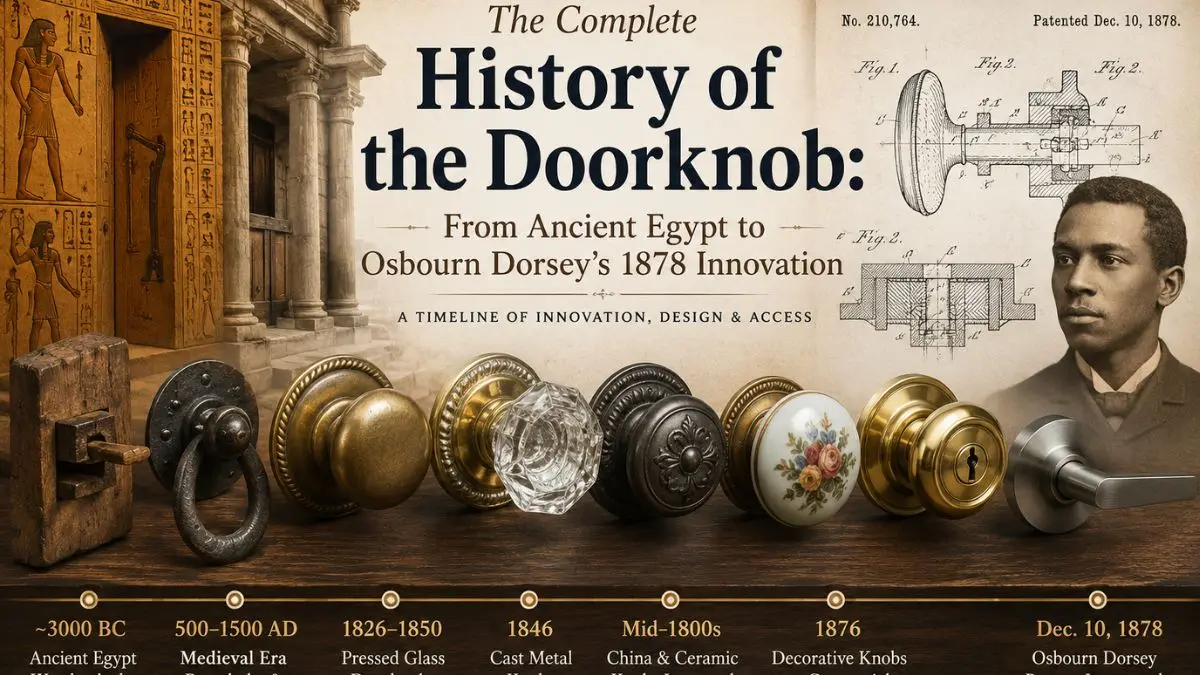
For thousands of years, people used doors without modern doorknobs. They opened and closed doors with latches, handles, wooden bars, leather straps, and bolts. At that time, people did not use round knobs like we see today.
Who Invented the Doorknob? Many people believe that the doorknob was invented in 1878 by Osbourn Dorsey, a young African-American inventor. He received a patent for a doorknob with a built-in locking system.
However, the full story is more interesting. Different types of doorknobs already existed before 1878. What Osbourn Dorsey actually invented was a better and more advanced design. His invention improved the way doors opened and locked, and it helped shape the modern doorknob we use today.
Who Invented the Doorknob? Full History
Ancient Egypt (3000 BC): Where the Story Started
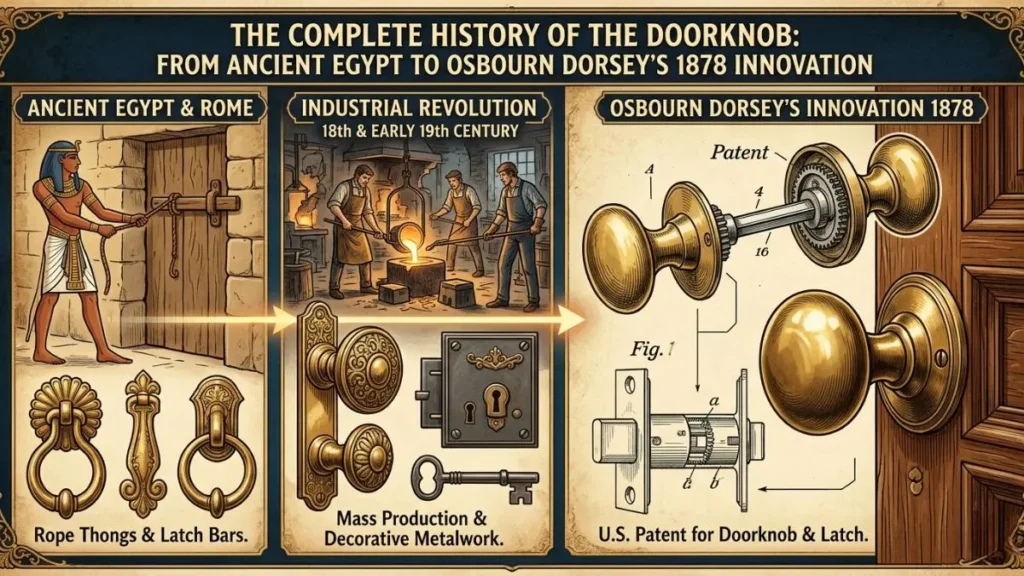
People started using doors and simple door hardware thousands of years ago. Around 3000 BC, people in Ancient Egypt built wooden doors and used basic wooden locking systems to keep their homes and buildings safe.
The ancient Egyptians invented one of the earliest door locks in history. They made these locks completely from wood and used a simple pin system to lock and unlock doors. Even today, many modern locks still use the same basic idea. This proves that Egyptian builders and engineers were very skilled for their time.
Ancient Egyptian paintings and artwork also show wooden doors, cloth curtains, and locking systems. These discoveries show that people cared about privacy, safety, and security even in ancient times.
Greek and Roman Improvements
Later, the Greeks and Romans improved door technology and made it stronger and more practical. They created better hinges and stronger metal hardware for doors.
Archaeologists have found ancient Greek and Roman hinges that look very similar to the hinges people use today. The Romans often used bronze to make door hardware because it was strong and lasted a long time.
These improvements made doors safer, stronger, and easier to open and close.
Must Read: Who Invented Homework and Why ? The Facts and History of Homework
Must Read: Who Invented Wi Fi? The Shocking Story of Hollywood Actress Hedy Lamarr!
Must Read: Real History of Zipper? Result of 20 Years of Failure and Continuous Hard Work
Must Read: Who Invented the Toothbrush? The Prison Invention that Cleaned up the World!
King Solomon’s Famous Doors
Ancient kings also understood the value of strong and beautiful doors. Historical records say that King Solomon used olive wood to build special doors for his temple.
This shows that people did not only use doors for protection. They also used them to show beauty, importance, and power.
Medieval Period: Doors for Safety and Privacy
The Dark and Middle Ages (500–1500 AD)
During the Middle Ages, people used doors very differently from the way we use them today. Most families lived together in one large room, so they did not need many inside doors for privacy.
People mainly used doors for safety and protection. To protect their homes from thieves or attacking soldiers, families blocked the main entrance with heavy wooden beams made from strong oak wood.
During the daytime, people often kept doors open to let fresh air inside. Open doors also helped smoke from cooking fires move out of the house. At that time, locks were expensive, so most ordinary people could not afford them.
Privacy Became More Important (Late 1500s)
In the late 1500s, society slowly changed. Kings, queens, and wealthy families started building larger homes and palaces with separate rooms. Because of this, people needed doors for privacy as well as security.
At first, rich families used large woven cloth coverings and tapestries as room dividers. Later, wooden doors became more common. Blacksmiths made simple metal strap hinges by hand to hang these doors.
Before modern locks existed, people used wooden or metal bolts to lock doors. Workers fixed these bolts into stone walls for extra strength. Poor families still used cloth curtains or simple wooden dividers, while wealthy people began using stronger and more advanced door hardware.
What People Used Before Doorknobs
Before modern doorknobs became popular, people opened and closed doors in many different ways.
Latch Strings
Most ordinary people used a latch-string system. They made a small hole in the door and passed a leather strap or string through it. Inside the house, the string connected to a wooden bar that kept the door closed.
Leather Straps and Wooden Beams
In the 1500s, many doors opened with leather straps instead of knobs or handles. People locked doors by placing a large wooden beam across the entrance to stop anyone from entering.
Rim Locks and Mortise Locks
Over time, people created better locking systems such as rim locks and mortise locks. These locks improved security, but they still did not include the simple turning doorknob system that people use today.
These early inventions slowly helped create the modern doors and locking systems we now use every day.
Colonial and Early American Period: Growth of Door Hardware
Wooden Doors and Simple Latches
In early American colonies, people used simple wooden doors. They added wooden latches to keep the doors closed. These latches helped people secure their homes without expensive locks.
Only rich people could afford metal locks at that time. So most families depended on wooden systems. This period slowly moved door design from old medieval styles toward more modern home setups.
1800s: Growth of Doorknobs
In the 1800s, doorknob design improved very quickly. Inventors worked hard to make doors easier to use.
Between 1830 and 1873, people filed 100 doorknob patents in the United States. This shows that many inventors focused on improving door systems.
In 1876, round decorative doorknobs appeared at the Centennial Exposition. This proves that round knobs existed before 1878, even though later inventions improved them further.
Materials Used Before 1878
People used different materials to make doorknobs:
- Pressed glass knobs (1826–1850): People liked shiny glass knobs
- Cast metal knobs (1846): Strong metal knobs became popular
- Cut glass knobs: People used them until around 1910
- Ceramic and china knobs (mid 1800s–early 1900s): Imported from Europe and used in many homes
- Spindle knobs (late 1800s): New designs came into use
Each material made doorknobs stronger, cheaper, or more beautiful.
Important Inventions Before Dorsey
Before Osbourn Dorsey, many inventors already improved locks:
- In 1805, Abraham O. Stansbury created an early pin tumbler lock design
- In 1848, Linus Yale Sr. improved the lock system further
These inventions helped build the base of modern door locks we use today.
The Critical Question: What Did Dorsey Actually Invent?
Myth vs Reality
Many modern articles say that Osbourn Dorsey invented the doorknob in 1878. This idea is not fully correct.
Dorsey did not invent the doorknob itself. Instead, he improved it in a major way. He created an integrated door system where the knob and latch worked together.
Before his invention, people used knobs and locks as separate parts. A knob only helped people pull or turn the door. The real lock system worked separately using bolts, rim locks, or mortise locks.
Dorsey combined these parts into one simple system. His design made doors easier and faster to use.
Old Records and Evidence
Old newspapers show that doorknobs already existed before 1878. For example, records like the 1833 Phenix Gazette mention doorknobs in use decades earlier.
But those early doorknobs did not have internal locking systems like Dorsey’s design. They only helped with turning the door, not locking it properly.
So, earlier systems had knobs and locks, but they did not work together in one unit.
Who Was Osbourn Dorsey?
Osbourn Dorsey was born during a very difficult time in American history. Records show he was born around 1862 in Virginia and was born into slavery.
He became free as a baby when slavery ended in Washington DC. He grew up in a free environment, which gave him a chance to learn and develop skills.
His family also gained freedom, although they had to pay compensation to their former enslaver.
From Blacksmith to Inventor
Dorsey learned skills on his own. He first worked as a blacksmith, where he learned how to work with metal.
Later, he became interested in inventing new machines. He also worked different jobs, including as a butcher when he was young.
His hands-on experience helped him understand how tools and machines worked.
The 1878 Patent
On December 10, 1878, Osbourn Dorsey received patent number 210,764.
His invention improved door systems by adding an internal latch mechanism connected to the knob. This made doors easier to open and close.
His design used metal parts like cast iron, which made it strong and long-lasting.
At that time, people used many different door systems, but his idea made the process simpler and more modern.
His Age at the Time
Some records say Dorsey was about 16 or 17 years old when he received the patent. Exact details are unclear because historical records are limited.
If true, this makes his achievement even more impressive because he was still very young.
Other Inventions
Dorsey did not stop after the doorknob. He created many other useful machines:
- He invented a clothes wringer to help with washing clothes
- He created a machine for making horseshoes faster
- He improved steam engine regulators
- He designed a machine for making thread spools
- He also worked on fire escape systems
- He invented a machine for making bricks
These inventions show that he focused on making daily life and industry easier.
Historical Confusion
There is some confusion in history because more than one person named Osbourn Dorsey lived in Washington DC at that time.
Because of this, researchers sometimes mix their records. But historical evidence shows that the inventor Dorsey was a real person with multiple innovations.
The Industrial Revolution: Making Doorknobs for Everyone
From Luxury to Everyday Use
The Industrial Revolution changed how people made doorknobs. Factories started producing them in large numbers, which made them cheaper and easier to buy.
Before this time, only rich people could afford strong locks and door hardware. Poor families often left their doors simple and kept valuables in small locked boxes.
But after industrial production began, doorknobs became common in almost every home. Osbourn Dorsey helped introduce an important improvement at the right time, when factories could produce his design on a large scale.
Around 1900: Big Improvements
Around the year 1900, doorknobs became even better. Manufacturers added ball bearings inside the mechanism.
These ball bearings helped doorknobs turn more smoothly and last longer. This was one of many small improvements during the Industrial Age.
By the early 1900s, doorknobs became standard in homes across America and Europe. They were no longer luxury items — they became everyday household objects.
Modern Era: Better Materials and Design
Brass Becomes the Most Popular Material
Today, many doorknobs use brass. Brass is strong and long-lasting, which makes it very useful for daily use.
Modern manufacturers now use forged brass instead of cast brass. They heat the metal to high temperatures and press it into shape. This process makes doorknobs stronger and more durable.
Decorative Door Designs
Doorknobs are not only functional now — they also look decorative. As factories grew, designers started making different styles to match home interiors.
Modern designs include styles like:
- Art Deco
- Minimalist designs
- Old-style Georgian and Tudor designs
People now choose doorknobs not just for use, but also for home beauty.
Victorian and Revival Styles
During the Victorian era and later revival periods, people liked classic door designs.
- Beehive knobs: These came from the Georgian era. People used them in Victorian homes too. They still appear in modern vintage-style houses.
- Lever handles: These became popular in the 1900s. People found them easier to use than round knobs, especially for children and elderly people. They are now common on many modern doors.
The Hidden History: Why Dorsey’s Story Matters
Lack of Recognition
Osbourn Dorsey lived during a time when racial discrimination was very strong. Because of this, history does not record much about his personal life.
Many African American inventors like him did not receive full recognition for their work, even when their inventions changed the world.
His Lasting Impact
Even though we know little about his life, Dorsey’s invention had a strong impact. His design helped improve how people open and close doors in daily life.
Why the 1878 Story Became So Popular
People wrongly believe that Osbourn Dorsey invented the doorknob in 1878 because AI tools and websites repeat a simple version of history. These sources often shorten the real story, so the same idea spreads everywhere, even if it is not fully correct.
Some people also say his invention was mainly for helping disabled people, but history does not strongly support this. Dorsey mainly improved how door systems worked. Other types of door handles already existed in different places before his patent.
The Timeline
| Period / Year | Development |
|---|
| ~3000 BC | Ancient Egypt develops wooden door locks with pin tumbler mechanisms |
| 970–931 BC | King Solomon builds temple doors from olive wood |
| Ancient Greece & Rome | Bronze hinges similar to modern designs are created |
| 500–1500 AD | Medieval period relies on simple bars and bolts for security |
| Late 1500s | Wealthy households begin using hand-forged strap hinges and tapestry doors |
| 1643–1715 | During the reign of Louis XIV, decorative gilded doorknobs become fashionable |
| 1805 | Abraham O. Stansbury patents the double-acting pin tumbler lock |
| 1826–1850 | Pressed glass doorknobs become popular |
| 1833 | Newspaper records show doorknobs already in common use |
| 1846 | Cast metal doorknobs are introduced |
| 1848 | Linus Yale Sr. improves lock mechanisms |
| 1868 | Charles Eastlake publishes Hints on Household Taste |
| 1873 | James Sargent invents the first time-delay “digital” lock |
| 1876 | Decorative round knobs appear at the Centennial Exposition; Colonial Revival begins |
| December 10, 1878 | Osbourn Dorsey patents an integrated door-latching mechanism (Patent #210,764) |
| 1880 | Dorsey develops additional patents, including a horseshoe manufacturing machine |
| 1881 | Dorsey receives a horseshoe manufacturing patent |
| 1882 | Dorsey patents an improved steam engine governor |
| 1889 | Dorsey patents a thread spool manufacturing machine |
| 1894 | Samuel Segal patents an early electronic door lock |
| Mid-1800s–Early 1900s | China and ceramic doorknobs imported from Europe gain popularity |
| Late 1800s | Spindle knobs are introduced |
| 1900 | Ball bearing doorknobs are introduced |
| Early 1900s | Lever handles become increasingly popular |
| 1966 | James H. Felt founds Latch Co. |
| 1968 | Yale’s Senseo electronic locks go on sale internationally |
| 1969 | Schlage acquires Latch Co. and expands electronic door lock development |
| 1990 | Americans with Disabilities Act (ADA) establishes accessibility standards for doors |
| 1995 | SimonsVoss introduces one of the first digital locking systems with electronic credentials |
| 2010s–Present | Smart locks with Bluetooth, RFID, biometrics, and smartphone integration dominate the market |
| Today | Forged brass remains highly popular while AI-powered and facial-recognition smart locks continue emerging |
From Mechanical to Electronic and Smart Locks
Early Electronic and Mechanical Innovations
Door locks slowly changed from simple mechanical systems into early electronic systems. Inventors like James Sargent and Samuel Segal made early designs for time-based and electronic locks in the late 1800s. These inventions helped build the base for modern security systems we use today.
The Rise of Keypads and Remote Access
In 1960s and 1970s, companies developed keypad entry systems and radio-controlled locks. These systems allowed people to enter buildings using codes instead of physical keys. This made access control easier in homes and commercial buildings.
The Smart Lock Era
Modern smart locks now use Bluetooth, Wi-Fi, and smartphone apps. They also include biometric systems like fingerprint and facial recognition. These features allow users to control doors remotely and improve security with real-time monitoring.
Accessibility and Modern Door Design
The ADA changed door design rules in 1990. It required doors to be easy to use without twisting or heavy force. Because of this, lever handles became more common than round doorknobs in public buildings.
Decorative Door Hardware Through History
Door hardware also became decorative over time. The Victorian era introduced engraved brass knobs, matching hardware sets, and artistic designs. Later styles like Art Deco, Bauhaus, and Colonial Revival shaped modern aesthetics.
FAQs
Who invented the first doorknob?
No single person invented the first doorknob. It evolved over time, and many inventors improved it.
Did a Black man invent the door knob?
Osbourn Dorsey improved the doorknob system in 1878, but he did not invent the very first doorknob.
Did Romans have door knobs?
No, Romans did not use modern doorknobs. They used keys, bolts, and metal locks instead.
What did we use before door knobs?
People used latches, bolts, wooden bars, leather straps, and ropes to open and close doors.
Why do people put socks on doorknobs?
People put socks on doorknobs to block sound, show privacy, or reduce noise when locking a door.
When did doorknobs become popular?
Doorknobs became popular in the 1800s and became common in most homes by the early 1900s.