
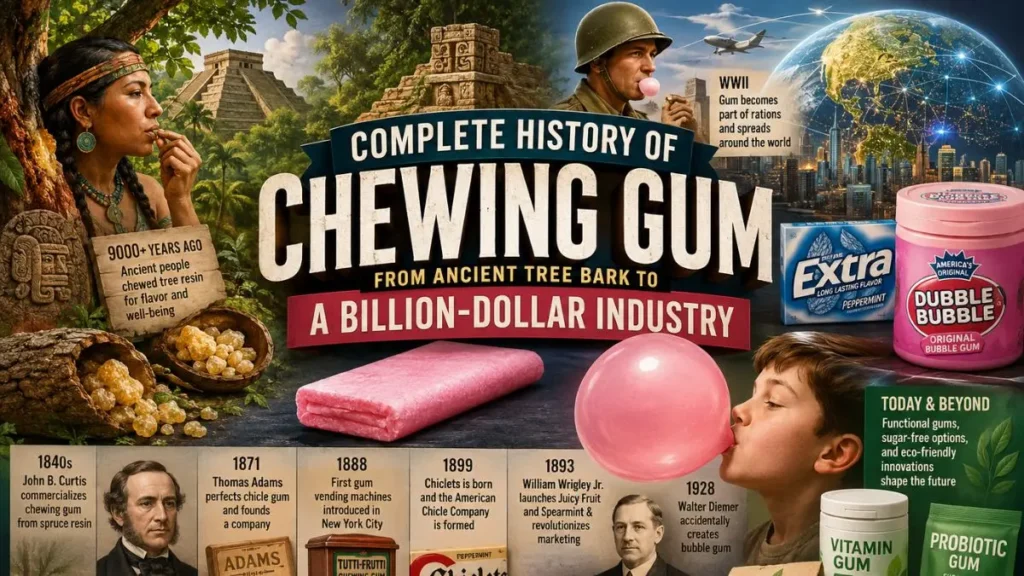
Complete History of Chewing Gum From Ancient Tree Bark to a Billion-Dollar Industry
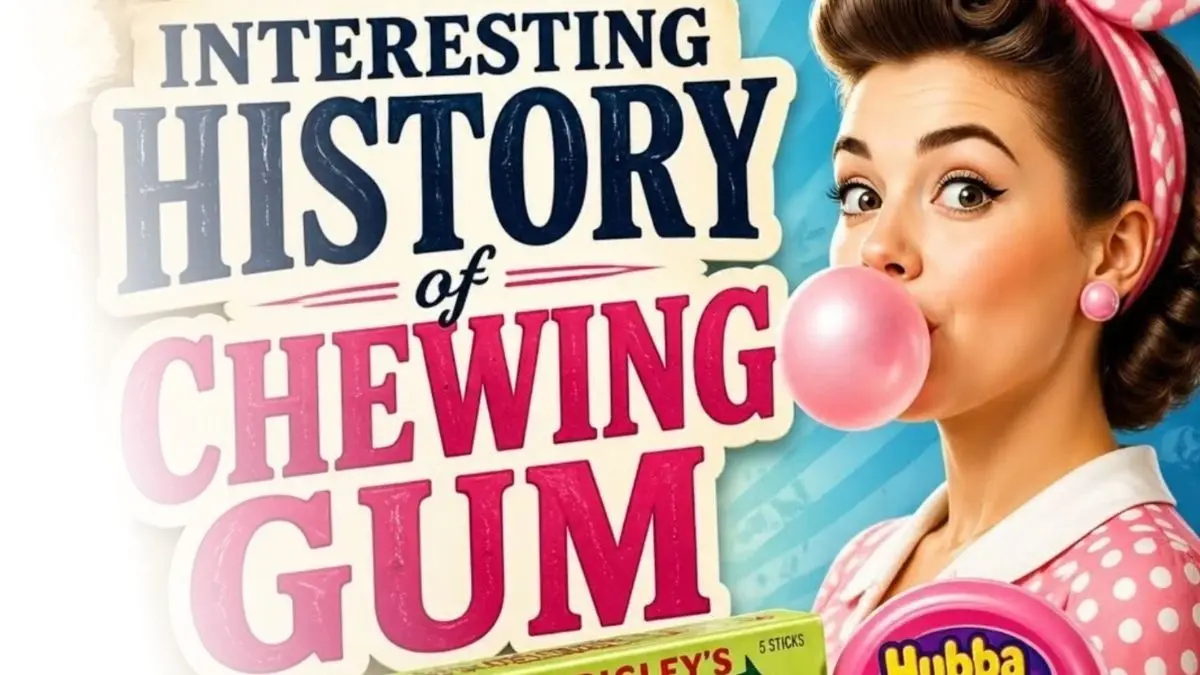
Who Invented Chewing Gum? Chewing gum was first commercially invented by John B. Curtis, who made and sold spruce resin gum in the 1840s.
Many people chew gum to freshen their breath or simply enjoy the taste and fun. But have you ever thought about where chewing gum came from? This soft, rubber-like treat has a long and surprising history. Chewing gum has existed for thousands of years and is linked to ancient civilizations, a Mexican general, and even a photographer.
The Ancient History of Chewing Gum
Long before chewing gum became a popular product, people around the world were already chewing natural substances from trees and plants. Different ancient civilizations discovered their own versions of gum, showing that humans have enjoyed chewing things for thousands of years.
The Greeks and Mastic Resin
About 2,500 years ago, the ancient Greeks chewed a natural resin called mastic, which came from the mastic tree. People believed it helped with health problems like stomach pain and colds. Modern studies later showed that mastic can actually help digestion and lower cholesterol.
Mastic was mainly produced on the Greek island of Chios. The resin dropped from the trees like tiny tears, which is why it became known as the “Tears of Chios.” The resin was extremely valuable. During the Byzantine period, it was even considered worth more than gold. Special fortified villages protected the mastic trade, and stealing it could lead to severe punishment.
The Mayans and Chicle
In Central America, the Mayans chewed a natural tree sap called chicle, taken from the sapodilla tree. They used it to reduce hunger, fight thirst, and clean their mouths. The Mayans also believed chewing chicle had spiritual importance and helped connect them with their gods.
The word “chicle” came from the Nahuatl word “tzictli,” which means “sticky stuff.”
The Aztecs and Gum Rules
The Aztecs later turned gum chewing into a social custom with strict rules. According to historical records, young unmarried women could chew chicle in public without any problem. Married women could also chew it, but usually in private. Women often used it to freshen their breath.
Men also chewed chicle to clean their teeth, but public chewing was seen as embarrassing because it was mostly linked with women.
When Spanish explorers arrived in the Americas, they became interested in chicle because it tasted sweet and helped reduce hunger. This discovery later played an important role in the creation of modern chewing gum.
Native Americans and Spruce Resin
In North America, Native Americans chewed spruce tree resin. European settlers saw this habit and quickly adopted it themselves. Over time, this practice helped inspire the first commercial chewing gum products in North America.
Finland’s 5,000-Year-Old Gum
In 2007, archaeologists in Finland discovered the oldest known piece of chewing gum. It was around 5,000 years old and still had teeth marks on it. The gum was made from birch bark tar, which contained natural antiseptic chemicals. This suggests ancient people may have chewed it not only for enjoyment but also to keep their mouths healthy.
The First Commercial Chewing Gum
During the 1840s, an American man named John B. Curtis saw that people already enjoyed chewing natural tree resin. He decided to turn this habit into a business opportunity. Curtis collected spruce resin from trees, boiled it, cleaned out the impurities, and shaped it into small strips.
In 1848, he introduced “The State of Maine Pure Spruce Gum,” which became the first chewing gum sold commercially. The product quickly became popular. At its peak, Curtis’s factory produced around 1,800 boxes of gum every day and employed more than 200 workers.
However, spruce gum had one major problem. It tasted strongly like a tree and became hard and brittle while chewing. Many people removed the gum from their mouths and dipped it in powdered sugar to improve the taste. Ironically, this probably caused more damage to their teeth.
Must Read: When and Who Really Invented Ice Cream? A Delicious Mystery Through Time
Must Read: The Real History of Pizza: Who Invented It and How It Became Global
William Semple and Rubber-Based Gum
As spruce gum became popular, some inventors tried to create better versions. One of them was William Semple, a dentist from Ohio. In 1869, he patented a new type of chewing gum made from rubber.
Unlike traditional gum, Semple’s gum was not sweet. Instead, it could be flavored, and he believed the rubber could help clean teeth because of its rough texture. His idea was one of the earliest attempts to connect chewing gum with dental health.
Semple created his gum by dissolving rubber in chemicals and mixing it with ingredients like chalk and powdered licorice root. Although the idea was innovative, the product did not become popular. Most people preferred sweeter and more natural gum options.
Even though Semple’s invention failed commercially, his ideas helped shape the future of chewing gum and its connection to oral hygiene.
Who Invented Chewing Gum? Modern Chew Gum
The story of modern chewing gum really begins with an unusual partnership between an American inventor and a Mexican general.
The Exiled General and His Idea
After losing the Battle of the Alamo in 1836 and facing political problems, Antonio López de Santa Anna, the former President of Mexico, went into exile in the United States.
Sometime in the mid-1850s, he arrived with a natural material called chicle. He believed it could be turned into rubber for making things like carriage tires. He hoped this invention would make him rich again and help him regain power. However, this idea was not successful.
Meeting Thomas Adams
To try his plan, Santa Anna needed help and found an American inventor and photographer named Thomas Adams, who lived in New York. Adams became interested and started experimenting with chicle.
He tried to turn it into rubber products such as toys, masks, rain boots, and bicycle tires. But all of his experiments failed because chicle was too soft to become proper rubber.
The Idea That Changed Everything
After almost a year of failure, Adams felt disappointed. One day, he saw a girl buying wax chewing gum in a drugstore. This reminded him of Santa Anna and chicle.
Then he had a new idea—if chicle cannot become rubber, why not use it as chewing gum?
The First Chewing Gum Success
Adams boiled chicle in his kitchen, added flavor, and made a simple gum. He gave it to a pharmacist, and people liked it.
His son, Thomas Jr., helped him sell the product. He suggested packaging it and selling it during his travel sales trips.
In February 1871, Adams’ gum called “Adams New York Gum” was sold in drugstores for one penny each. It came in colorful wrappers and became very popular quickly.
Because of this success, Adams created a machine to produce gum in large amounts. This made him one of the key founders of the modern chewing gum industry.
Building an Empire
Thomas Adams continued improving his chewing gum business and became a true industry pioneer.
Adams promoted his gum with a catchy slogan:
“Adams’ New York Gum No. 1 — Snapping and Stretching.”
In 1884, he launched Black Jack, a licorice-flavored chewing gum. It became very popular and is still sold even today, more than a century later.
Vending Machine Revolution
In 1888, Adams introduced another big innovation called Tutti-Frutti gum. The special thing about this gum was not only the flavor but also how it was sold.
He placed gum vending machines in New York City subway stations. These machines allowed people to buy gum directly without a shopkeeper. This was one of the first examples of automated retail sales and changed how products were sold.
Chiclets and Global Fame
In 1899, Adams launched Chiclets, a gum named after the natural chicle base used in its production. Chiclets became one of the most famous chewing gum brands in the world and is still sold globally today.
Formation of a Big Company
That same year, Adams merged his business with other gum companies to create the American Chicle Company. He became the first chairman of this powerful new company, which dominated the gum market for many years.
Later Years and Legacy
Adams later stepped down from active leadership but stayed on the company board until his old age. He died in 1905 at the age of 87.
After his death, his company continued to grow:
- It was bought by a pharmaceutical company in 1962
- Later renamed “Adams” in 1997 to honor him
- In 2002, it was acquired by Cadbury for billions of dollars
Today, brands like Chiclets are still sold worldwide, showing how Adams’ small kitchen experiment turned into a global industry.
The Marketing Revolution: William Wrigley Jr.
After Thomas Adams helped create chewing gum as a product, William Wrigley Jr. changed how the entire gum industry worked. He was not just a manufacturer—he was a master of marketing and advertising.
From Soap Salesman to Gum Business
Wrigley started his career selling soap in Philadelphia. Later, he moved to Chicago in 1891 and tried a smart business idea.
He gave store owners free baking powder when they ordered his soap. Surprisingly, customers liked the baking powder more than the soap itself.
So he changed his strategy and started giving free chewing gum with baking powder orders. Soon, he noticed something important—people were more interested in the gum than the baking powder.
Turning Point: Focus on Gum
Seeing this demand, Wrigley made a big decision. He stopped focusing on baking powder and fully switched to chewing gum.
In 1893, he launched two famous gum brands:
- Juicy Fruit
- Wrigley’s Spearmint
These brands became extremely popular and are still known worldwide today.
The Power of Advertising
Wrigley’s biggest strength was advertising. He understood how to connect with people emotionally.
In 1915, his company sent free gum samples to every person listed in American telephone directories. This helped spread awareness across the entire country.
He also sent gum to children on their birthdays to build positive memories linked with his brand.
Changing Everyday Life
Wrigley’s marketing made chewing gum more than just a product—it became part of daily life. It was connected with:
- happiness
- youth culture
- sports
- movies and entertainment
Because of his smart advertising, gum became a normal habit for millions of people.
The Accidental Birth of Bubble Gum
For many years, chewing gum was mainly used for fresh breath and simple enjoyment. But inventors also dreamed of creating gum that could be blown into bubbles.
Early Experiments: Frank Fleer
An early gum company owner named Frank Fleer tried to create bubble gum in the early 1900s. In 1906, he made a product called Blibber-Blubber.
It was an interesting idea, but it had problems. The gum was too sticky and messy, so it was not practical to use. Because of this, it failed in the market.
The Big Accident: Walter Diemer
Many years later, in 1928, an accountant named Walter Diemer was working at the Fleer Gum Company. While experimenting with gum recipes, he accidentally created a new formula.
This new gum was different. It was:
- less sticky
- more stretchy
- perfect for blowing bubbles
Without planning it, he had created the first successful bubble gum.
Dubble Bubble Becomes Popular
Diemer’s invention was named Dubble Bubble. It quickly became very popular, especially among children and teenagers.
For the first time, chewing gum was not just for fresh breath—it became fun entertainment. People enjoyed blowing bubbles and competing to make the biggest ones.
The Pink Color Accident
There is also a fun story behind bubble gum’s pink color. When Dubble Bubble was first made, the factory only had pink food coloring available. So the gum turned pink by accident.
That accident became a tradition, and even today most bubble gum is still pink.
The Global Phenomenon: Why Gum Won
Chewing gum became popular in America through companies like Adams and Wrigley, but it was a global war that turned gum into a worldwide habit.
World War II and Chewing Gum
During World War II, American soldiers were given chewing gum as part of their daily food supplies.
Gum helped soldiers in many ways:
- reduced stress
- kept their mouths from getting dry
- helped with oral hygiene
- kept them alert during long missions
As soldiers moved across Europe, Asia, Africa, and the Pacific, they also shared gum with local people. This made gum a symbol of American lifestyle and culture.
After the War: Global Popularity
After the war ended, American culture became very influential around the world. Chewing gum spread alongside other cultural icons like movies, music, and soft drinks such as Coca-Cola.
Soon, gum was no longer just an American product—it became a global habit.
Change from Natural to Synthetic Gum
After the war, demand for chewing gum increased very quickly. Natural chicle, which comes from trees in Central America, could not meet this huge demand.
By the 1960s, companies started using synthetic materials instead of natural chicle. These included:
- synthetic rubber bases
- plastic-like compounds
These new materials were cheaper, easier to produce, and gave more consistent texture and flavor.
Today’s Gum Industry
Even today, some companies still use natural chicle to keep the traditional method alive and appeal to eco-friendly consumers. But most modern chewing gum is made using synthetic ingredients.
How Modern Gum Is Made (Simple Version)
Today’s chewing gum is made using a careful mix of science and manufacturing.
The process starts with a gum base, which can be natural chicle or synthetic rubber. To this base, companies add:
- sweeteners
- flavors
- softeners (to keep it soft and chewy)
The mixture is heated, then cooled and rolled into thin sheets. After that, it is cut into small pieces or shapes. Finally, it is coated with a shiny layer that helps lock in the flavor.
Modern factories can produce millions of gum pieces every day, which is very different from the early kitchen experiments of Thomas Adams.
The Future of Gum: Health and Wellness
Chewing gum is no longer just for fresh breath. Today, it is becoming part of the health and wellness industry.
Functional Gum: Modern companies are adding active ingredients into gum, such as:
- vitamins
- minerals
- caffeine
- probiotics
- CBD
This type of gum is called functional gum, because it does more than just taste good—it may also support health.
Why It Works: When you chew gum, the mouth can absorb ingredients quickly through its inner lining. This makes gum a fast and easy way to deliver certain substances without needing water or pills.
Health and Smoking Help: One of the biggest uses of functional gum is smoking cessation gum (nicotine gum). It helps people reduce smoking habits and is now widely used as part of quitting programs.
Sugar-Free Gum Trend: Today, more than half of the global gum market is sugar-free gum. People prefer it because it is better for teeth.
Dentists even say that chewing sugar-free gum after meals can help reduce cavities and keep teeth cleaner.
A New Problem: Environment and Plastic Gum
There is also an environmental concern. Most modern gum uses synthetic materials that behave like plastic. When thrown away, gum can take a very long time to break down.
Because of this, new companies are now creating eco-friendly gum made from natural ingredients like chicle again.
Some brands are trying to bring gum back to its original natural form, making it biodegradable and better for the environment.
The Market Today: A Global Industry
Chewing gum is now a huge global industry. It has become popular all over the world for many simple reasons.
People like gum because it is:
- easy to carry anywhere
- cheap to buy
- lasts a long time in the mouth
- useful for many things like fresh breath, stress relief, better focus, and even entertainment
Wrigley’s strong marketing also helped a lot. Over time, gum became not just a product, but a daily habit and lifestyle for many people.
Global Market Growth
Today, chewing gum is a billion-dollar industry. In 2025, the global market value reached around $29.89 billion, and it is still growing.
The industry is expanding mainly in regions like Asia and Latin America, where more people are starting to use gum every year.
An interesting change is that Turkey became the largest gum exporter in 2024–2025, even more than the United States. This shows how global the gum business has become.
At the same time, countries like China and India are seeing fast growth in gum demand, making Asia-Pacific the fastest-growing market.
Fascinating Stories About Chewing Gum
The Willy Wonka Story
In the famous book Charlie and the Chocolate Factory, Willy Wonka creates a magical gum that tastes like a full meal. This includes flavors like tomato soup, roast beef, and blueberry pie. This idea is only fictional, but it shows how creative people have been about chewing gum.
The Myth About Swallowing Gum
Many people believe that swallowing gum is dangerous or can kill you. This is mostly a myth.
In rare cases, problems have happened in history, including one reported incident in 1897 involving a child. Because of this, people became afraid of swallowing gum.
However, in normal situations, swallowing a small piece of gum is usually not harmful, but it is still not recommended.
Singapore’s Gum Ban
Singapore once had strict rules against chewing gum sales. The government did this to keep streets clean and reduce litter.
It was one of the few countries that took such a strong action against gum use.
Ancient to Modern: The Same Idea
Even after thousands of years, the purpose of chewing gum has stayed almost the same.
- Ancient Aztecs used chicle to freshen breath
- Byzantines chewed mastic for health benefits
- Modern people chew gum for focus, stress relief, and vitamins
The tools and products have changed, but the basic human reason for chewing gum is still the same: comfort, freshness, and mental ease.
Conclusion
The story of chewing gum is not just about business or invention. It shows how humans use creativity to turn simple ideas into global products. It also shows how accidents, curiosity, and smart thinking can change history.
Thomas Adams started using chicle because he did not want to waste a leftover natural material. Walter Diemer created bubble gum while testing new recipes by chance. William Wrigley Jr. found success when people liked his free gum more than his main products. Even Santa Anna’s failed plan helped start the gum industry.
Many small accidents also shaped gum history. A factory in 1928 only had pink food coloring, and that is why bubble gum is still mostly pink today. The same natural chicle used in the 1800s is now coming back as an eco-friendly option to reduce plastic waste.
Some Facts
- Ancient people have been chewing tree resin for more than 9,000 years.
- Mastic gum was once so valuable that it was worth more than gold.
- The Aztecs had strict rules about who could chew gum and where they could do it.
- Bubble gum is pink only because a 1928 factory had limited food coloring at the time.
- People around the world chew about 375 billion pieces of gum every year.
- Chiclets, created by Thomas Adams in 1899, is still sold in many countries today.
- In 2025, the global chewing gum market is worth around $29.89 billion.
- More than 54% of gum sales today are sugar-free.
- Turkey is now the biggest exporter of chewing gum in the world.
- Modern “functional gums” with vitamins, probiotics, and nicotine are growing very fast.
- Eco-friendly gum made from natural chicle is coming back, bringing the industry full circle to its original ingredient.