
The Complete History of Fans: From Ancient Cooling to Modern Smart Ceiling Fans
Fans are one of the most useful inventions, especially during the harsh summer days. Today, we use electric fans in homes, offices, and almost everywhere. But electricity didn’t always power fans. Long ago, people used hand-held fans made from feathers, and cotton to keep cool. Over time, these fans evolved into the modern machines we use today.
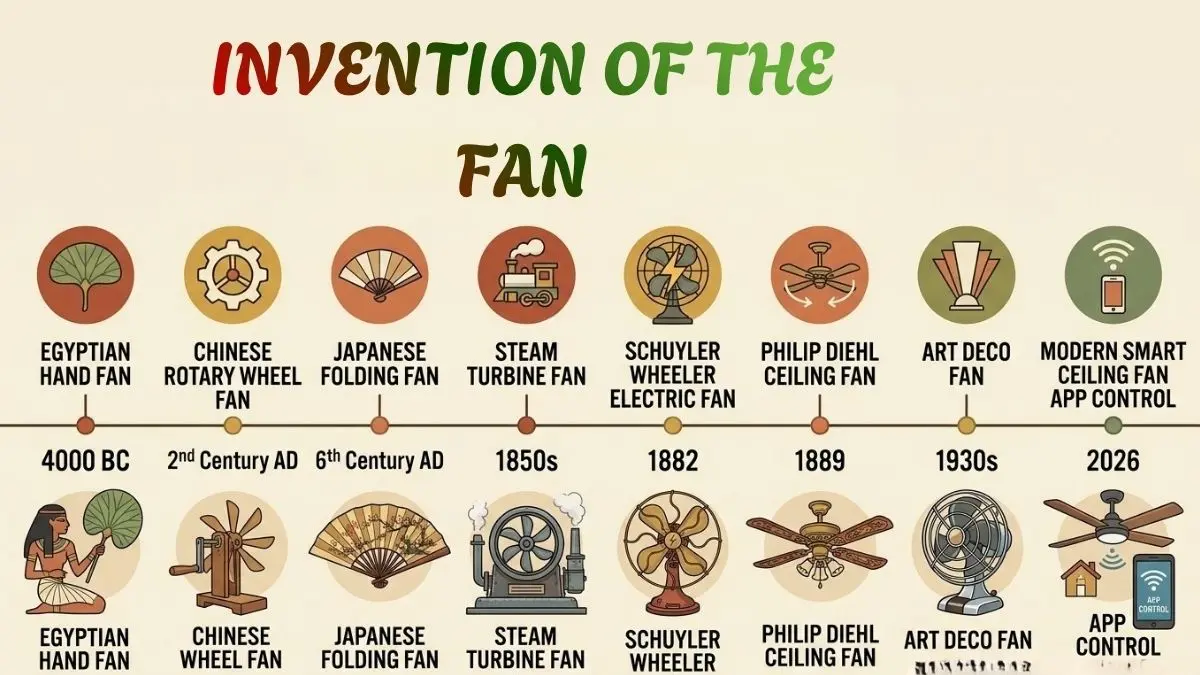
Who Invented the Fan? Around the 2nd century BCE, Ding Huan created a large mechanical fan with seven wheels. It was designed to cool entire halls. Much later, in 1882, Schuyler Skaats Wheeler invented a two-bladed electric desk fan. This invention changed how people cooled themselves at home and work.
Let’s explore the journey of the fan from ancient times to the modern electric fan.
Who Invented the Fan? Ancient History – The Era of Hand Fans (4000 BC – 1800s AD)
The First Fans: Ancient Egypt and Early Civilizations
Fans are one of the oldest inventions in human history. People used hand fans for cooling, cleaning grain, and helping fires burn stronger. Archaeologists discovered that hand fans existed in ancient Egypt more than 4,000 years ago.
Ancient Egyptians were the first known people to use fans for personal cooling. Rich Egyptians often had servants wave large lotus leaves to create cool air. They also learned an early form of evaporative cooling by blowing air over wet mats or water containers to make rooms cooler.
Fans were also important symbols in Egyptian culture. They were used in religious ceremonies and represented royalty and power. This importance can be seen in the two beautiful fans found inside the tomb of Tutankhamun. One fan had a gold handle with ostrich feathers, while another was made from ebony, gold, and precious stones. These discoveries show that fan-making was a highly skilled art for wealthy people.
Early Fan Designs in Other Civilizations
Many ancient civilizations later adopted fan technology in different ways.
The Hebrews, Persians, Greeks, and Romans all used hand fans. Greek and Roman writings, as well as the Bible, mention fans in daily life. Greeks and Romans often used peacock feathers as fans. Roman rulers even used snow brought from the Alps to cool the air, which was similar to an early form of air conditioning.
Around 500 BC, people in ancient India created fans using palmyra leaves. These large fans moved slowly back and forth and later inspired mechanical fan designs.
China’s Mechanical Fan Revolution
While hand fans remained common, Chinese inventors began creating mechanical fans. Around 180 AD during the Han Dynasty, inventor Ding Huan built a large rotary fan with seven wheels, each about 10 feet wide. One person could operate this machine to cool an entire hall, which was a major engineering achievement for that time.
Chinese rotary fans later became useful for more than cooling. People used them to clean grain, ventilate mines, and move air through large buildings. This showed that fans could help both homes and industries.
Fans During the Medieval and Renaissance Periods
Japan’s Folding Fan Innovation
In the 8th century, Japanese inventors created the folding fan. Some historians believe they copied the way bats fold their wings. This elegant design later became very popular across Asia.
China’s Ming Dynasty
During the Ming Dynasty, hand fans became highly decorative art pieces. Artists painted beautiful designs on fans, turning them into symbols of culture, beauty, and social status.
Fans Arrive in Europe
In the 1400s, Portuguese traders brought Asian fans to Europe. During the 17th, 18th, and 19th centuries, fans became extremely popular in European society.
European fans were used not only for cooling but also as fashion accessories and art pieces. Some fans displayed paintings, political cartoons, theater maps, and even song lyrics. Over time, fans became tools for entertainment, personal expression, and social communication.
The Pre-Electric Era – Steam and Mechanical Power (1734–1882)
The Paddle Fan and Early Mechanical Designs
The move from hand-operated fans to powered fans started in the 18th century. In 1734, John Theophilus Desaguliers invented a paddle fan and showed it to the Royal Society.
This early machine helped improve air circulation in hospitals, prisons, and public buildings. Moving paddles pulled air through a vertical duct and pushed it out through side openings. The system reduced bad air and moved both hot and cool air around large spaces.
Steam and Water-Powered Fans
By the 1850s, inventors began using steam engines and water turbines to power fans. Belt-driven systems connected several fans together to cool large buildings, especially in the hot southern United States. These systems proved that mechanical power could help control indoor temperatures.
In 1886, father-and-son inventors John and James Hunter created a ceiling fan powered by a water turbine. The fan mounted directly to the ceiling, which was an important step in the development of modern ceiling fans. The spinning blades moved air around the room while saving floor space.
Early Air Cooling Experiments
In the 1830s, American doctor and scientist John Gorrie experimented with cooling methods in Apalachicola. He used cloths filled with ice to cool rooms. One report claimed the method lowered the temperature in a sick president’s room by 20 degrees. However, the system required 436 pounds of ice every hour, making it impractical for everyday use.
Willis Carrier and the Birth of Modern Air Conditioning
The biggest breakthrough came from Willis Carrier. In 1902, he designed the first modern air-conditioning system and changed indoor cooling forever.
Carrier first wanted to solve a problem at a printing company. High humidity was damaging paper and printing quality. He built a cooling system that used an industrial fan to blow air over cold water-filled coils. The moisture in the air condensed on the coils, creating cooler and drier air.
Carrier later understood the relationship between temperature, humidity, and dew point while waiting for a train on a cold, foggy night. This idea helped him improve his invention further.
In July 1902, he installed his first air conditioner at the Sackett-Wilhelms printing plant in Brooklyn. The system was designed to keep paper cool and dry, but it also became the foundation of modern air conditioning technology.
The Electric Fan Revolution (1882–1910)
Schuyler Wheeler and the First Electric Fan
Between 1882 and 1886, American electrical engineer Schuyler Skaats Wheeler invented one of the most important cooling devices in history: the electric fan.
Inspired by inventors like Nikola Tesla and Thomas Edison, Wheeler believed electricity could power mechanical machines. He began working on a fan powered by electricity.
In 1882, he created his first prototype called the “buzz fan.” The design was very simple compared to modern fans. It had two blades connected to a small motor and did not include any protective cover. The fan used direct current (DC) electricity and was dangerous because the spinning blades were exposed. Even with these problems, the invention proved that electricity could create continuous airflow.
Commercial Production and Improvements
In 1887, the Crocker and Curtis Electric Motor Company started producing Wheeler’s fan commercially. The company improved the original design in several ways.
The new fan had six blades instead of two. It also included an interchangeable light that controlled the fan speed, showing an early attempt to combine lighting and cooling in one device.
At the same time, Stout, Meadowcraft & Co. introduced a desktop direct-drive electric fan in 1885, giving customers another option in the growing market.
By 1892, the fan design improved even more. Manufacturers replaced the light control with a two-speed switch, making operation easier. They also added an optional safety cage around the blades, similar to the protective covers used on modern fans today. These changes made electric fans safer and more practical for everyday use.
Recognition and Industry Growth
In 1904, Schuyler Skaats Wheeler received the prestigious John Scott Medal from the Franklin Institute for inventing the electric fan. This award officially recognized his important contribution to modern technology.
At first, electric fans were very expensive, so only wealthy families and offices could afford them. However, things changed during the 1920s. Factories began mass-producing steel fan blades in different shapes, which greatly lowered production costs.
Manufacturers also created overlapping blade designs that worked more quietly than older fans. New colors and styles made fans more attractive to customers. Because of these improvements, electric fans changed from luxury products into common household appliances used by people everywhere.
The Ceiling Fan Innovation (1886–1910)
Philip Diehl and the Invention of the Ceiling Fan
While Schuyler Skaats Wheeler was improving portable electric fans, another inventor named Philip Diehl was developing a new idea.
In 1882, Diehl created the world’s first electric ceiling fan. Instead of using a regular motor, he attached fan blades to a sewing machine motor and mounted the entire system on the ceiling. This simple but smart idea changed home cooling forever.
In August 1889, Diehl applied for a patent for his invention. On November 12, 1889, the United States Patent Office granted him patent #405,688 for the ceiling-mounted electric fan.
This invention solved several problems at the same time:
- It saved floor space
- It circulated air more efficiently
- It cooled larger areas
- It introduced a new and exciting design
Although Diehl is mainly credited for inventing the ceiling fan, the earlier work of John and James Hunter in 1886 also played an important role. Their water-powered ceiling fan helped inspire future designs.
Combining Fans and Lighting
Philip Diehl continued improving his invention. He later added a light kit to the ceiling fan, creating one unit that provided both cooling and lighting.
This idea became extremely popular and later became standard in millions of homes around the world.
The First Oscillating Ceiling Fan
In 1904, Diehl and his company introduced another innovation: the oscillating ceiling fan. They added a split-ball joint that allowed the fan to change direction.
Three years later, the design improved again and became the first fully oscillating fan that could move back and forth while running.
Early 20th Century Improvements
As owner of his own company, Philip Diehl continued refining ceiling fan technology.
In 1896, manufacturers began making fans with more than two blades. These extra blades improved airflow and cooling performance.
In 1910, Westinghouse started advertising electric fans for home use. The company claimed the fans used electricity that cost only one-fourth of a penny per hour, which encouraged many families to buy them.
Around the same time, Willis Carrier introduced air conditioning systems into movie theaters, department stores, and even the United States Congress by 1929. However, ceiling fans remained the main cooling method in many homes before air conditioning became common.
Japan and Mass Production
In 1909, Japanese company KDK became a pioneer in the mass production of electric fans for homes.
Mass production lowered prices and made electric fans affordable for middle-class families across Asia and later around the world.
Design Innovation and the Art Deco Revolution (1920s–1930s)
The Big Changes of the 1920s
The 1920s brought major changes to fan design and manufacturing. Factories improved mass production methods, allowing companies to produce fans faster and at lower costs.
At the same time, designers started treating fans as stylish household items instead of simple cooling machines. Steel blades became more common because they were cheaper and stronger. Motor technology also improved, making fans quieter, smoother, and more energy efficient.
The Art Deco Era and Emerson Electric
The 1930s introduced one of the most important design periods in fan history. In early 1930, a young interior designer named Jane Evans visited St. Louis for design work. During her visit, she met the president of Emerson Electric and suggested a bold new fan design unlike anything available at the time.
In 1932, Emerson released a revolutionary fan inspired by yacht propellers and protected by a stylish metal cage. The company called it the “Silver Swan” fan.
The design became an instant success and reportedly helped Emerson survive the Great Depression. The Silver Swan fan became one of the most famous Art Deco products of its time and showed that fans could combine beauty with practical use.
New Colors, Materials, and Better Motors
After Emerson’s success, manufacturers began experimenting with new materials and colors. Aluminum blades became more popular because they were lightweight and durable.
Companies offered fans in many colors and finishes, including:
- Ivory
- Forest Green
- Dark Brown
- Chrome
- Nickel
Motor technology also improved during this period. Emerson introduced the capacitor start motor, which started faster, operated more quietly, and used energy more efficiently than older motors.
These new motors were much smaller, only about four inches wide, but still powerful enough to spin large aluminum blades effectively.
Aerodynamic Blade Designs
Manufacturers also improved blade shapes using ideas from the aviation industry. Engineers designed cast aluminum blades with better aerodynamics, helping fans move air more efficiently while reducing noise.
This exchange of ideas between airplane engineering and fan manufacturing led to quieter and more advanced fan designs.
New Plastic Innovations
In 1934, British company Vent-Axia introduced self-contained window fans made from plastic instead of metal. This was an important step toward modern fan materials.
In 1937, manufacturers started using a plastic laminate called Micarta to coat fan blades. This material reduced noise and helped protect blades from warping and corrosion over time.
Post-War Changes and the Impact of Air Conditioning (1940s–1960s)
Fans During World War II
During the 1940s, many fan manufacturers stopped focusing on consumer products and began supporting the war effort. Factories used their equipment and resources to produce military supplies instead of household fans.
Because of this shift, very few electric fans were made for regular customers during the war years. Fan designs also remained mostly unchanged during this period.
After the war ended, companies restarted fan production, but most manufacturers continued using the same designs that existed before the war.
The Rise of Home Air Conditioning
By the 1950s, air conditioning systems started becoming available for residential homes. This new technology slowly reduced the popularity of table fans as the main cooling solution in developed countries.
Some fan companies tried to keep fans attractive to buyers by creating wooden fan cases that matched home furniture and television sets. However, more people were becoming interested in air conditioning systems.
During this decade, fan manufacturers focused mainly on reducing production costs rather than creating new designs.
Companies began using cheaper materials such as nylon gears instead of brass or steel. They also introduced new colors and paint finishes, including:
- Grey
- Aqua
- Turquoise
Many fans featured textured or wrinkled paint styles that became popular during the 1950s.
The Decline of Traditional Fans
By the 1960s, air conditioning had become common in many homes across North America and Western Europe. As a result, many American fan manufacturers slowly stopped producing traditional fans.
By the end of the decade, many classic fan designs had disappeared from the market. It seemed like the fan era was coming to an end in wealthier countries.
However, fans did not disappear completely. In developing nations, fans remained extremely important because they were affordable, simple to use, and consumed less electricity than air conditioning systems. These advantages would later help fans make a strong comeback around the world.
Revival and Global Expansion (1970s–1990s)
The Energy Crisis and the Return of Fans
During the 1970s, the global oil embargo caused a major energy crisis. Electricity prices increased sharply, and people began looking for cheaper ways to stay cool.
This situation helped ceiling fans become popular again. Compared to air conditioners, ceiling fans used much less electricity while still providing effective cooling.
During this time, companies such as Crompton Greaves and Encon Industries improved induction motor technology. Their new ceiling fans used only 70 to 80 watts of power, much less than older models, while still delivering strong airflow.
Growth of Fan Manufacturing in Asia
Ceiling fans became extremely popular in developing countries because they were affordable and energy efficient. Demand increased rapidly across Asia, Africa, and Latin America.
Indian companies such as:
- Clyde
- Usha
- India Electric Works
- Orient
had already started producing ceiling fans during the 1930s and 1940s. However, the 1970s energy crisis greatly increased demand and turned ceiling fans into standard household appliances.
These manufacturers focused on making fans affordable, efficient, and durable. Over time, they also improved fan designs by using better materials and more attractive finishes.
Must Read: An Invention That Changed the World—but Ruined its Inventor
Must Read: Who Invented Wi Fi? The Shocking Story of Hollywood Actress Hedy Lamarr!
Must Read: Thomas Edison Didn’t Invent the Light Bulb. Here’s the Real Story (From 1761 to LED)
New Motor Technology
In 1962, engineers introduced an important innovation called the Brushless Direct Current motor, also known as the BLDC motor.
This new technology changed the ceiling fan industry. BLDC motors used less than 50 watts of power, making fans even more energy efficient. They also lasted longer, produced less noise, and required less maintenance than older motor systems.
The introduction of BLDC technology marked the beginning of a new generation of modern ceiling fans.
Modern Ceiling Fans – Design, Features, and Technology
Ceiling Fans Become Part of Home Design
Since the 2000s, ceiling fans have changed a lot. People no longer see them only as cooling devices. Now, they also use them as part of home decoration and interior design.
Companies started making fans with better looks, energy-saving features, and modern styles. They introduced 3-blade, 4-blade, and designer fans that improve both airflow and room appearance.
Modern Features in Ceiling Fans
Today’s ceiling fans come with many advanced features, such as:
- Built-in LED lights
- Different blade materials like wood, metal, and composite
- Remote control operation
- WiFi connectivity
- Voice control support
- Mood lighting options
- Timer settings
- Motion sensors
- Variable speed control
These features make modern fans more comfortable and easier to use.
Types of Modern Ceiling Fans
Standard Fans
These are the most common fans used in homes. They usually have 3 or 4 blades and provide simple, reliable air circulation at low cost.
Designer Fans
Designer fans focus on style and appearance. They come in different colors, shapes, and finishes. Some look modern and minimal, while others follow classic or luxury designs.
Fans with Lights
These fans combine cooling and lighting in one unit. They include simple bulbs or decorative lights, sometimes even chandelier-style designs for a premium look.
BLDC Motor Fans
Brushless Direct Current motor (BLDC) fans use electronic control instead of traditional brushes. They use less electricity, make less noise, and last longer than older fan types.
Reversible Fans
These fans change direction based on season. In summer, they rotate counter-clockwise for cooling. In winter, they rotate clockwise to circulate warm air.
Smart Fans
Smart fans connect to phones and smart home systems. Users can control them using apps, remote controls, or voice commands.
Dual Motor Fans
These fans use two motors with separate blades. They are designed for large rooms or high ceilings where normal fans are not enough.
Hugger Fans
Hugger fans are made for low ceilings. They fit close to the ceiling and still provide good airflow safely.
Outdoor Fans
Outdoor fans are designed for balconies, patios, and open spaces. They resist dust and moisture for long-lasting use outside.
Commercial Fans
Commercial fans are large and powerful. They are used in warehouses, gyms, factories, and big halls to circulate air in wide spaces.
Motor Technology – The Heart of Modern Fans
Induction Motors vs. BLDC Motors
Modern ceiling fans mainly use two types of motors. Both work differently and give different benefits.
Traditional Induction Motors
Induction motors are the older and more common type used in many fans.
They work by using electromagnetic coils to create a rotating magnetic field that spins the blades.
Key points:
- They cost less to buy
- They use more electricity
- They usually consume around 70–80 watts
- They wear out faster over time
- They produce more noise due to moving parts
These fans are good for people who want a low initial price.
Brushless DC (BLDC) Motors
Brushless Direct Current motor (BLDC) are a newer and more advanced technology used in modern ceiling fans.
They use permanent magnets instead of traditional electromagnets and convert AC power into DC internally to run the motor efficiently.
Key points:
- They use only about 25–50 watts of power
- They run much quieter
- They last longer than induction motors
- They need less maintenance
- They cost more initially but save money long-term
Because of these benefits, BLDC fans are becoming very popular in modern homes.
Energy Use and Cost Comparison
The running cost of a ceiling fan depends mainly on:
- Wattage of the fan
- Electricity price in your area
Traditional Induction Fans
- Power usage: 70–80 watts
- Running cost: higher over time
- Best for: people who want cheaper purchase price
BLDC Motor Fans
- Power usage: 25–40 watts
- Running cost: much lower
- Best for: people who want long-term savings
Long-Term Value
Although BLDC fans cost more at the start, they save a lot of electricity over time.
In most cases, over 10 years:
- BLDC fans recover their higher price through energy savings
- They become more economical than traditional fans
- They also provide better performance and comfort
This is why many modern households are slowly switching to BLDC technology for ceiling fans.
How Ceiling Fans Work
Basic Working Process
A ceiling fan works in a simple but smart way.
- You turn on the switch and electricity flows into the fan motor
- The motor converts electrical energy into movement
- The motor spins the blades
- The blades push air around the room
- This moving air spreads and creates a cooling feeling
So basically, the fan does not cool the air—it moves the air.
Physics Behind Cooling Effect
Ceiling fans work on a simple rule of nature: hot air rises and cool air stays lower.
When the fan runs:
- It pushes warm air upward
- It breaks the hot air layer near the ceiling
- It mixes warm and cool air
- It spreads air evenly in the room
This airflow makes the room feel cooler, even if the temperature does not actually drop.
That is why fans work very well with air conditioners—they help spread cool air faster in the room.
Summer and Winter Modes
Modern reversible fans can change direction.
Summer Mode (Counter-Clockwise)
- Blades push air downward
- You feel a cooling breeze on your skin
- Room feels cooler due to air movement
Winter Mode (Clockwise)
- Blades pull air upward
- Warm air near the ceiling moves down the walls
- Room temperature becomes more balanced
How to Choose the Right Ceiling Fan
1. Room Size Matters
- Small room (75–144 sq ft): 36–42 inch fan
- Medium room (144–225 sq ft): 42–52 inch fan
- Large room (225+ sq ft): 52–56 inch or dual fan
2. Ceiling Height
- Normal ceiling (8–9 ft): any standard fan
- High ceiling (9–12 ft): down rod fan works best
- Very high ceiling: special long rod required
3. Blade Size
- Bigger blades = more airflow
- Smaller blades = quieter operation
4. Placement
- Always install fan in the center of the room
- Keep at least 12 inches distance from walls
5. Design and Style
Choose based on:
- Modern or traditional design
- Blade material (wood, metal, plastic)
- Color and finish
- Light integration
- Smart home features
6. Energy Ratings
In many countries, fans come with energy ratings:
- 5 Star: highest efficiency
- 4 Star: very efficient
- 3 Star: average efficiency
- 2 Star: basic efficiency
- 1 Star: minimum standard
Higher star rating means lower electricity bill.
Ceiling Fan Installation Guide
Step 1: Turn Off Power
Switch off electricity and confirm using a tester.
Step 2: Remove Old Fixture
Remove the old light or fan and disconnect wires carefully.
Step 3: Mounting Setup
Choose one:
- Flush mount (close to ceiling)
- Down rod mount (better airflow for most rooms)
Secure the bracket tightly.
Step 4: Wiring Connection
Connect matching colored wires carefully and use proper connectors.
Step 5: Install Moto
Fix the motor unit to the ceiling bracket and tighten screws.
Step 6: Test Power
Turn on electricity and check if fan runs properly.
Step 7: Attach Blades
Fix blades evenly so the fan stays balanced.
Step 8: Final Check
Test all speeds and check for noise or vibration.
Safety Rules
- Install at least 7–8 feet above floor
- Keep safe distance from walls
- Use a professional electrician if unsure
Modern Innovation and Future Trends
Smart Ceiling Fans
Modern fans are now part of smart homes. They can:
- Work with voice assistants like Alexa and Google Home
- Be controlled through mobile apps
- Run on schedules automatically
- Change speed based on room temperature
- Turn on when someone enters the room
Energy and Eco Improvements
Manufacturers now focus on saving electricity:
- BLDC motors are widely used
- LED lights replace old bulbs
- Fans use lighter and recyclable materials
- Blade design improves airflow efficiency
Future of Ceiling Fans
Future fans will become even smarter:
- AI-based automatic speed control
- Ultra-quiet motor systems
- Hybrid fans that work with AC systems
- Bladeless air circulation designs
- Advanced materials for lighter and stronger blades
Conclusion: From Palm Leaves to Smart Fans
The history of the fan shows how humans always try to improve comfort in smart ways. What started with simple palm leaves in ancient Egypt slowly turned into advanced machines that cool entire rooms.
Over time, fans evolved step by step. Ancient civilizations used hand fans, then China introduced early mechanical designs, and Europe turned fans into decorative art pieces. Later, industrial innovations brought steam-powered and electric fans that changed daily life.
A major turning point came when Schuyler Skaats Wheeler invented the electric fan in 1882. Soon after, Philip Diehl created the ceiling fan patent in 1889. These inventions made cooling easier, cheaper, and available to millions of people.
In the 20th century, air conditioning reduced fan use in richer countries. But the energy crisis in the 1970s and 1980s brought fans back, especially in developing countries where electricity saving became important. Later, BLDC motor technology made fans even more efficient and long-lasting.
Today, ceiling fans are not just cooling devices. They are part of modern home design. They combine style, smart features, energy efficiency, and technology in one product. Modern fans can connect to phones, respond to voice commands, and adjust automatically.
From ancient hand tools to smart IoT devices, the basic idea has never changed: moving air to create comfort.
Even in the future, ceiling fans will remain important because they are simple, affordable, and energy efficient. As the world looks for sustainable cooling solutions, the humble fan will continue to play a key role in human life for many years to come.
Key Facts About Fan History and Technology
- Oldest Fan Evidence: Hand fans in ancient Egypt, approximately 4,000 years ago
- Ancient Mechanical Fan: Ding Huan’s 7-wheel rotary fan in Han Dynasty China, circa 180 AD
- First Electric Fan: Schuyler Skaats Wheeler, 1882-1886
- Commercial Electric Fan: Crocker & Curtis Electric Motor Company, 1887
- First Ceiling Fan Patent: Philip Diehl, November 12, 1889 (Patent #405,688)
- Desktop Electric Fan: Stout, Meadowcraft & Co., New York, 1885
- Water Turbine Ceiling Fan: John & James Hunter, 1886
- Safety Cage Introduction: 1892 (Crocker-Wheeler)
- Oscillating Fan: Diehl & Co., 1904 (first), 1907 (fully oscillating)
- Mass-Produced Fans: KDK of Japan, 1909
- Art Deco Fan: Emerson Electric “Silver Swan,” 1932
- First BLDC Motor Fans: Introduced 1962
- Modern Smart Fans: 2000s onward with IoT integration
- BEE Star Ratings: Mandatory in India from January 2023
- Traditional Fan Power Consumption: 70-80 watts
- BLDC Fan Power Consumption: 25-50 watts
- Typical Ceiling Height for Fans: Minimum 7-8 feet from floor
- Blade Span Diameter: 36-56 inches depending on room size
Sources: Crompton, Dan Plater, Vinod Pottayil, Cheavei Hour, Edison Archives, Franklin Institute, Wikipedia, Encyclopedia Britannica, BEE (Bureau of Energy Efficiency), Patent Office Records