
Thomas Edison Didn’t Invent the Light Bulb. Here’s the Real Story (From 1761 to LED)
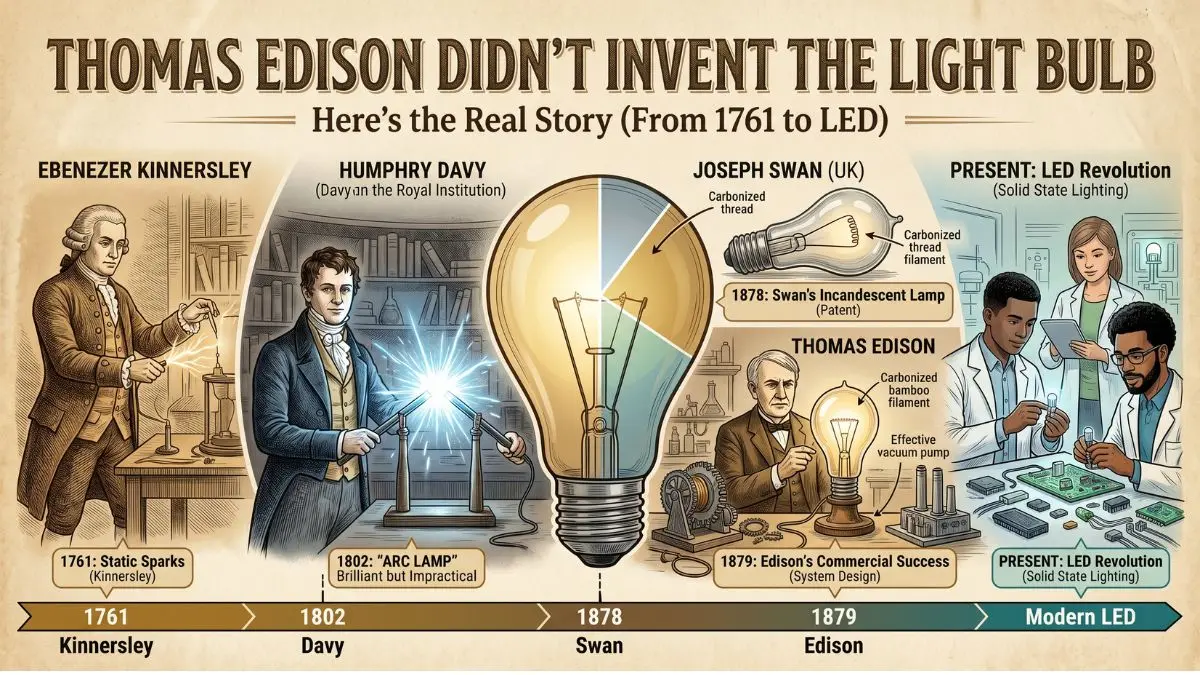
Who Invented the Light Bulb? Whenever the electric bulb is mentioned, the first name that comes to our mind is Thomas Edison. But did you know that many scientists tried to make the light bulb before Edison? The invention of the light bulb wasn’t the result of a single day’s work, but rather the result of years of hard work.
Initial Efforts
Before Thomas Edison’s famous light bulb of 1879, about 20 different inventors had found ways to produce light:
Ebenezer Kinnersley’s Glowing Wire (1761) — The Overlooked Pioneer
The story of electric light actually starts even earlier than most people think. In 1761, an English scientist named Ebenezer Kinnersley wrote a letter to Benjamin Franklin. In this letter, he explained that he had heated a wire until it became “red hot” and started giving off light.
This process is called incandescence, which is the same basic idea used in traditional lightbulbs.
Kinnersley made this discovery almost 40 years before Alessandro Volta. His experiment was not a real lightbulb, but it showed something very important—that electricity can create heat and light.
His work helped scientists understand this connection and encouraged further experiments, which later led to the invention of the lightbulb.
Alessandro Volta and the Voltaic Pile (1800)
The story of the modern lightbulb begins in 1800 with Alessandro Volta. He created the first practical way to produce electricity, called the Voltaic Pile.
This device was simple but very smart. It used layers of zinc and copper discs. Between these discs, there were pieces of cardboard soaked in salt water.
When a wire was connected to both ends, electricity started to flow. This was a big achievement because it gave a steady and controlled electric current.
Because of this invention, scientists could finally test and study electricity in a proper way. They no longer depended on random sparks. Volta even saw that a wire could glow when electricity passed through it. This was one of the earliest signs of electric light.
In simple words, Volta did not invent the lightbulb. But his invention made it possible. It gave scientists the tool they needed to explore and create electric lighting in the future.
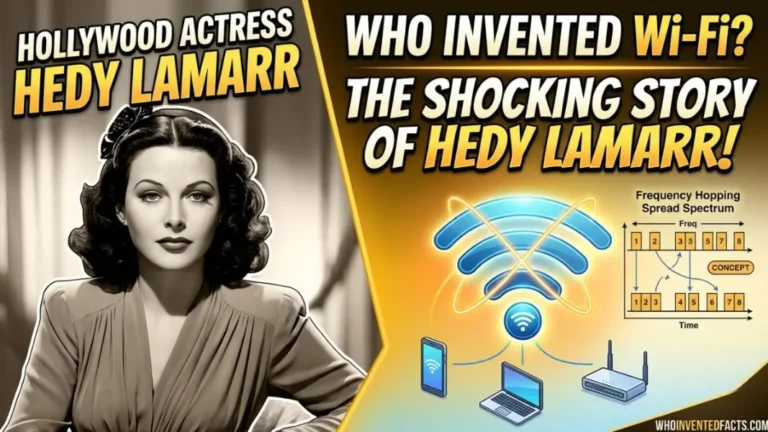
Must Read: Who Invented Wi Fi? The Shocking Story of Hollywood Actress Hedy Lamarr!
Must Read: An Invention That Changed the World—but Ruined its Inventor
Must Read: Real History of Zipper? Result of 20 Years of Failure and Continuous Hard Work
Humphry Davy’s Electric Arc Lamp (1802)
Soon after Volta’s discovery, British scientist Humphry Davy created the first electric lamp in 1802.
He used a very powerful battery made of about 2,000 cells at the Royal Institution of Great Britain. First, he passed electricity through a thin piece of platinum. Then he connected two carbon (charcoal) rods and allowed electricity to flow between them.
This produced a very bright light. It was called the Electric Arc Lamp because of the strong arc of light formed between the two rods.
Although this lamp was a big step forward, it had problems. It burned out quickly and was too bright for homes or normal use.
Still, Davy’s invention was very important. His ideas helped in the development of safer lamps for miners and also led to street lighting in cities like Paris and other parts of Europe in the 1800s.
James Bowman Lindsay’s Constant Electric Light (1835)
In 1835, a Scottish inventor named James Bowman Lindsay showed a constant electric light at a public meeting in Dundee, Scotland.
He said his light was strong enough to read a book from about one and a half feet away. Lindsay had been working on electric light since 1829. He was motivated by safety concerns, especially fires in local jute mills.
His light had many advantages. It did not burn like a flame, so it was non-combustible. It produced no smoke and was cheaper than earlier lights, like those using platinum.
This was an important step forward. It proved that a steady and practical electric light was possible—almost 40 years before Thomas Edison introduced his famous bulb.
However, Lindsay did not continue developing his invention. He also did not properly document his work, so his contribution remained mostly unknown for many years.
Marcellin Jobard’s Vacuum Carbon Filament (1838)
In 1838, a Belgian inventor and lithographer named Marcellin Jobard developed an early version of an incandescent light bulb.
His idea was very important. He used a carbon filament instead of expensive metals like platinum. Carbon was cheaper and worked well for producing light.
He also placed the filament inside a vacuum chamber. This vacuum removed air, which helped protect the filament from burning or rusting (oxidation).
This design combined two key ideas:
- A cheap carbon filament for light
- A vacuum environment to protect it
Although his bulb was not perfect, it was a major step forward. Jobard’s idea became the foundation for future incandescent light bulbs and influenced many later inventors.
Other Early Patents (1841–1897)
During the 1800s, many inventors tried to improve the incandescent light bulb. The development of electric light moved forward step by step.
In 1841, British inventor Frederick de Moleyns received the first patent for an incandescent lamp. His design used thin platinum wires inside a vacuum glass bulb.
A few years later, in 1845, American inventor John W. Starr patented his own version. He used carbon filaments to produce light.
One of the most important contributions came from Russian inventor Alexander Lodygin. In 1872, he created an incandescent bulb inside a glass enclosure. Later, in 1897, his U.S. patent described using strong rare metals like tungsten for filaments.
This idea was very important because tungsten filaments became a key technology in modern light bulbs. Lodygin later sold his patent rights to General Electric, helping the company become a leader in electric lighting.
In simple words, all these inventors added small but important improvements that helped shape the modern light bulb.
Warren de la Rue and Platinum Filaments (1840)
In 1840, a British scientist named Warren de la Rue created an improved version of an electric light bulb.
He used a coiled platinum filament instead of copper. This filament was placed inside a vacuum glass tube, where most of the air was removed.
His idea was smart. Platinum can handle very high temperatures without melting, so it was suitable for producing light. The vacuum also helped because there were fewer gas particles inside to damage the filament, which made it last longer.
However, there was a big problem. Platinum was extremely expensive. Because of this, his design could not be used for large-scale or commercial production.
Even though it was not practical, de la Rue’s work was an important step. It helped scientists understand how better filaments and vacuum bulbs could improve electric lighting.
The Rise of Practical Incandescent Lighting
As electric lighting developed, many inventors were working on similar ideas at the same time. The competition became very intense.
William Sawyer, Albon Man, and the Competing American Patent
Two American inventors, William Sawyer and Albon Man, also created designs for incandescent lamps. They even received a U.S. patent for their invention.
Their work became important because it directly challenged the later claims of Thomas Edison. There was a legal debate about whether Edison’s patents copied or overlapped with their earlier designs.
At that time, many inventors were trying to solve the same problem—creating a safe, long-lasting electric light bulb. Because of this, several similar inventions appeared almost together.
This led to strong patent fights in the 1880s. These battles showed that the invention of the light bulb was not the work of one person alone, but the result of many inventors working toward the same goal at the same time.
The Critical Role of the Sprengel Pump (1865)
A very important breakthrough for the electric light bulb was not the bulb itself, but a machine called the vacuum pump.
In 1865, German chemist Hermann Sprengel invented the Sprengel Pump.
This pump used falling drops of mercury inside a glass tube to slowly remove air. By doing this, it created a very strong vacuum inside glass bulbs. At that time, it was one of the most powerful ways to remove air.
This invention was extremely important. Earlier inventors had struggled because air inside the bulb caused filaments to burn out quickly. The Sprengel pump solved this problem by making a much better vacuum.
Later, Thomas Edison used advanced vacuum systems in his laboratory at Menlo Park. He combined different pumps, including the Sprengel pump, to remove almost all air from his glass bulbs.
This allowed him to reach a very high vacuum level, which helped the filament last much longer.
In simple words, the Sprengel pump was the missing piece. It made the practical electric light bulb possible by solving one of its biggest problems—air inside the bulb.
Henry Woodward and Matthew Evans’ Canadian Patent (1874)
In 1874, Canadian inventors Henry Woodward and Matthew Evans filed a patent for an early electric lamp.
Their design used carbon rods placed inside a glass cylinder filled with nitrogen gas. This gas helped slow down the burning of the carbon, making the light last longer.
However, they could not turn their invention into a successful commercial product. Because of financial difficulties, they later sold their patent rights in 1879 to Thomas Edison.
Edison was especially interested in one part of their work—the idea of connecting lamps in a parallel circuit, which improved how electric lights could be powered in buildings.
Even today, there is debate about their contribution. The Canadian government has stated that Woodward and Evans played a very important role in the early development of the light bulb.
In simple terms, they were among the early inventors who helped shape the idea of electric lighting, even if they did not achieve commercial success themselves.
The Race Between Swan and Edison
While many inventors in Europe were still experimenting with electric light, the focus gradually narrowed to two major figures.
In England, inventor Joseph Swan was developing his own version of a practical light bulb. At the same time in the United States, Thomas Edison was working on the same goal.
Both men were trying to create a light bulb that was not only bright, but also long-lasting and affordable enough for everyday use. This made the competition very intense.
Their work marked a turning point in history. The invention of the light bulb was no longer just about experiments—it had become a global race to build a product that could be used in homes, streets, and businesses.
In simple words, Swan and Edison were the two main inventors who led the final race to create the practical electric light bulb.
Joseph Swan’s Carbonized Paper Filament (1850–1879)
In 1850, English chemist Joseph Swan began working to make electric lighting cheaper and more practical.
By 1860, he had developed an early working light bulb. It used carbonized paper filaments placed inside a vacuum glass tube. This helped produce light when electricity passed through it.
Swan later improved his design and received a U.K. patent in 1878. In 1879, he publicly demonstrated his working lamp in Newcastle, England—almost one year before Edison’s famous public demonstration.
His bulb could last about 40 hours, which was a major improvement at the time. However, it had a limitation. It needed large amounts of electricity because the filament had low resistance. This made it less efficient and harder to use commercially compared to later designs.
Even so, Swan’s work achieved several historic milestones:
- His home in Low Fell, Gateshead became the first house lit by a light bulb
- In 1880, Mosley Street in Newcastle became the first street in the world lit by incandescent lamps
- In 1881, the Savoy Theatre in London became the first public building fully lit by electricity
In simple words, Swan made electric lighting practical in real life settings. His inventions showed the world that electric light could be used in homes, streets, and public buildings.
Hiram Maxim’s Near-Miss (1879–1880)
Around the same time as Edison and Swan, inventor Hiram Maxim also worked on electric light technology.
He tried to patent a light bulb design, but there was a delay. His patent was not approved by the U.S. Patent Office until July 1880, which was after Thomas Edison had already achieved major success.
Because of this timing, Maxim’s work did not receive as much attention, even though he contributed to early lighting development.
Walther Nernst’s Ceramic Lamp (1897) — A Forgotten Rival
In 1897, German scientist Walther Nernst introduced a very different type of incandescent lamp called the Nernst lamp.
Instead of using a metal filament, it used a ceramic rod known as a “globar.” Even more unusual, it did not need a vacuum or special gas inside the bulb to work, which was a major difference from other designs of that time.
The Nernst lamp was about twice as efficient as older carbon filament bulbs. For a short time, it became popular and was considered a strong competitor in lighting technology.
However, as better metal filament bulbs (like tungsten lamps) were developed, the Nernst lamp slowly became outdated.
In simple words, Nernst showed that even the basic design of a light bulb was still not final in the 1890s, and different ideas were still competing to become the standard.
Thomas Edison: Making the Lightbulb Practical
Thomas Edison was born in Ohio on February 11, 1847. He later became one of the most important inventors in history.
In 1876, he opened a laboratory in Menlo Park, New Jersey. This place was not just a workshop—it was more like an “invention factory.” It is considered one of the earliest examples of modern research and development (R&D).
Many historians believe Edison’s greatest idea was not a single invention, but the way he organized work. His laboratory allowed many people to work together on solving problems.
Edison filled Menlo Park with all kinds of tools, materials, and equipment. He also hired skilled technicians and scientists to help test ideas and improve inventions.
To support his work, he also convinced investors like banker J.P. Morgan to provide money. This funding helped him continue experiments and turn ideas into real products that could be sold.
In simple words, Edison created a system where inventions could be developed, tested, and improved quickly.
Edison’s Superior Vacuum Technology
Thomas Edison made important improvements in vacuum technology that helped his light bulb last much longer.
Between October 16 and October 21, 1879, Edison and his team greatly improved the vacuum inside the bulb. They increased it from about 1:100,000 to 1:1,000,000 atmospheres. This stronger vacuum reduced damage to the filament and made the bulb more durable.
The Filament Obsession (Over 6,000 Materials Tested)
Edison did not find the right filament easily. Between 1878 and 1880, he and his team tested thousands of ideas and materials.
He later said:
“I tested no fewer than 6,000 vegetable growths…”
They tried many natural materials from plants, trees, and fibers. Most of them burned out quickly.
A breakthrough came when they used a carbonized cotton thread. It worked for about 15 hours before breaking. Even though it was short, it showed they were moving in the right direction.
In November 1879, Edison received Patent No. 223,898 for his electric lamp.
The Bamboo Filament Breakthrough (1880)
Later, Edison discovered that carbonized bamboo was much stronger. This filament could last over 1,200 hours (about 50 days of continuous use).
On January 27, 1880, he patented an improved version of the bulb. This design also included the screw-type base, which is still used in modern light bulbs today.
Additional Innovation: Malignani’s Phosphorus Solution (1893–1898)
Later improvements came from Italian inventor Arturo Malignani. Around 1893, he discovered that phosphorus vapors could remove leftover oxygen and moisture inside the bulb. This process was called a “getter.”
In 1896, he patented the use of red phosphorus inside bulbs, making them last up to 800 hours and cheaper to produce.
In 1898, Edison recognized the importance of this idea and purchased Malignani’s patent.
The Complete System: Edison’s Real Genius
Thomas Edison did not only improve the light bulb. His biggest achievement was building a complete system to make electric lighting usable in everyday life.
He understood that a bulb alone is useless without electricity to power it. So he created a full network to generate and deliver power to homes and businesses. He based this idea on the existing gas lighting systems used in cities.
In 1882, Edison demonstrated electricity distribution in London using a central generator. That same year, he built the Pearl Street Station in lower Manhattan, which became the first commercial power station. He also invented the first electric meter to measure how much electricity each customer used.
By 1882, Edison’s system was working in real life. It successfully lit homes, offices, and streets in downtown Manhattan. This was a major turning point in modern history because electricity became practical for everyday use.
The “War of Currents” — Edison’s Darkest Chapter
Edison’s success was later challenged in what became known as the War of Currents.
His system used direct current (DC), which worked well but could only travel short distances. Two other key figures—Nikola Tesla and George Westinghouse—supported alternating current (AC), which could transmit electricity over long distances more efficiently and at lower cost.
A fierce competition began between DC and AC systems. Edison tried to protect his technology and launched a public campaign against AC power. He used newspapers to highlight accidents involving electricity and even staged public demonstrations where animals were electrocuted using AC to show it as dangerous.
He also supported the development of the first electric chair, which used AC, in an effort to link AC with danger and death.
Despite these efforts, AC eventually won. It was simply more efficient for large-scale power distribution and became the foundation of modern electrical grids around the world.
Improvements After Edison: The March of Progress
After Thomas Edison made electric lighting practical, other inventors continued improving the technology.
Lewis Howard Latimer’s Contribution (1882)
In 1882, Lewis Howard Latimer made two important improvements to the light bulb.
First, he developed a better way to manufacture carbon filaments. This made bulbs cheaper and easier to produce in large numbers.
Second, he created a method of placing the carbon filament inside a stronger cardboard-like support. This helped protect the filament and made it less likely to break.
Latimer worked with many famous inventors of his time, including Edison, Alexander Graham Bell, and Hiram Maxim. His work helped make electric lighting more practical and widely available.
The Tungsten Filament Breakthrough (1904)
Edison had already suggested that tungsten would be the best material for filaments because it can withstand very high temperatures. But at that time, it was too difficult to work with.
The real breakthrough came in 1904 when Hungarian inventor Sándor Just and Croatian inventor Franjo Hanaman developed a working tungsten filament lamp.
Their bulb was brighter, stronger, and lasted longer than carbon filament bulbs. It was later sold under the brand “Tungsram,” which is why tungsten bulbs are still called “Tungsram bulbs” in some countries.
This invention built on earlier ideas, including work by Alexander Lodygin, who had also explored tungsten filaments.
Mass Production Improvements (1910)
In 1910, scientist William David Coolidge improved the way tungsten filaments were made. His process allowed bulbs to be produced on a large industrial scale.
This made tungsten the standard material for light bulbs, and it is still used today in many incandescent lamps.
Further Refinements in Light Bulb Technology
After Edison’s success, inventors continued improving both the bulb and the way it was made.
In 1903, Willis R. Whitney developed a treatment for carbon filaments. This stopped bulbs from turning black inside and helped them stay bright for longer.
Later, in 1913, scientist Irving Langmuir made another important discovery. He filled bulbs with an inert gas like nitrogen. This reduced filament damage and nearly doubled bulb efficiency, making incandescent lighting much more practical.
Mass Production Breakthrough (1926)
By the 1900s, the main challenge was no longer invention—it was mass production.
In 1926, engineers at Corning Glass Works created the Ribbon Machine. This machine continuously produced glass bulbs using a moving ribbon of molten glass.
By 1939, it could produce about 1,000 bulbs per minute. By the 1970s, only a few machines worldwide were enough to supply most of the world’s incandescent bulbs.
This innovation made electric lighting cheap and widely available.
The Age of Fluorescent Lighting
Earlier experiments like the Geissler Tube showed that electricity could produce light in gases. This idea later led to neon lights and fluorescent lamps.
In the early 1900s, Peter Cooper Hewitt developed the mercury vapor lamp. It was more efficient than incandescent bulbs, but its blue-green light made it less suitable for homes.
Phosphor Coating and Fluorescent Lights
In the late 1920s and 1930s, scientists improved these lamps by adding phosphor coatings. These coatings turned invisible ultraviolet light into visible white light.
Fluorescent lights were shown at major events like the 1939 New York World’s Fair. During World War II, they became widely used in factories because they saved energy.
By 1951, fluorescent lighting produced more light in the U.S. than any other source.
Compact Fluorescent Lamps (CFLs)
After the 1973 oil crisis, engineers worked on making fluorescent lights smaller and more efficient.
In 1976, Edward E. Hammer designed the first spiral-shaped Compact Fluorescent Lamp (CFL).
CFLs became popular in the 1980s and 1990s. They used about 75% less energy than incandescent bulbs and lasted much longer, although they contained small amounts of mercury.
The LED Revolution
In 1962, Nick Holonyak Jr. created the first visible red LED while working at General Electric. This was the beginning of modern LED lighting.
LEDs (Light Emitting Diodes) are very small devices made from semiconductors. They produce light more efficiently and in a specific direction.
Today’s lighting efficiency is measured in lumens per watt:
- Incandescent bulbs: ~15 lm/W
- CFL bulbs: ~73 lm/W
- LED bulbs: ~85–120 lm/W
Timeline: Key Dates in Lightbulb History
| Year | Event |
|---|---|
| 1761 | Ebenezer Kinnersley writes to Benjamin Franklin about heating a wire to incandescence |
| 1800 | Alessandro Volta develops the voltaic pile (first practical electricity source) |
| 1802 | Humphry Davy creates the electric arc lamp using 2,000 cells |
| 1835 | James Bowman Lindsay demonstrates a constant electric light in Dundee |
| 1838 | Marcellin Jobard invents vacuum carbon filament bulb concept |
| 1840 | Warren de la Rue develops platinum filament bulb in vacuum |
| 1841 | Frederick de Moleyns receives first incandescent lamp patent |
| 1848 | William Staite improves arc lamp using clockwork mechanism |
| 1850 | Joseph Swan begins experimenting with electric light |
| 1860 | Swan develops carbonized paper filament bulb |
| 1865 | Hermann Sprengel invents mercury vacuum pump |
| 1872 | Alexander Lodygin creates glass-enclosed incandescent bulb |
| 1874 | Woodward and Evans file Canadian patent for nitrogen-filled carbon rod lamp |
| 1878 | Swan receives UK patent; Edison files first patent application |
| Feb 1879 | Swan demonstrates working electric lamp in Newcastle |
| Oct 1879 | Thomas Edison demonstrates light bulb in Menlo Park |
| Nov 1879 | Edison files patent for carbon filament lamp |
| Jan 27, 1880 | Edison patents improved carbonized bamboo filament bulb |
| 1880 | Mosley Street (Newcastle) becomes first street lit by incandescent lamps |
| 1881 | Savoy Theatre (London) becomes first public building fully lit by electricity |
| 1882 | Lewis Howard Latimer improves carbon filament manufacturing |
| 1882 | Edison’s Pearl Street Station begins electric power supply in Manhattan |
| 1897 | Walther Nernst develops ceramic Nernst lamp |
| 1897 | Alexander Lodygin patents tungsten filament process |
| 1898 | Edison acquires Malignani’s phosphorus getter patent |
| 1903 | Willis R. Whitney develops anti-blackening carbon filament |
| Dec 13, 1904 | Sándor Just and Franjo Hanaman patent tungsten filament lamp |
| 1906 | General Electric patents tungsten filament manufacturing in U.S. |
| 1910 | William David Coolidge improves tungsten filament production |
| 1913 | Irving Langmuir discovers inert gas improves efficiency |
| 1920s | Frosted bulbs and neon lighting developed |
| 1926 | Corning Ribbon Machine enables mass production of bulbs |
| 1930s | Fluorescent lamps developed with phosphor coatings |
| 1951 | Fluorescent lighting becomes dominant in U.S. |
| 1962 | Nick Holonyak Jr. invents first visible LED |
| 1973 | Oil crisis drives need for energy-efficient lighting |
| 1976 | GE develops spiral Compact Fluorescent Lamp (CFL) |
| Mid-1980s | CFLs reach consumer market |
| Present | LED lighting dominates global lighting; incandescent bulbs phased out |
Conclusion
The lightbulb changed the world by bringing electric light to homes and workplaces. It allowed people to work, study, and enjoy activities at night. Many inventors contributed to improving the lightbulb over time. Thomas Edison played an important role, but he was not alone. It shows that big inventions are made through teamwork and small improvements over many years.