
Did a Cigarette Maker Invent our Drinking Straw? The Secret History
Who invented straws? The real credit for inventing the modern paper straw goes to an American businessman, Marvin Chester Stone. And yes, he wasn’t a scientist, but a cigarette holder manufacturer!
Whether we’re drinking juice, coconut water, or a cold drink, we immediately pick up a straw and start drinking. It’s a common thing we never pay attention to. But did you know that behind this small tube hides a 5,000-year-old story connected to a struggling cigarette maker?
If you’re searching for “Who invented straws?” the true answer isn’t just a name, but a wonderful journey of human need and wisdom.
Who Invented Straws? Complete History
People have been using drinking straws for more than 6,000 years, much longer than most people think.
Ancient Origins: The Earliest Straws
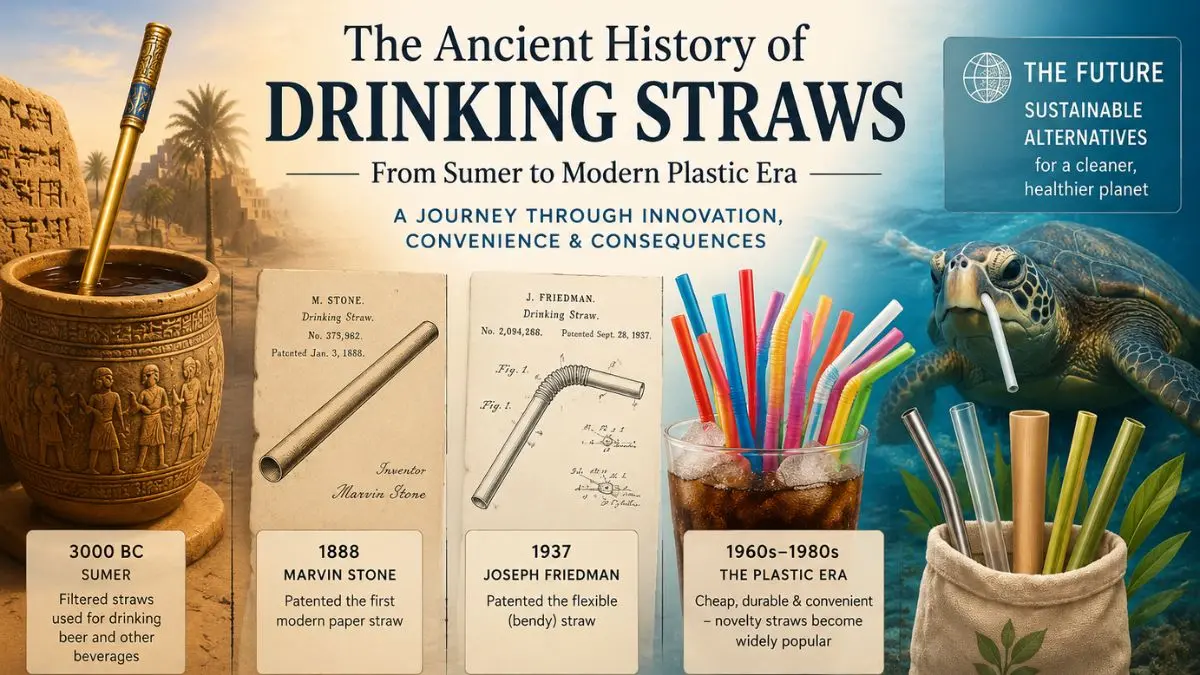
The earliest known straws appeared around 3,000 BC in ancient Sumer, located in Mesopotamia. Archaeologists discovered drawings on Sumerian clay seals from around 3,850 BC that show people sitting around large pots and drinking through very long straws. Some of these straws were nearly three feet long.
The Sumerian Beer Culture
These early straws were not just simple tubes. The people of ancient Sumer created them to solve a real problem while drinking beer.
Sumerian beer was very thick and looked more like porridge than the clear drinks people know today. During the brewing process, heavy grain pieces and other materials settled at the bottom of the pot, while yeast and impurities floated on the top. Drinking directly from the container would have been unpleasant because the drink contained many solid pieces.
To solve this problem, the Sumerians designed special straws with filtered tips. The ends of the straws had small holes near the bottom that acted like a natural filter. When people placed the straw into the pot, they could drink the cleaner liquid from the middle without disturbing the thick material at the bottom or the debris on the surface.
This system also allowed many people to sit together around one large pot and drink at the same time, each using their own straw. It became both a practical and social way to enjoy drinks together.
Royal Straws: Luxury and Status
In ancient Sumer, ordinary people used simple straws made from hollow reeds. These straws were often bent slightly so people could drink comfortably while sitting.
However, for royalty, straws were not simple tools. They were beautifully crafted luxury items that showed wealth, power, and high social status.
One famous example comes from the tomb of Queen Pu-abi of the ancient city of Ur, dating back to around 2600 BCE. She was an important figure in Sumerian society, possibly a queen or a priestess, according to different interpretations of her title. Her tomb contained many valuable items, including a specially designed drinking straw.
This royal straw was made from a hollow copper tube decorated with gold and lapis lazuli beads. It was about 1.2 meters (4 feet) long and used with a large silver jar, likely filled with beer.
These long straws had both practical and symbolic meaning. Practically, they helped people drink from large containers. Symbolically, they showed status—the longer the straw, the higher the person’s rank in society.
Today, this ancient straw is kept in museums like the British Museum and the Penn Museum. It remains one of the oldest known straws and shows how important drinking culture was in ancient Sumer.
Beyond Mesopotamia
The use of drinking straws was not only common in Sumer. Other ancient civilizations also used similar tools thousands of years ago.
The oldest physical straws were found in the northern Caucasus region of Russia in 1897. These artifacts are about 5,500 years old. Like the Sumerian straws, they were long tubes with small perforations at the tip. Experts believe people used them to filter beer and avoid drinking the thick sediment at the bottom.
The ancient Egyptians also used straws in their drinking culture. Artwork from around 1,300 BC shows people drinking with straws. Beer was very important in Egyptian society, just like in Sumer.
In Egypt, beer was even considered a royal drink. It was part of the daily diet of pharaohs, and people often gave it as a gift to rulers. Beer was also used in religious ceremonies and sacred offerings.
The Social Importance of Communal Drinking
Archaeological findings show that straws were often used with large shared beer pots. These pots had several straws sticking out from the top, allowing many people to drink from the same container at the same time.
These were not just simple drinking tools. They played an important social role. Groups of people would gather around one pot, each using their own straw, and share the drinking experience together. This turned drinking into a social activity instead of something done alone, similar to how people socialize while drinking today.
In Babylonian culture, this practice became even more formal and ceremonial. Royalty used long golden straws that sometimes reached from their throne to a nearby container filled with high-quality beer.
Beer consumption also depended on social class. Workers received about 2 liters per day, civil servants got around 3 liters, and administrators and high priests received up to 5 liters daily. The beer in ancient Sumer was usually mild, with about 2% alcohol.
Kings and royalty drank a special high-quality beer called “Alulu,” which was considered a luxury and was very expensive.
Medieval Europe and the Rise of Rye Grass
In medieval Europe, straws were not widely used, but historical stories show that they could still be very useful in everyday life.
A famous example comes from a Spanish story written in 1554 called The Life of Lazarillo de Tormes and of His Fortunes and Adversities. This story is a satire about a clever boy named Lázaro who uses smart tricks to survive difficult situations.
In the story, Lázaro works for a blind beggar who does not share his wine with him. Lázaro finds a way to secretly drink the wine by using a long straw made from rye grass. He places the straw into the wine jug while the beggar is distracted.
At first, the trick works, but the beggar soon notices and tries to stop him by keeping the jug between his legs. Lázaro does not give up. He then makes a small hole in the bottom of the jug and covers it with wax. When he sits near the fire, the wax slowly melts, and the wine starts flowing out so he can drink it secretly.
This story shows early examples of how simple straw-like tools were used creatively in medieval Europe.
The Rye Grass Era: A Grassy Problem
In 19th-century America, people widely used natural rye grass stems as drinking straws. This became popular mainly because cocktails with ice had become common. When people drank iced beverages, the ice cubes often hit their lips and made drinking uncomfortable.
To solve this, people started using hollow rye grass stems. They cut them into small pieces, dried them, and used them as straws. The word “straw” also comes from this practice of using real straw material for drinking.
Even famous writer Charles Dickens noticed this trend during his visit to America. He wrote about it in his novel Martin Chuzzlewit, where he described people happily drinking cocktails like sherry cobblers through straws.
However, rye grass straws had many problems. They were very thin, so people often had to use two straws at the same time to drink properly. They also became soft and soggy very quickly after being placed in liquids.
Over time, they would start to break, rot, or even develop mold. They also gave drinks a slightly grassy and unpleasant taste. Even though better materials came later, the word “straw” stayed in use and became part of drinking culture.
The Paper Revolution: Marvin Stone and Modern Drinking Straws
Marvin Chester Stone changed the way people drink and created an invention that later influenced many industries.
Early Life and Inspiration
Marvin Stone was born on April 4, 1842, in Rootstown, Ohio. His father, Chester Stone, was also an inventor and created improved machines like a washing machine and a cheese press. Innovation was already part of his family background.
Stone studied at Oberlin College, but he paused his education to join the American Civil War. He served as a private in the 7th Ohio Volunteer Infantry.
During the war, Stone faced very harsh conditions. He fought in major battles such as Gettysburg and Chancellorsville. In 1863, he was badly wounded during the Battle of Lookout Mountain in Tennessee, which left him unfit for active combat. Later, he served in the Veteran Reserve Corps in Washington, D.C., until the war ended in 1865.
After the war, he returned to Ohio and resumed his education in 1868. He first studied music but later graduated from the College of Theology in 1871. His interests were wide and varied.
After finishing college, Stone worked as a journalist in Washington, D.C. He wrote for newspapers like the Cleveland Leader and the New Orleans Picayune. In 1875, he married Jane “Jennie” Platt, and they had one son named Lester Marvin Stone.
The Path to Invention
In the late 1870s, Marvin Stone began using his inventive skills in business. He created a machine that could make paper cigarette holders and secured a contract with W. Duke Sons & Company. He then opened a factory in Washington, D.C., where he produced cigarette holders for the company’s Cameo cigarette brand.
His production was extremely large. His factory was making around 1 million cigarette holders every day for the Duke tobacco company in North Carolina.
The idea for his most famous invention came during a simple moment after work. According to popular stories, Stone was drinking a mint julep when he became annoyed with the grassy taste left by rye grass straws. Instead of ignoring the problem, he decided to fix it.
Using his experience with paper cigarette holders, he created a prototype straw. He wrapped strips of paper around a pencil, glued them in place, and then removed the pencil to form a tube. He tested this early version at a bar on Ninth Street in Washington, D.C., where the owner allowed him to try it in drinks. Other customers liked it so much that they also wanted to use it.
However, the first paper straws had a problem. They became soft and broke quickly in liquid. Stone solved this by coating the paper with paraffin wax. This made the straw stronger, waterproof, and tasteless, so it did not change the flavor of drinks.
The Perfect Specifications
Marvin Stone carefully improved his invention to make it more practical. He decided the ideal straw length should be about 8.5 inches, which is longer than many modern straws. He also set the width so it would stop things like fruit seeds or lemon bits from getting stuck inside.
These exact measurements became the standard design for paper straws for many years.
On January 3, 1888, Stone officially received a patent for his “artificial straw” (Patent No. 375,962). When the product was tested in local bars, people liked it immediately. By 1890, his factory in Washington, D.C. was producing more drinking straws than cigarette holders.
Stone also promoted his invention through advertisements. He highlighted its main benefits and described it as clean, safe, and free from taste or smell. His straws were designed for single use, which made them more hygienic than natural rye grass straws.
The ads also claimed that paper straws were cheaper, cleaner, and better for health. This helped people understand that his invention was a modern and improved alternative for everyday drinking.
Industrial Expansion and Patents
In the 1890s, the Stone Straw Company became one of the biggest private manufacturing businesses in Washington, D.C. It employed around 400 workers, mostly young women. Marvin Stone treated his workers with care and respect. He provided them not only with salaries but also with facilities like a library, a music room, a meeting hall for debates, and even a dancing area inside the factory. He was known as a kind employer who cared about the well-being and social life of his staff.
On February 6, 1896, Stone applied for two more U.S. patents for a new machine that could automatically produce paper straws. This invention removed the need to manually roll each straw by hand. The patents were officially published on June 22, 1897, and played a major role in expanding the straw industry.
Marvin Stone passed away on May 17, 1899, at his home in Washington, D.C., after a long illness. He died before his automated machine was fully put into production. After his death, the company continued under the leadership of his brothers-in-law, L.B. and W.D. Platt.
In 1902, the company successfully defended its patent in a legal case against William Thomas of the American Straw Company, a former employee who tried to copy the design.
By 1906, the first automated straw-making machine was finally put into full use. This completely changed production by removing the slow hand-rolling process. Later, the factory became extremely efficient and was producing about 8 million straws per day by 1956. Additional factories were also opened in Maryland, including Beltsville and College Park.
Beyond Straws: The Stone Legacy
Marvin Stone was not only an inventor of drinking straws. He also created other useful products during his life, including a fountain pen and an umbrella. His final invention focused on adding color to fine china.
Even with his business success, Stone remained generous and kind. He used his money for charity and social work. He built two blocks of housing in Washington, D.C. to support African-American families and provide them better living conditions. This was a very progressive step for his time.
Stone also built a large and elegant home called “Cliffburn” in Washington Heights. He and his wife Jennie hosted social gatherings there, where they met important political and social figures. This showed that the Stone family had become part of high society in Washington.
After his death, Marvin Stone was buried in Green Mount Cemetery in Baltimore, Maryland. The company he founded, Stone Straw, continued to grow and still exists today in different forms.
One branch of the company operates in Branford, Ontario, Canada, after being acquired many years ago. Today, it produces plastic, biodegradable, and compostable straws. In this way, the company continues Stone’s original mission of improving the way people drink.
Far-Reaching Industrial Impact
Marvin Stone’s spiral-wound paper straw design had an impact far beyond just drinking straws. His invention created a new way of making strong, rolled tubes from paper.
In 1928, engineers began using a similar spiral-wound tube design in early mass-produced radios. These tubes were made using the same basic method that Stone had patented years earlier.
Over time, this simple idea became extremely important in many industries. Today, spiral-wound tubing is used in electric motors, electronic devices, aerospace parts, automotive components, batteries, transformers, and even medical packaging.
It is also used in textile machinery, fuses, pyrotechnics, and many other industrial products.
What started as a simple solution to improve drinking straws eventually became a foundation for modern manufacturing and technology. A small invention to solve an everyday problem ended up shaping many industries in the 20th century.
The Bendy Straw Revolution: Joseph Friedman’s Contribution
While Marvin Stone improved the quality of straws, another inventor solved a different problem—how to make drinking easier and more comfortable.
The “Judith Problem”
In the 1930s, inventor Joseph B. Friedman (1900–1982) was sitting in a fountain shop in San Francisco when he noticed something important. His young daughter Judith was trying to drink a milkshake through a straight paper straw, but she struggled because the straw was too tall and hard for her to use comfortably.
This simple difficulty became known as the “Judith problem.”
The Invention of the Bendy Straw
Instead of ignoring the issue, Friedman decided to fix it. He took a paper straw and inserted a screw inside the top part. Then he wrapped dental floss around it to create small grooves. After removing the screw, the straw had a ridged, flexible shape like an accordion.
This design allowed the straw to bend easily without collapsing or blocking the flow of liquid. It made drinking much more comfortable, especially for children.
An Old Idea, Reimagined
Interestingly, the ancient Sumerians had already solved a similar problem thousands of years earlier by slightly bending their straws. However, Friedman’s design was new for the modern industrial world and became widely successful.
His invention made drinking straws more practical, flexible, and user-friendly for everyday use.
Patent and Patent Rejection
Joseph Friedman officially patented his invention on September 28, 1937, and received U.S. patent number 2,094,268 for his “Drinking Tube.” His design explained a simple but useful idea: the straw should have a flexible part near the top so it can bend over the edge of a glass and reach the mouth easily without forcing the user to lean awkwardly.
Later, in the 1950s, Friedman also received two more U.S. patents and three international patents for improvements in straw design and manufacturing.
However, his invention did not become popular immediately. He tried to sell his bendy straw idea to several straw manufacturers starting in 1937, but they all rejected it. They did not believe the product had commercial value.
Even after these rejections, Friedman did not give up. He decided to produce the bendy straws himself and move forward on his own.
The Flex-Straw Corporation
In 1939, Joseph Friedman officially started his company called the Flexible Straw Corporation in California. But soon after, World War II slowed down his progress. During this time, he worked in an optometry practice in Oakland and also did real estate and insurance work to support his family.
To continue developing his straw machine, Friedman took financial help from family members and close associates. This support helped him build and improve his manufacturing equipment.
By the late 1940s, he completed his machine and began producing bendy straws himself. He later renamed the company the Flex-Straw Company.
His invention quickly found success in hospitals. Patients who were lying in bed could easily bend the straw and drink without sitting up. This solved a major comfort and care problem in medical treatment.
Friedman made his first hospital sale in 1947, which marked the beginning of wider use in healthcare.
Old advertisements preserved by the Smithsonian Institution praised the bendy straw as a “personalized drinking tube.” It helped patients drink easily at any angle, saved staff time, and improved patient dignity.
Over time, it replaced fragile glass drinking tubes that needed constant cleaning and often broke. This made hospital care safer, cheaper, and more hygienic.
Must Read: Complete History of Chewing Gum From Ancient Tree Bark to a Billion-Dollar Industry
Must Read: The Real History of Pizza: Who Invented It and How It Became Global
Must Read: When and Who Really Invented Ice Cream? A Delicious Mystery Through Time
A Case Study in Universal Design
The bendy straw is now seen as a classic example of “universal design.” This design idea focuses on creating products that are easy for everyone to use, no matter their age or physical ability.
Joseph Friedman’s invention followed this idea naturally. He looked at a simple object and improved it so that children, hospital patients, and anyone who could not easily tilt their head could still drink comfortably from a glass.
This human-focused way of thinking also appeared in his other inventions. His first patent was for a fountain pen that showed how much ink was left inside it. This small improvement made the pen more practical and easier to use.
The Smithsonian Collection
In 2000, archivist Alison Oswald from the Smithsonian visited Encino, California, to meet Friedman’s family. There, she discovered a large collection of 16 boxes filled with his personal and professional materials stored in a garage.
This collection included detailed records of his inventions, business papers, photographs, letters, newspaper clippings, and advertising materials. According to Oswald, the collection is special because it clearly shows how his ideas developed over time from start to finish.
The archive also contains interesting items like drawings for inventions, advertising sketches, business cards, and creative notes. Some even include playful ideas and doodles that show his imagination.
The Smithsonian also collected physical objects linked to Friedman, such as pens, tools, and household items. His daughter, Judith Rosen, said that preserving his work meant a lot to the family. She felt it was important that his papers were saved properly so future researchers could study how an inventive mind works and develops ideas.
From Hospitals to the World
In 1969, the Flex-Straw Company sold its U.S. and international patents, trademarks, and licensing rights to the Maryland Cup Corporation. After this deal, production grew on a massive scale, with around 500 million flexible straws being sold every year. This level of success would have been hard for Friedman to imagine.
Joseph Friedman once told his daughter, Judith Rosen, that she would eventually see the Flex-Straw used all over the world. His prediction turned out to be true.
Today, bendy straws are used globally in homes, restaurants, and hospitals. Rosen herself has even collected Flex-Straws from different countries during her travels, showing how widely the invention spread.
What began as a simple solution to help a child drink more easily became a worldwide product used by millions of people every day.
An Unexpected Legacy
Joseph Friedman likely never imagined how creatively his invention would be used in later generations. His youngest daughter, Pamela Friedman Leeds, has used Flex-Straws in her artwork for many years. She even calls the invention “the family icon.”
Over time, she has created and collected many straw-inspired art pieces. These include a six-foot-tall sculpture made from cast straws, a bronze Styrofoam cup paired with a Flex-Straw, and even a bronze Christmas tree where a Flex-Straw is used as the trunk.
The Smithsonian has noted that straws are often simple objects we take for granted. We usually only notice their importance when they are missing, such as when a drink comes without one at a drive-through.
Still, the story behind the bendy straw shows that the mind behind this everyday object was far from ordinary. What seems simple today was once a creative solution that changed how people around the world drink.
The Plastic Era: Convenience and Consequences
Paper straws were widely used until the early and mid-20th century. But in the 1960s, things changed. Many people became unhappy with paper straws because they quickly lost their shape in drinks. As a result, companies began making plastic straws as a replacement.
Plastic straws had clear advantages. They were cheap to produce, very strong, and did not break or become soft in liquid. They also worked well with plastic to-go cups. Because of these benefits, fast-food chains like McDonald’s quickly switched to plastic straws, and paper straws almost disappeared from the market.
By the 1980s, the plastic straw industry grew even more. Companies started creating fun and unusual designs to attract customers, especially children. This era became known for “novelty straws,” including Crazy Straws and other playful shapes that made drinking more entertaining.
The Environmental Awakening: The Turning Point
For many years, plastic straws were seen as harmless. But later, people began to understand the environmental damage caused by single-use plastics. In the United States alone, hundreds of millions of plastic straws are thrown away every day, and billions end up polluting oceans.
These straws are especially dangerous for marine animals. Sea turtles and other sea creatures often mistake plastic for food. Because straws are thin and sharp, they can block airways or cause serious injuries when swallowed.
A 2015 study in the journal Science found that plastic straws make up a small part of ocean plastic waste, but they still contribute to a larger global pollution problem. Environmental groups call them “gateway plastics” because they are easy to remove from daily use and help people start reducing plastic waste.
This awareness has led many people and companies to rethink how everyday convenience affects the environment.
The Sea Turtle That Changed Everything
In 2015, a powerful viral video helped change how many people think about plastic pollution. The video was recorded by marine biologist Christine Figgener and her team from the Leatherback Trust while they were studying olive ridley sea turtles in Costa Rica.
During their research, they found a male sea turtle in serious distress. A plastic straw, about 4 inches (10 cm) long, was stuck deep inside its nose and extended into its throat.
The straw made it very hard for the turtle to breathe and even smell. This was very dangerous because turtles depend on their sense of smell to find food, avoid danger, and navigate long migrations. It may also have affected its ability to find a mate.
The researchers carefully tried to remove the straw using pliers. The process took more than eight minutes and was painful and difficult to watch. The turtle even bled during the removal, but the team continued because it was necessary to save its life.
Christine Figgener later explained that she wanted people to see the real harm caused by a single plastic item. She said it helps people understand that something thrown away by humans can end up causing serious suffering to animals in the ocean.
The video quickly spread across social media and was watched millions of times. Many people saw for the first time how plastic waste can directly hurt marine life.
Experts say this moment became a turning point in the environmental movement. It showed, in a very emotional and clear way, how everyday items like plastic straws can have devastating effects on animals in the ocean.
The Global Impact
News channels and online platforms across the world shared the story, and each time it was shared, more people became aware of the damage caused by plastic waste.
Social media played a big role in spreading the message. People discussed it widely, shared posts, and raised awareness about ocean pollution. This helped turn concern into action. Schools, environmental groups, and public figures used the video to teach people about the dangers of single-use plastics.
As public pressure grew, many governments and organizations started taking action. The turtle became a symbol of environmental harm caused by everyday plastic items. In a surprising outcome, the same turtle was later found again in 2016 by the researchers. It was healthy and even seen mating, showing that it had survived.
Legislative and Corporate Response
After growing concern, several cities and countries introduced rules to reduce plastic straw use. Seattle became the first major U.S. city to ban single-use plastic straws in 2018. Later, other places like Washington and California introduced restrictions, often allowing straws only when requested.
In 2019, the European Union passed a broader ban on single-use plastic items, including straws, cutlery, and stirrers. This law took effect in 2021. Many countries, including the UK, China, Kenya, and Thailand, also introduced similar rules.
Companies also began changing their policies. Starbucks announced plans to remove plastic straws globally, replacing them with alternative lids and materials. McDonald’s, airlines like American Airlines, and hotel chains like Hyatt also reduced or removed plastic straws from their services.
Important Pushback: The Disability Community
However, not everyone supported full straw bans. Many people with disabilities explained that straws are not just convenience items for them—they are essential for drinking safely and independently.
This created an important discussion about balancing environmental protection with accessibility needs. As a result, many new policies were adjusted to allow straws on request instead of removing them completely. This helped create a more balanced approach that considers both the environment and human needs.
Modern Alternatives and the Future
Today, there are many alternatives to plastic straws, each with different strengths and weaknesses.
Paper Straws
Paper straws have made a strong comeback. They bring back the idea first introduced by Marvin Stone more than a century ago. These straws are biodegradable and have less environmental impact than plastic. However, they often become soft in drinks, and some people do not like how they feel while drinking.
Stainless Steel Straws
Metal straws are strong, reusable, and long-lasting. They can save money over time and reduce waste. But they must be cleaned properly after every use. They can also be difficult for some people with disabilities who may struggle to clean inside them.
Glass Straws
Glass straws look clean and stylish. They are also transparent, so users can easily see if they are clean. However, they can break easily, which makes them unsafe for travel or daily outdoor use.
Silicone Straws
Silicone straws are flexible, soft, and reusable. They can handle both hot and cold drinks and do not crack or break easily. Many are attached to bottles for convenience. Still, they need regular cleaning to stay hygienic.
Plant-Based and Compostable Straws
Some companies now make straws from plant materials like wheat stems. These straws are biodegradable and do not need harsh chemicals during production. They break down naturally and are considered one of the more eco-friendly options available today.
Other Innovative Options
There are also creative alternatives such as bamboo straws, edible straws made from food ingredients, color-changing straws, and extendable straws for juice boxes. Wider straws are also used for thick drinks like milkshakes and bubble tea, allowing better flow and taste.
Reusable Straw Solutions: The Tfees Straw
One modern design is the Tfees straw, made from durable Tritan co-polyester. It is reusable, dishwasher safe, and transparent so users can easily check cleanliness. However, some environmental programs still reject plastic-based products, even when they are reusable, which limits their adoption.
The Future
The future of straws is moving toward more sustainable, safe, and user-friendly designs. The goal is to reduce waste while still making drinking easy and accessible for everyone.
A Broader Perspective on Plastic Pollution
Some critics say the focus on plastic straws is useful for awareness, but it hides a bigger problem. They argue that plastic packaging is the main source of plastic waste in the world. Items like bottles, cups, and shopping bags create far more pollution than straws.
Another major issue is cigarette butts. They contain harmful chemicals like arsenic that can pollute oceans and harm marine life. However, environmental supporters say straws still matter because they act as a “gateway issue.” They help people understand the wider problem of plastic pollution and encourage better habits.
The Current State of the Crisis
Plastic pollution is now a global crisis. Experts warn that by 2050, there could be more plastic in the oceans than fish by weight if current trends continue. Studies also suggest that global plastic use must be reduced by about 75% to meet climate goals.
Research shows that millions of plastic straws are already polluting coastlines around the world. Scientists estimate billions of straws may be present in oceans and shorelines globally.
The damage is also spreading to wildlife. Around 90% of seabirds have already consumed plastic, compared to less than 5% in the 1960s. Experts fear that by 2050, almost all marine birds may ingest plastic if the problem continues.
Even more concerning is the rise of microplastics—tiny plastic particles that come from broken-down waste. These particles are now found in food, water, and even air, and scientists are still studying their long-term impact on human health.
Key Facts Summary
- Ancient Sumerians used filtered drinking straws around 3,000 BC
- Queen Puabi’s 4,500-year-old gold straw is a major ancient artifact
- Marvin Stone patented the modern paper straw in 1888
- Joseph Friedman patented the bendy straw in 1937
- Americans use hundreds of millions of straws every day
- A viral 2015 sea turtle video helped spark global awareness
- Millions of plastic straws pollute oceans and coastlines
- Over 30 countries have introduced plastic bans since 2015
- Many alternatives now exist, including paper, metal, glass, and plant-based straws
- Accessibility needs must be considered in environmental solutions