
The Real History of Pizza: Who Invented It and How It Became Global
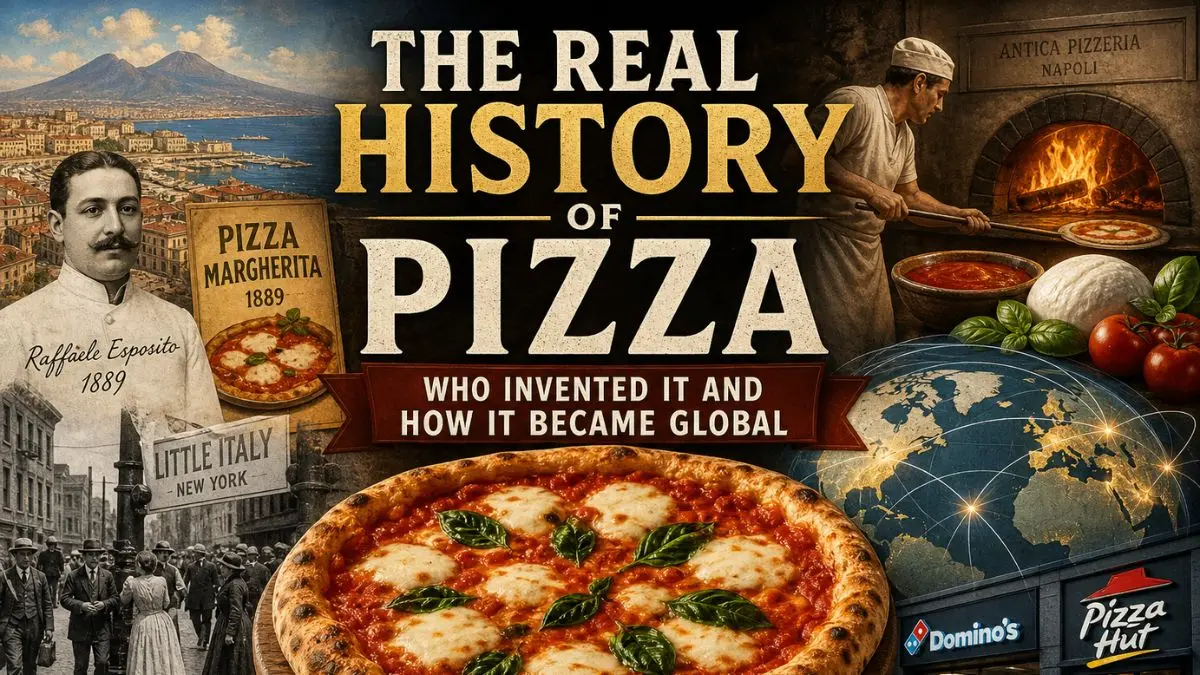
Who invented pizza? Raffaele Esposito is generally considered the creator of modern pizza.
Pizza may be America’s favorite food today, but its true origin isn’t American. Pizza actually originated in the Italian city of Naples.
The story of pizza is quite interesting. It was originally a simple food for the poor, but gradually became popular throughout the world. Today, it has become a symbol of Italian food and is enjoyed everywhere.
Today, pizza is one of the most popular foods in the world. Approximately 3 billion pizzas are eaten in the United States each year. Most people eat pizza at least once a month, and many people eat it weekly.
But the question is… how did pizza become so famous? And who invented pizza first? Let’s explore its interesting history.
Who Invented Pizza? Full History
People have been eating pizza-like things for thousands of years, but the pizza we know today isn’t even 200 years old.
The real story of pizza dates back to ancient times, when people in the Mediterranean and other civilizations first began making simple flatbreads.
The Earliest Flatbread Traditions
Food historians believe that many ancient cultures like Egyptians, Greeks, Romans, and Persians used to eat flatbreads with different toppings. These early foods were not like today’s cheesy pizza, but they helped create the idea of modern pizza.
Persian soldiers would bake floss on their shields and eat it with cheese and dates. The Greeks used to cook floss by adding herbs, onions, and cheese to it. The Romans called it “penis fossacius” (an ancient form of fossacchia), which was used on floss with various toppings.
Persians made a dish called dukkan, which was flatbread with cheese and dates. In Egypt, people added herbs, spices, and olive oil on their flatbreads. Greeks used oil, herbs, and cheese, making something similar to today’s focaccia. Romans also enjoyed flatbread meals, and each region had its own style.
Literary and archaeological evidence
There is written proof of pizza-like food in ancient Rome. In the 3rd century BCE, Cato the Elder described bread topped with olives and herbs. Later, the Roman poet Virgil mentioned a story in The Aeneid where people ate bread with toppings and even ate the bread plates themselves. This shows that such food existed long ago.
Archaeologists also found evidence in Pompeii. Before the city was destroyed by Mount Vesuvius in 72 CE, people were already making flatbreads with toppings. Scientists even discovered preserved flatbreads in the ruins, proving that these foods were part of daily life.
The Neolithic and medieval periods
Flatbread cooking goes back to the Neolithic period, when humans first learned to cook on hot stones. Later, Egyptians discovered leavening, which made bread softer, lighter, and easier to digest. This was an important step in the development of pizza.
The word “pizza” also has an old history. In the 7th century AD, the Lombards brought a word like “bizzo” or “pizzo,” meaning “bite.” Around the year 1000 AD, the word “pizza” started appearing in official documents. By 1195, it was recorded in Penne, Italy, and later documents also mentioned similar terms for baked foods in central and southern Italy.
In 1535, writer Benedetto di Falco clearly used the word “pizza” in his book about Naples, helping establish the name for the dish we know today.
Who Invented the Modern Pizza? (Naples)
While flatbreads had existed for centuries, the modern pizza we enjoy today began in Naples, Italy, in the late 1700s and early 1800s.
The Naples Setting
Naples was founded around 600 B.C. as a Greek settlement. By the 1700s and early 1800s, it had become a busy coastal city. It was known for having many poor workers, called the lazzaroni. These people lived in crowded areas, often in small homes, and spent much of their time outdoors.
Because of their lifestyle, they needed cheap and quick food. Pizza became the perfect solution. It was a flatbread with simple toppings, easy to eat on the go, and sold by street vendors or small shops.
These early pizzas included ingredients like tomatoes, cheese, oil, anchovies, and garlic. Even though some people criticized this food, it became very popular among the working class because it was affordable and filling.
By the late 1700s, people in Naples started adding tomatoes to their flatbread, which was an important step in creating modern pizza. By the mid-1800s, pizza with cheese and herbs was common street food across the city.
The First Pizzerias
Before 1830, pizza was mostly sold in open-air stalls or bakeries. Around 1830, the first real pizzerias appeared, where people could sit and eat. By 1807, there were already 54 pizzerias in Naples.
The first known pizzeria was Antica Pizzeria Port’Alba, which opened in 1830 (some say 1738). It still exists today and serves traditional pizza. Another early pizzeria, Mattozzi, opened in 1833 and was mentioned in historical writings.
By the 1800s, pizza had become popular among all people in Naples, not just the poor. There were many types of toppings, and writers of that time described its variety and popularity.
By the end of the 19th century, people in Naples were eating pizza for every meal—breakfast, lunch, and dinner. Pizza-making also improved, with new toppings and styles, and it became an important part of the city’s culture.
The Legend of Pizza Margherita
A major moment in pizza history came in 1889, when a royal visit helped turn pizza from simple street food into a famous dish.
The Royal Visit
Italy became one country in 1861. In 1889, King Umberto I and Queen Margherita visited Naples. According to the popular story, they got tired of eating fancy French food and wanted to try local dishes. So, they ordered different pizzas from a well-known place called Pizzeria Brandi.
The Pizza Margherita Story
A pizza maker named Raffaele Esposito prepared three types of pizza for the queen. One of them had tomatoes, mozzarella cheese, and fresh basil. These ingredients matched the colors of the Italian flag—red, white, and green.
Queen Margherita liked this pizza the most. So, Esposito named it “Pizza Margherita” in her honor. According to the legend, the queen even sent a thank-you letter, which the pizzeria still shows today.
However, some historians are not sure if this story is fully true. There is little proof from that time, and the story became popular many years later. Still, it remains an important and famous part of pizza history.
The Global Impact
Whether true or not, Pizza Margherita became one of the most famous pizzas in the world. Many people consider it the start of modern pizza.
Today, traditional Neapolitan pizza follows strict rules. It uses special ingredients like San Marzano tomatoes, olive oil, fresh basil, and buffalo mozzarella. It must also be baked in a wood-fired oven.
Even now, pizza styles are different in Italy. In Naples, the base is soft and flexible, while in Rome, it is thin and crispy.
Pizza Remains Regional
Even after this royal story, pizza was not popular all over Italy right away. It stayed mostly in Naples until the 1940s. After World War II, pizza finally spread to the rest of the country and later to the whole world.
The History of Tomatoes and Pizza: The Columbian Exchange
To understand modern pizza, it’s important to know the history of tomatoes. Tomatoes did not originally come from Italy—they were brought from the Americas during a major exchange of plants and cultures.
The Columbian Exchange
Tomatoes were introduced to Europe in the 1500s by Spanish explorers. This happened during the Columbian Exchange, which began after the voyages of Christopher Columbus in 1492 and the conquest of the Aztec capital by Hernán Cortés in 1521.
From Spain, tomatoes spread to other parts of Europe, including Italy. Because Naples was under Spanish rule and had strong trade connections, tomatoes reached Italy quickly. By around 1550, Italian gardeners had already started growing them.
One of the earliest written mentions of tomatoes in Europe came from Pietro Andrea Mattioli in 1544. He described them as a new kind of eggplant and later called them “pomi d’oro,” meaning “golden apples.”
Initial Resistance and Acceptance
At first, Europeans were afraid of tomatoes. Their bright color and unusual look made people think they were poisonous. Some believed tomatoes could cause illness, madness, or even death. They were even linked to witchcraft in some stories.
There was also a real reason for confusion. Wealthy people who ate tomatoes on pewter plates sometimes got sick or died. They blamed the tomatoes, but the real cause was lead poisoning from the plates—not the fruit itself.
Because of these fears, most rich people avoided tomatoes. However, poor people, especially in Naples, continued to eat them because they were cheap and easy to find. Over time, tomatoes became popular in southern Italy and matched well with local foods like bread and seafood.
Tomato Becomes essential
After about 200 years, people finally accepted tomatoes as safe and useful. They became a common ingredient in kitchens across Europe and America.
Soon, sliced tomatoes were added to flatbreads, helping create the modern pizza. By 1927, a famous Italian cookbook by Ada Boni included recipes with tomatoes and mozzarella, showing that tomato-based pizza had become standard.
During the 1700s and 1800s, pizza became more popular in Italy. Travelers even visited Italy just to try this simple but delicious food, which had once been known as a “poor man’s meal.”
Pizza arrives in America
While pizza was still mostly limited to Naples in Italy, Italian immigrants brought it to the United States. They started making the same simple, tasty pizzas in cities like New York and slowly introduced it to a new audience.
The Italian Immigration Wave
Between 1880 and 1920, many Italians moved to America for work. These immigrants, especially from Naples, brought their food traditions with them. At first, they were not trying to make pizza famous—it was just their everyday food.
They made and sold pizza from their homes or small street stalls. Pizza was mostly found in cities with large Italian communities, such as New York City, Boston, Chicago, and St. Louis. At this stage, pizza was mostly unknown to the wider American public.
Early Pizza in America: Documented History
The first written mentions of pizza in the U.S. appeared in the late 1800s and early 1900s. In 1905, the first licensed pizzeria, Lombardi’s, officially began selling pizza.
Before that, it started as a small grocery store in 1897, selling tomato pies to factory workers. Getting a license in 1905 made it the first recognized pizza business in America.
Pizza also gained attention from famous people like Enrico Caruso, which helped increase its popularity.
The First American Pizzerias
As pizza spread, more pizzerias opened in different cities. Some of the early and famous ones include:
- Mario’s Restaurant (opened 1919)
- Frank Pepe Pizzeria Napoletana (opened 1925)
- Totonno’s Pizzeria Napolitano (opened 1924)
- Joe’s Tomato Pies (opened 1910)
- Papa’s Tomato Pies (opened 1912)
These places helped keep the traditional Neapolitan style alive in America.
Must Read: The Accident That Changed The World: Origins and Development History of Tea
Must Read: Who Invented the Tea Bag? One Small Mistake that Revolutionized the World of Tea!
Must Read: Who Invented the Ice Cube Tray? The Surprising Full History Of Ice Cube Trays
The Rise of American Pizza Styles
In 1943, Pizzeria Uno opened and introduced deep-dish pizza, a thick and rich style very different from the original Italian version.
This marked the beginning of unique American pizza styles. Over time, pizza became one of the most popular foods in the United States and then spread across the world.
Pizza’s Rise to Mainstream Popularity
For many years, pizza was mostly eaten in Italian neighborhoods in America. It was not widely popular until after World War II, when several changes helped it spread across the country.
The Postwar Pizza Boom
After World War II, American soldiers returned home from Europe with a taste for pizza. They had tried it during their time in Italy and wanted it again back home.
At the same time, Italian American families moved from cities to suburbs, bringing their food with them. Pizza quickly became popular everywhere. It was no longer seen as just an ethnic food, but as a fun, quick, and tasty meal for everyone.
The 1950s and 1960s: Explosive Growth
The 1950s and 1960s were the biggest growth period for pizza in America. Several important changes made pizza more popular than ever.
Frozen pizza invention
In the 1950s, Rose Totino created frozen pizza. This allowed people to cook pizza easily at home. By the 1970s, frozen pizza had become very common in American households.
Pizza chains and franchises
Large pizza companies started during this time and helped spread pizza across the country:
- Pizza Hut (1958)
- Little Caesars (1959)
- Domino’s (1960)
These chains made pizza easy to buy and helped turn it into a regular family meal.
Celebrity Endorsement and Mainstream Appeal
Pizza also became more popular because famous people promoted it. Celebrities like Frank Sinatra and Joe DiMaggio helped make pizza seem trendy and acceptable to everyone, not just Italian communities.
Regional Expansion and Pizza Culture
By the 1970s, small local pizzerias were common in many American cities. Places like New York City, Philadelphia, Baltimore, and Chicago became famous for their own pizza styles.
These local shops competed with each other, which improved quality and created strong pizza traditions in different regions. Over time, pizza became one of the most loved foods in the United States and eventually around the world.
American Pizza Styles And Regional Variations
As Italian American food spread across the United States, pizza changed in different regions. People adapted it to local tastes, and many new styles were created. Over time, pizza became more American, with creative toppings and new ways of cooking.
New York Style Pizza
New York-style pizza is one of the most famous types in America. It has a thin crust that is soft but slightly crispy. The sauce is made from tomatoes, garlic, oil, and herbs. It uses mozzarella cheese and is cut into large slices that can be folded.
Many people believe the taste is also influenced by New York’s water. This style became very popular and set the standard for pizza in many parts of the country.
Chicago Deep Dish Pizza
Chicago deep dish pizza is very different from regular pizza. It has a thick crust that is baked in a deep pan. It contains lots of cheese, sauce, and toppings.
This pizza is so thick that it is usually eaten with a knife and fork. It was created in 1943 at Pizzeria Uno by Ike Sewell. It became very popular in Chicago and nearby areas.
Detroit Style Pizza
Detroit-style pizza is rectangular in shape. It was first made in 1946 when a bar owner wanted to try something new. His wife shared a family recipe from Sicily, which inspired the style.
This pizza uses a soft dough similar to focaccia. The toppings are placed on the dough, and sauce is added on top. It also uses a mix of cheeses that creates a crispy, golden edge.
Supreme Pizza
Supreme pizza became popular in the 1970s. It was created as a marketing idea to offer a pizza with many toppings.
It usually includes pepperoni, sausage, onions, and peppers. Different restaurants may add their own extra toppings. The idea is to make a “loaded” pizza with many flavors in one slice.
Other American Variations
America also has many other pizza styles, such as:
- California gourmet pizza with creative toppings
- Stuffed crust pizza with cheese inside the edges
- Thin crust pizza popular in some regions
- Hand-tossed pizza, which is the most commonly ordered style
- Thick crust Sicilian-style pizza
In general, people in America often prefer meat toppings more than vegetables. Pizza has become one of the most flexible and popular foods in the country.
Pizza Takes Over The World
Today, pizza is a global food. Big pizza chains like Domino’s and Pizza Hut operate in around 60 countries. Pizza is no longer just an Italian or American dish—it is enjoyed all over the world. Each country has also changed it to match local tastes and ingredients.
Global Pizza Variations
Different countries use unique toppings based on their food culture. Here are some examples:
India
In India, pizza often includes local flavors. Popular toppings are pickled ginger, minced mutton, and paneer cheese. These make pizza taste closer to Indian food.
Japan
In Japan, pizza toppings are very creative. Common choices include mayonnaise with potato and bacon, squid, and even eel.
Brazil
In Brazil, green peas are a popular pizza topping. It is a simple but common choice in many pizza shops.
Russia
In Russia, people often enjoy pizza with red herring, which gives it a strong and salty flavor.
Norway
Norway has one of the highest pizza consumptions in the world. On average, each person eats about 11 pounds of pizza every year.
United Kingdom
In the UK, people eat pizza regularly but in smaller amounts. On average, a person eats about 88 grams of pizza per week.
Italy
Pizza returned to Italy after becoming popular in America. Today, Italians eat it regularly again. On average, a person in Italy eats about 17.5 pounds of pizza per year.
Global Pizza Industry
The pizza industry is now very large worldwide. It is worth hundreds of billions of dollars and keeps growing every year. Pizza is made and sold in many ways, including restaurants, street food stalls, and delivery services.
In Italy, restaurant pizza is usually served whole and eaten with a knife and fork. In casual settings, it is cut into slices and eaten by hand.
Pizza is also sold in supermarkets as frozen meals or ready-made kits that people can cook at home. Frozen pizza is very popular, especially in the United States, where millions of people eat it regularly.
UNESCO Recognition And Cultural Significance
Pizza is not only a popular food, but also an important part of cultural heritage. Because of its history and tradition, Neapolitan pizza-making has received special international recognition.
The UNESCO Intangible Heritage Designation
In 2009, Neapolitan pizza received Protected Designation of Origin (PDO) status from the European Union. This meant only pizza made using specific traditional methods could be called authentic Neapolitan pizza.
Later, in December 2017, UNESCO officially recognized the art of Neapolitan pizza-making as part of the UNESCO list of Intangible Cultural Heritage of Humanity.
This recognition was not just for pizza as food, but for the skill and tradition of making it. It highlights the importance of the pizza makers, known as pizzaiuoli, and their cultural craft.
Significance of the UNESCO Designation
UNESCO gives this type of recognition to protect traditions that are passed down through generations. It helps make sure they are not lost over time.
In Naples, this recognition was a big moment. Many people celebrated, and pizza makers even gave out free slices on the streets. One pizza maker, Enzo Coccia, said that pizza had finally become part of humanity’s shared heritage after centuries of history.
UNESCO also explained that pizza-making brings people together and helps different generations connect. It is seen as an important cultural symbol that is understood and loved worldwide.
Training And Preservation
To protect this tradition, the Association of Neapolitan Pizzaiuoli was formed in 1988. It runs training programs where new students can learn traditional pizza-making skills. Each year, around 120 apprentices are trained in Naples.
Many people also learn pizza-making from their families, making it a skill passed from one generation to the next. In Naples, there are about 3,000 professional pizza makers today.
The association has also created a museum that shows the history and development of pizza-making. It helps preserve the story of how pizza became one of the world’s most loved foods.
Pizza Consumption Statistics: By The Numbers
The pizza industry is huge worldwide, and the numbers show how popular pizza really is, especially in the United States.
American Pizza Market Size
- The U.S. pizza industry is worth about $45–47 billion
- There are more than 71,000 pizza restaurants in the country
- About 70% of pizza comes from chain restaurants
- Around 55% of pizza shops are independent local stores
- The industry continues to grow every year
Personal Consumption In The United States
- Americans eat about 3 billion pizzas every year
- Around 350 slices are eaten every second
- The average person eats about 45–46 slices per year
- About 93% of Americans eat pizza every month
- Around 40% eat pizza every week
- Almost 98% of Americans have eaten pizza at least once
- Many people even eat pizza for breakfast sometimes
- A large number of people say pizza is their favorite comfort food
Eating Habits And Timing
- Most people order pizza around 6:50 PM
- Saturday night is the most popular time to eat pizza
- During the Super Bowl, over 12 million pizzas are sold in one day
- On average, people spend about 13 minutes eating pizza
Delivery And Frozen Pizza
- Pizza is the most popular delivery food in the U.S.
- About 60% of food delivery orders are pizza
- Many families order pizza about 30 times a year
- Frozen pizza makes up about 25% of all pizza sales
- Over 200 million Americans eat frozen pizza
- Popular frozen brands include DiGiorno and Red Baron
Regional Preferences In The U.S.
- Some states like pizza more than others, especially in the Northeast and Midwest
- Cities like New York, Chicago, Los Angeles, and Miami are big pizza consumers
- West and Midwest areas prefer thin crust
- Southern states like both thin and regular crust
Most Popular Toppings
- Pepperoni is the most popular topping in the U.S.
- It appears on more than one-third of all pizzas
- Other popular toppings include sausage, mushrooms, onions, and extra cheese
- Mozzarella is the most used cheese, on over 85% of pizzas
- Many people prefer meat toppings over vegetables
Least Popular Toppings
- Anchovies are the least liked topping for most people
- Eggplant, broccoli, and artichokes are also unpopular
- Pineapple remains a controversial topping, with strong opinions on both sides
Crust Preferences
- Hand-tossed crust is the most common, used in over 55% of orders
- Thin crust is also very popular
- Different regions prefer different crust styles
Global Pizza Consumption
- The global pizza market is worth over $144–233 billion
- Norway has one of the highest pizza consumptions per person
- Pizza is eaten in many different styles across the world
- Each country adds its own local flavors and ingredients
The Science Behind Pizza’s Popularity
Pizza is not only tasty but also interesting from a science and nutrition point of view. Its popularity comes from both what it contains and how people experience it.
Nutritional Aspects
Pizza is a mixed food, so it contains different types of nutrients. The crust provides carbohydrates, the cheese and toppings provide protein, and the sauce adds vitamins and minerals.
However, pizza also has some health concerns if eaten too much:
- One slice of pizza usually has about 250 to 350 calories
- Nearly half of these calories come from fat
- Pizza is often chosen for quick meals because it is cheap and easy
- It is one of the most commonly “craved” foods in the world
- It can contain high levels of fat, salt, and sugar if eaten frequently
This means pizza can be both nutritious and unhealthy, depending on how much and how often it is eaten.
Psychological And Cultural Factors
Pizza is popular around the world not only because of taste, but also because of how people feel about it. Several reasons explain its global success:
1. Versatility And Customization
Pizza can be made in many ways. People can choose different toppings, sauces, and crusts. This makes it suitable for many tastes and diets.
2. Portability And Convenience
Pizza is easy to eat. It can be eaten quickly, at home, at work, or on the go. This makes it a very convenient food.
3. Social Nature
Pizza is often shared with family and friends. It is commonly eaten at parties, celebrations, and gatherings. This makes it a social food that brings people together.
4. Affordable Comfort Food
Pizza is usually affordable and filling. Many people see it as a comfort food that makes them feel happy and satisfied.
5. Cultural Pride
For people of Italian heritage, pizza is also a symbol of culture and tradition. It connects them to their history and identity.
6. Adaptation And Innovation
Pizza can easily change with local tastes. Every country adds its own ingredients and style. Because of this, pizza feels familiar and local everywhere in the world, even though it has the same basic idea.
FAQs
Who Invented Pizza?
The answer is not simple. Pizza was not invented by one single person. Flatbread foods have existed for thousands of years in many ancient civilizations. However, modern pizza developed in Naples, Italy, during the late 1700s and early 1800s.
A pizza maker named Raffaele Esposito is often credited with creating the famous Pizza Margherita in 1889, but historians still debate this story. In reality, pizza was developed slowly over time by many bakers in Naples.
Where Was Pizza Invented?
Modern pizza was invented in Naples. The city had poor working-class people who needed cheap and quick food. Flatbreads with toppings became the perfect solution. Over time, this simple food became modern pizza.
When Was Pizza Invented?
The word “pizza” appears in records as early as 997 AD. But the pizza we know today—with tomatoes, cheese, and toppings—was created in the late 18th century in Naples. The famous Pizza Margherita appeared in 1889.
Why Did Pizza Start In Italy?
Pizza began in Italy because Naples had the right conditions. It had simple local ingredients, a large poor population, and a strong tradition of flatbread food. After tomatoes arrived from the Americas, they became part of the recipe, helping pizza develop further.
Is Pizza Italian Or American?
Pizza is originally Italian. Italy created it, especially in Naples. However, it became famous worldwide because of American immigrants and businesses. Italy gave pizza its origin, while America helped spread it across the world.
When Did Pizza Come To America?
Pizza came to America with Italian immigrants between 1880 and 1920. At first, it was only found in Italian neighborhoods. After World War II, it became popular across the whole country.
Why Are Tomatoes On Pizza?
Tomatoes were brought from the Americas during the Columbian Exchange. At first, Europeans thought tomatoes were dangerous. But in Naples, people used them because they were cheap and tasty. Later, tomatoes became a key ingredient in pizza.
What Was Pizza Before Tomatoes?
Before tomatoes, flatbreads were topped with herbs, cheese, garlic, oil, and salt. These early foods were eaten in ancient Rome and Mediterranean regions. Tomatoes were added later, creating modern pizza.
How Did Pizza Become Popular In America?
Pizza became popular in America due to several reasons:
- Italian immigrants brought it to U.S. cities
- Soldiers brought the taste back after World War II
- Frozen pizza made it easy to cook at home
- Big chains like Domino’s and Pizza Hut spread it nationwide
- It was cheap, fast, and easy to eat
Neapolitan Vs American Pizza
Neapolitan pizza is soft, thin, and simple. It uses fresh ingredients like tomatoes, mozzarella, and basil, and is cooked in a wood oven.
American pizza is usually thicker and has more toppings. It comes in many styles like New York thin crust, Chicago deep dish, and Detroit-style pizza.
Is Pizza Healthy?
Pizza can be healthy if eaten in moderation. It provides carbohydrates, protein, and some vitamins. But it can also contain high fat, salt, and calories, so balance is important.
Why Is Pizza So Popular?
Pizza is loved worldwide because it is:
- Easy to customize
- Quick and convenient
- Affordable
- Good for sharing with others
- Adaptable to local tastes
Final Thought
Pizza started as a simple flatbread in ancient times. It developed in Naples, Italy, and later spread across the world. Today, it is one of the most popular foods on the planet, enjoyed in many styles and flavors everywhere.